FN8, FG8, FG15, HN8, HG9, HG17 - Circles, circumference and area
Describe a circle, measure its boundary and calculate its area. FG8 and HG9 supply the vocabulary; FG15 and HG17 supply circumference, area and composite-shape calculations. FN8 and HN8 let you keep multiples of exact, so you can choose between an exact answer and a requested decimal.
Circle vocabulary
A round mat is replaced by one with twice its diameter. Will the cord around its edge and the fabric covering it both double? First identify which circle measurements describe the edge and the inside.
Circle
A circle is the set of points in a plane a fixed distance from a centre. That fixed distance is the radius. A diameter joins two points on the circle through the centre, so . The circumference is the circle's boundary, or its length.
A chord is a straight line segment joining two points on the circle. Every diameter is a chord; a chord need not pass through the centre. A tangent is a straight line touching a circle at one point.
[DIAGRAM: asset_name: Parts of a circle; asset_slug: circle-vocabulary; caption: Distinguish a straight chord, a curved arc, a sector and a segment.; description: Four exact circle panels identify centre O, radius OC, diameter AB and chord DE; a tangent at T; a sector bounded by two radii and an arc; and a minor segment bounded by a chord and its arc.]
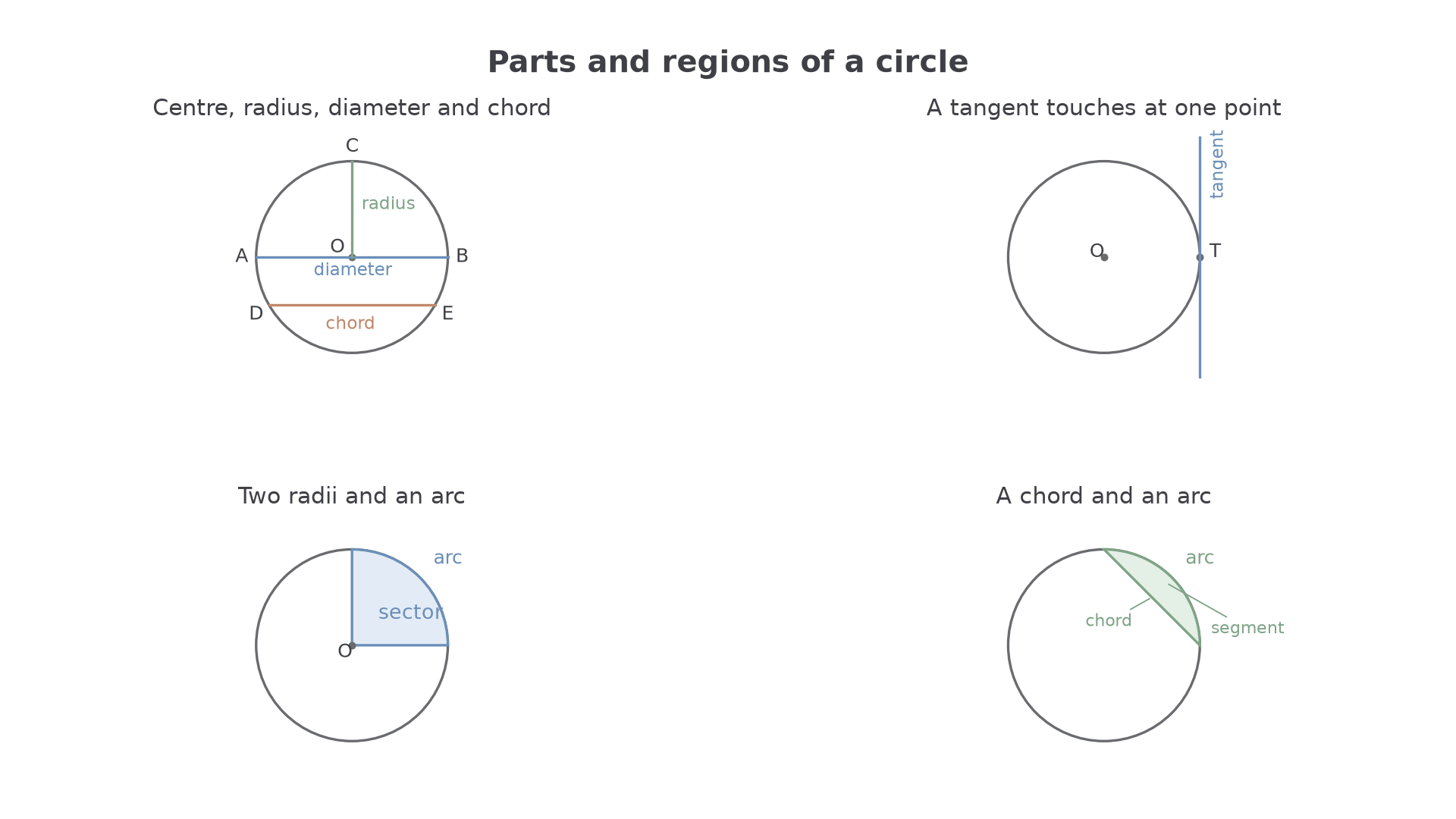
An arc is part of the curved circumference. A sector is a region bounded by two radii and an arc. A segment is a region bounded by a chord and an arc. The smaller arc between two non-diametrically opposite endpoints is the minor arc; the larger one is the major arc. Corresponding smaller/larger regions are called minor/major sectors or segments.
Worked example 1: chord or diameter
Question. A line segment joins two points on a circle. It passes through the centre and has length . Name it and find the radius.
Plan. Use the centre condition to identify the special chord.
It is a diameter because it joins circle points through the centre.
Answer. A diameter; radius .
Check. Two radii make the whole diameter: .
Keep the circle, but change the boundary of the shaded region from a diameter to a general chord.
Worked example 2: sector or segment
Question. A shaded region is bounded by a chord that does not pass through the centre and the smaller arc joining its endpoints. Name the region.
Plan. Identify the straight part of its boundary.
There is one chord, rather than two radii. Together with the smaller arc it encloses a minor segment.
Answer. A minor segment.
Check. A sector would need two straight boundary pieces meeting at the centre. That is not the stated boundary.
Naming the correct boundary helps you choose the later calculation.
Watch out
An arc is curved; a chord is straight. A sector has two radii, while a segment has one chord. Do not use “segment” as another name for a sector.
Identify a region from its complete boundary description.
Circumference
For every circle, circumference divided by diameter has the same value, , approximately . Therefore ; replacing by gives .
Circumference
Here is the diameter and is the radius. Circumference has length units. Supplied on the additional formulae sheet.
An exact multiple such as retains the full value of . Use the calculator's key for a decimal answer and round at the end. Do not replace by partway through a longer calculation.
Worked example 3: a full circumference
Question. Find the circumference of a circle of radius , exactly and to one decimal place.
Plan. Double the radius to obtain the diameter, then multiply by .
Answer. Exactly ; to one decimal place .
Check. The diameter is , and a circumference a little over three diameters is a little over , agreeing with .
For a semicircle, the curved edge is half a circumference. Its complete perimeter also includes the straight diameter.
Continue this lesson.
You’re previewing NovaLearn without an account. Create a free account to read the rest.
Create free account