HN16 - Calculating with bounds
Learn how rounding uncertainty passes through sums, differences, products and quotients, and decide how accurately an answer can be reported. This develops HN16 by choosing the right limiting values, distinguishing possible values from unattainable endpoints, and interpreting answers in context.
Bounds of sums and differences
Two lengths are reported as and , each to the nearest . Their reported difference is . Does that mean the actual difference rounds to too?
The rounding step is , so the uncertainty extends half that step, , on either side. Using the usual positive-measure rounding intervals:
Here are the numerical lengths in centimetres. Treat them as independent: knowing one length does not narrow the other's interval.
Bounds and attainable endpoints
A lower bound is a value below which the quantity cannot fall; an upper bound is a value above which it cannot rise. We seek the tightest bounds supplied by the information. A minimum or maximum must actually be attainable. An excluded endpoint can be a tight bound even though no allowed value equals it.
To make a sum small, make both terms small. To make small, make small but large: subtracting more reduces the result. This change of direction is why differences need opposite extremes.
Worked example 1: a sum
Question. Find the bounds of , where and .
Plan. Add the two lower endpoints and then the two upper endpoints.
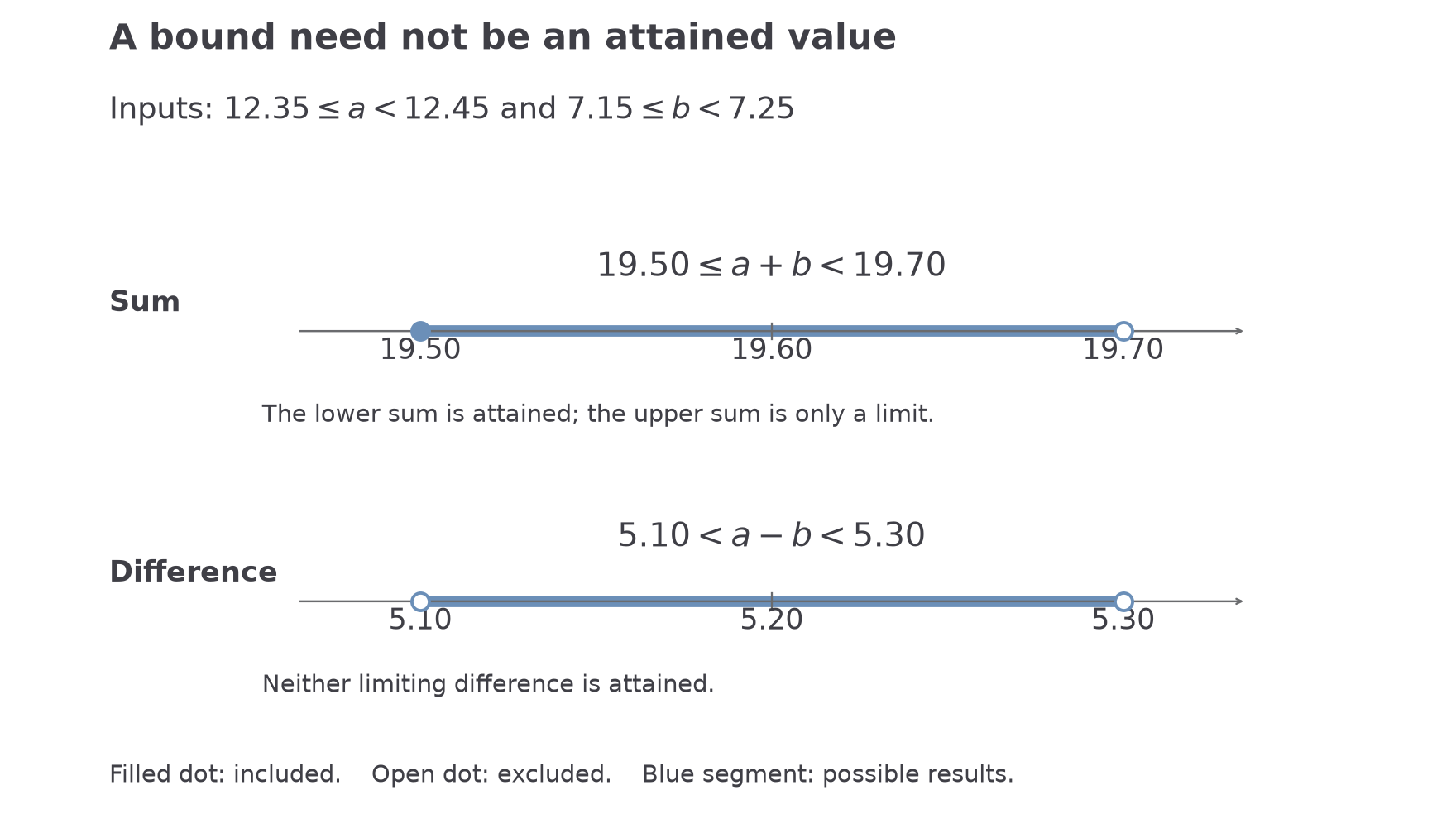
Both lower endpoints can occur together. Neither upper endpoint is included.
Answer. . The minimum is ; there is no attained maximum, but values can approach as closely as desired.
Check. Taking , gives , below the upper bound. Adding the reported values gives , inside the interval.
Keep the same information and change only addition to subtraction.
Worked example 2: a difference
Question. Find the bounds of for the same intervals.
Plan. Use the smallest and largest limiting for the lower bound; reverse those choices for the upper bound.
The first calculation needs the excluded value ; the second needs the excluded value . Neither limiting difference is attained.
Answer. . These are limiting bounds, not an attained minimum and maximum.
Check. and approach the two bounds from inside the interval.
The interval symbols carry information that the endpoint calculations alone do not.
[DIAGRAM: asset_name: Included and excluded result bounds; asset_slug: sum-difference-bounds; caption: The sum includes its lower endpoint; the difference includes neither limiting endpoint.; description: Exact number lines show 19.50 less than or equal to a plus b less than 19.70 with a filled lower dot and open upper dot, and 5.10 less than a minus b less than 5.30 with both dots open. Both use the inputs 12.35 less than or equal to a less than 12.45 and 7.15 less than or equal to b less than 7.25.]
Watch out
Subtracting the two lower endpoints does not give the lower bound of a difference. Here , but can be smaller. To minimise a difference, subtract as much as possible.
Apply the same choice of extremes to new measurements.
Bounds of products and quotients
For independent positive quantities, increasing either factor increases a product. Increasing a positive numerator increases a quotient, but increasing its positive denominator decreases it.
For instance, but . A larger denominator shares the same numerator into more parts, making each part smaller.
| Desired bound, with positive inputs | Product | Quotient |
|---|---|---|
| Lower | Lower , lower | Lower , upper |
| Upper | Upper , upper | Upper , lower |
Check the input intervals and whether their endpoints are included before choosing the result's inequality symbols.
Worked example 3: multiplying positive measurements
Question. Positive measurements and are each correct to the nearest . Find the bounds of .
Plan. Form the input intervals, then multiply matching extremes.
Answer. . Both lower inputs are allowed, so the lower product is attained; the upper product is excluded.
Check. The reported-input calculation lies inside the bounds. Using gives a product close to, but below, the upper bound.
Keep the same positive input intervals and change the operation to division. The denominator choices must reverse.
Worked example 4: dividing positive measurements
Question. Find the bounds of for and .
Plan. For the lower bound divide the smallest numerator by the largest limiting denominator; reverse the choices for the upper bound.
Answer. . The limiting values are approximately and . Neither is attained: the lower needs excluded , and the upper needs excluded .
Check. The central quotient lies inside. Also, and , verifying the endpoint arithmetic by multiplication.
These rules require the stated conditions. If the denominator's interval reaches zero, the quotient may be undefined or have no finite bound: do not divide by an endpoint of zero. Negative inputs need a fresh direction check; for example, is less than , so increasing a factor need not increase the product. Linked inputs also need care: if , then , so choosing their extremes independently would overstate the possible variation.
Problem-solving
Describe the direction before choosing endpoints: “larger numerator makes it larger; larger positive denominator makes it smaller.” This explains the choices and helps prevent a reversed quotient bound.
Keep the quotient exact until any requested final rounding.
Reliable accuracy
A calculator can display many digits even when the input information cannot justify them. To decide which reported answer is guaranteed, ask whether every allowed true result rounds to the same value at the proposed accuracy.
Use the complete output interval, not just the nominal calculation from the reported inputs. Keep exact bounds or enough guard digits while checking a rounding threshold. If you give a decimal enclosure, round its lower bound down and its upper bound up so that it still contains every possible value.
Worked example 5: a guaranteed decimal answer
Question. A positive measurement is reported as , correct to the nearest . A result is , with exact. Find the greatest number of decimal places to which can be guaranteed.
Plan. Divide both measurement bounds by the exact positive number, then compare the possible results at successive rounding accuracies.
Every number in this interval rounds to to two decimal places: the whole interval lies between the rounding thresholds and . Three decimal places are not guaranteed; permitted values and round differently.
Answer. is guaranteed to two decimal places, but not three.
Check. The threshold for rounding up to is , beyond the upper bound. The threshold below which the result would round to is , below the lower bound.
Now keep the same nominal calculation but make the denominator a measurement too. That one change increases the uncertainty.
Worked example 6: uncertainty in the denominator
Question. Now and are each correct to the nearest , and . Find the greatest number of decimal places to which is guaranteed.
Plan. Use opposite quotient extremes before testing the rounding accuracy.
The limiting values are approximately and . Values near the lower limit round to to one decimal place; values near the upper round to . However, every allowed result lies between and , so all round to to the nearest whole number.
Answer. Only zero decimal places, giving , is guaranteed. The nominal value is not a guaranteed two-decimal-place answer.
Check. Allowed inputs give about , while give about . Their one-decimal-place results differ, confirming the failure at that accuracy.
At a rounding threshold, remember whether the endpoint is included. Every positive value in rounds to to two decimal places, even though the excluded upper endpoint would round to . Interpret the limit from inside the interval.
Context can require an integer rather than a rounded decimal.
Worked example 7: a possible whole-number count
Question. A tank contains , correct to the nearest litre. Each bottle holds exactly . What is the maximum possible number of full bottles?
Plan. Use the upper volume limit, divide by the exact bottle size, then check which whole count can actually occur.
Sixteen bottles would need , outside the allowed volume. Fifteen need , which is allowed.
Answer. The maximum possible count is full bottles. Do not round to .
Check. An allowed tank volume of fills exactly bottles, so this integer maximum is attained. It is not guaranteed for every tank: fills only full bottles.
If the limiting quotient is exactly an integer at an excluded endpoint, that count may be impossible. For example, with litres and exact one-litre bottles, full bottles cannot occur; the maximum is . Always check that the proposed whole count can actually fit.
The opening difference lies strictly between and . Its value to one decimal place is not guaranteed to be , but every possible difference rounds to to the nearest centimetre.
Key idea
Guaranteed accuracy means the entire allowed interval gives the same rounded result. A possible maximum count is a different question: check both that the count fits and that the next one cannot fit.
Use the interval to decide a fresh quotient's reliable digits.
Quick Recap
- Sums use matching extremes; differences use opposite extremes.
- For positive independent inputs, products use matching extremes and quotients use opposite extremes.
- Tight limiting endpoints need not be attainable minima or maxima.
- Reliable digits must agree across the full output interval; whole-number contexts need a separate fit check.
The opening reported difference is a nominal calculation. Only to the nearest centimetre is guaranteed by those rounded measurements.