FN15–FN16, HN15–HN16 - Accuracy and error intervals
A rounded measurement describes a range of possible values, rather than one exact value. Learn to write those ranges with inequalities, distinguish rounding from truncation, and report accuracy honestly. FN15 and HN15 supply the interval notation; FN16 and HN16 explain what the limits mean for a measurement.
Rounding intervals
Two lengths are reported as and . They have the same numerical value, but do they give the same information about accuracy? The answer depends on the place to which each was rounded.
Suppose a positive length rounds to to the nearest tenth of a centimetre. Values closer to than to or produce this result. The halfway boundaries are and .
Use this convention throughout the positive rounding examples: a value exactly halfway rounds to the larger neighbouring value. Thus rounds to , while rounds to .
Error interval
An error interval is the range of values that could produce a stated rounded or truncated result. For a positive value rounded to a fixed step, include the lower halfway boundary and exclude the upper one, using the halfway convention above.
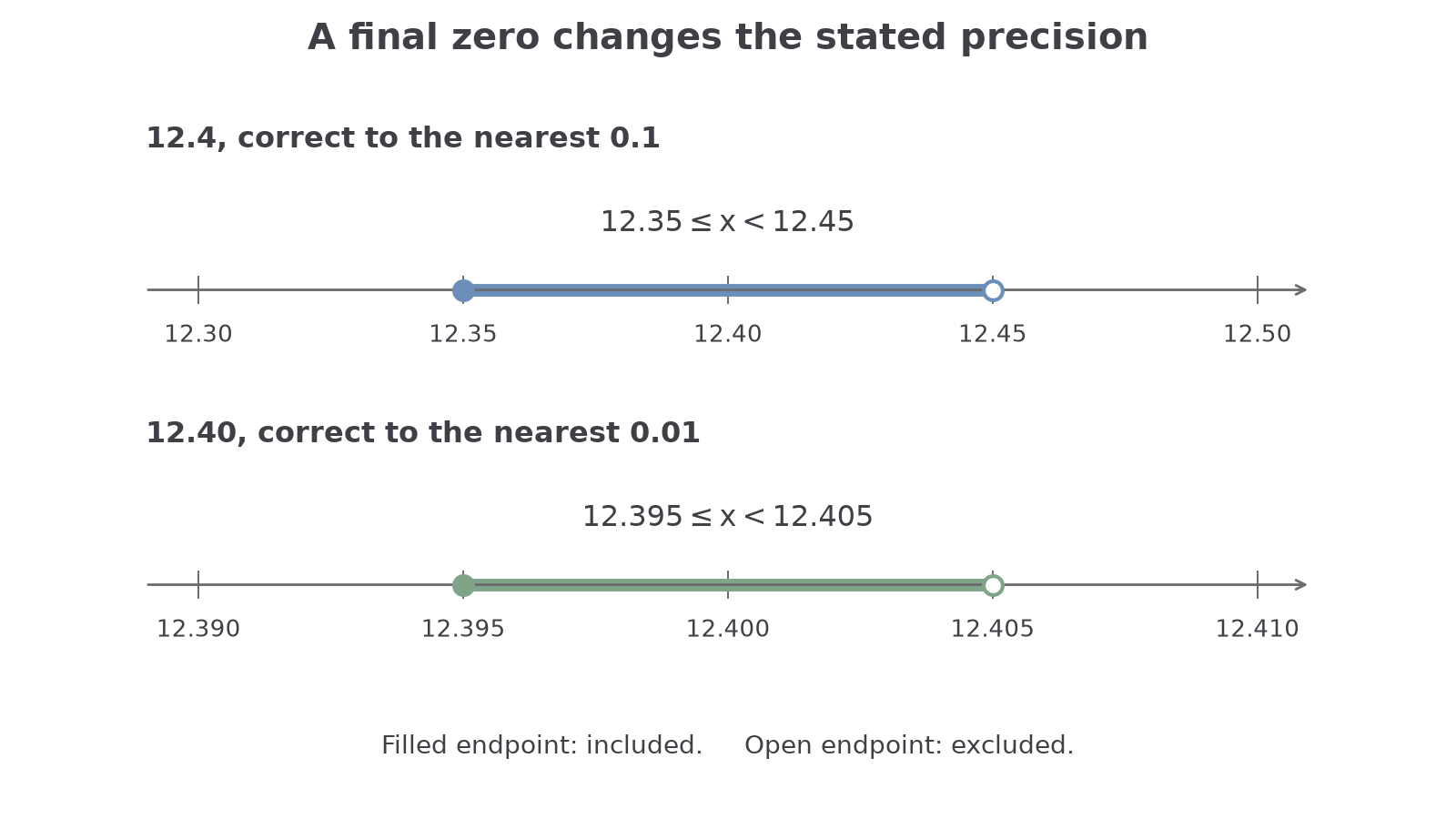
If is the length in centimetres, write . Read the chain as two statements: is at least , and is less than . The interval concerns uncertainty from rounding, rather than a mistake in the calculation.
The rounding step is the gap between neighbouring possible rounded answers. To find the boundaries, subtract and add half the step, not half the reported measurement.
| Accuracy stated | Rounding step | Half the step |
|---|---|---|
| Nearest | ||
| Nearest | ||
| Nearest |
Worked example 1: a rounded length
Question. A length is , correct to one decimal place. Write an error interval for its actual length centimetres.
Plan. Find the rounding step, then move half a step each way from the reported value.
Answer. .
Check. rounds to , so it is allowed. rounds to , so it is excluded. An interior value such as rounds to .
Now change only the stated precision. The centre stays the same, but the interval becomes narrower.
Worked example 2: an extra decimal place
Question. A length is , correct to two decimal places. Write an error interval for its actual length centimetres.
Plan. Use a step of , because the final retained place is a hundredth.
Answer. .
Check. rounds to , whereas rounds to . The interval width is , matching the rounding step.
The number lines use different scales to make both intervals visible. Their inequalities show the actual widths.
[DIAGRAM: asset_name: Rounded measurement intervals; asset_slug: rounded-measure-intervals; caption: The extra decimal place gives a narrower range of possible lengths.; description: Two number lines show 12.35 less than or equal to x less than 12.45 for 12.4 to one decimal place, and 12.395 less than or equal to x less than 12.405 for 12.40 to two decimal places. Filled circles mark included lower endpoints and open circles mark excluded upper endpoints. The scales differ.]
For significant figures, identify the last retained place value first. A positive mass of , correct to two significant figures, is rounded to the nearest . Its interval is , where is in grams.
The lower bound is the lower limiting value and the upper bound is the upper limiting value. Here is the upper bound, but it is not a possible mass in the interval. There is no greatest possible real value below : however close you choose, another allowed value can be closer.
Watch out
For to one decimal place, is too wide. Those are neighbouring rounded answers. The boundaries are halfway between them and : use and .
Find the place value before writing both inequality signs.
Truncation intervals
Truncation discards digits instead of choosing the nearest value. Knowing which process was used changes the error interval.
Truncation
To truncate a number to a specified decimal place, remove all digits after that place without increasing any retained digit. For signed numbers this moves the value towards zero, or leaves it unchanged if nothing is removed.
For example, truncated to one decimal place is , but rounded to one decimal place it is . The corresponding negative value truncates to , moving to the right on a number line. “Always round down” would therefore be a misleading description.
Worked example 3: positive truncation
Question. A positive number gives when truncated to one decimal place. Write its error interval.
Plan. Keep all values whose first decimal digit is , stopping before the next tenth.
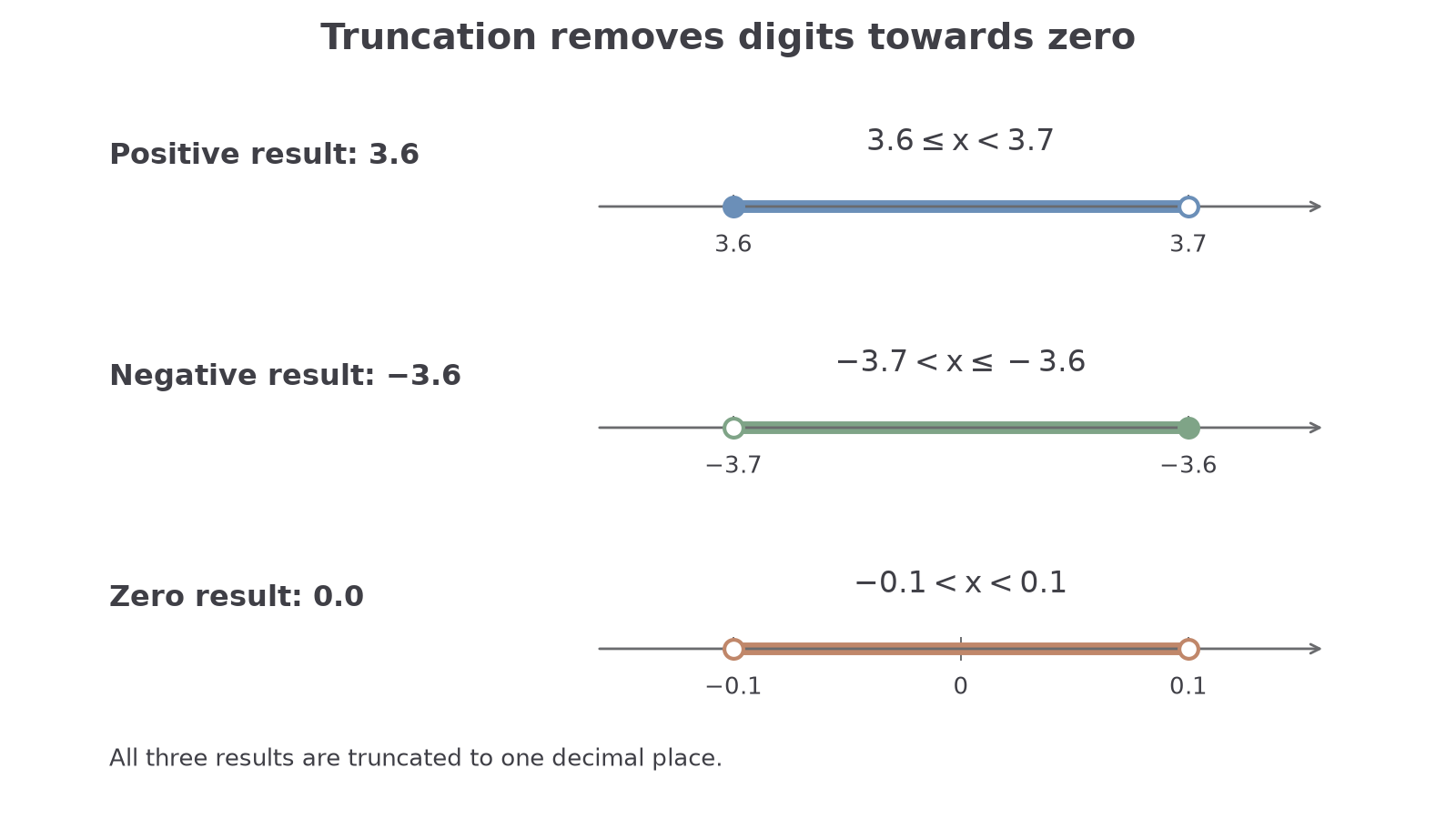
Answer. .
Check. The original lies inside the interval, and discarding its hundredths digit gives .
Now change only the sign. The discarded digits still move the value towards zero, so the included endpoint changes sides.
Worked example 4: negative truncation
Question. A number gives when truncated to one decimal place. Write its error interval.
Plan. Use the positive interval to find the possible sizes, then put those values in their correct negative order.
The possible values include , and . They extend towards , but itself would remain .
Answer. .
Check. is inside and truncates to . At the right endpoint, stays ; at the left endpoint, gives a different result.
Zero needs its own check. If a signed number truncates to to one decimal place, it may have come from either side: and both give zero. Hence the interval is , including but excluding both outer endpoints. If the original quantity is stated to be non-negative, its allowed interval is instead .
[DIAGRAM: asset_name: Signed truncation intervals; asset_slug: signed-truncation-intervals; caption: Truncation towards zero gives different endpoint patterns for positive, negative and zero results.; description: Three number lines show 3.6 less than or equal to x less than 3.7, minus 3.7 less than x less than or equal to minus 3.6, and minus 0.1 less than x less than 0.1. Filled circles mean included endpoints and open circles mean excluded endpoints.]
Watch out
The rounding interval for is centred on ; its truncation interval is not. For a negative truncated result, do not copy the positive inequality signs: test both endpoints by actually truncating them.
Apply the endpoint check with two decimal places.
Interpreting accuracy
The way a number was obtained tells you whether it has a rounding interval. A count, a measured length and a price set by a shop can have very different meanings even if they contain the same digits.
Exact and approximate values
An exact value is given without rounding uncertainty, such as a complete count of objects. An approximate value has been rounded, estimated or measured with limited precision. Extra written digits do not make an approximate measurement exact.
A complete count of tickets means exactly , if every ticket was counted. An attendance reported as to the nearest ten could instead mean any whole-number count from to . The accuracy statement matters: the final zero alone does not establish how the number was obtained.
Likewise, a fixed price of £ is exactly pence. A length reported as to two decimal places is a rounded measurement. Do not automatically attach an interval to every decimal.
Choose reported accuracy that suits the data and the question. Use the stated unit and requested decimal places or significant figures. Avoid adding digits that suggest more precision than the measurements justify.
For example, a ruler reading reported as to the nearest has interval . Rewriting it as correct to three decimal places would claim a much narrower interval without taking a better measurement. Adding zeros can preserve a numerical value; it cannot create new information about the actual length.
Worked example 5: a rounded count
Question. A school newsletter reports that people attended an event, correct to the nearest ten. Find the least and greatest possible actual numbers of people.
Plan. Write the rounding interval, then restrict it to whole-number counts.
Since counts people, it must be an integer.
Answer. Least people; greatest people.
Check. and both round to , but rounds to and rounds to .
Change only how the number was obtained. There is now no rounding step to reverse.
Worked example 6: an exact count
Question. Staff count every person at a second event and record exactly people. Find the least and greatest possible numbers consistent with that count.
Plan. Use the stated exact value rather than invent an accuracy interval.
Answer. Both the least and the greatest are .
Check. An actual count of or would contradict the stated exact count, even though either would round to to the nearest ten.
This resolves the opening question. If means correct to one decimal place and means correct to two, their centres match but the second interval is ten times narrower. A smaller rounding step gives more precise information; the two actual lengths need not be identical.
Key idea
Read the accuracy statement before deciding what a number means. For a continuous measure an excluded upper bound need not be a greatest possible value; for a whole-number count there may be a greatest allowed integer below it.
Compare a known count with a measured value.
Quick Recap
- A positive rounded measurement lies between two halfway boundaries, with the lower included and the upper excluded under the stated convention.
- Truncation removes digits towards zero. Test signed and zero endpoints rather than copying the positive rounding rule.
- Exact counts do not acquire an interval just because they end in zero.
- The stated precision distinguishes the information carried by and .