FG5–FG6, HG5–HG6 - Congruence and geometric proof
When does matching a few sides or angles guarantee that two whole triangles match? FG5 and HG5 give four congruence tests. Use them with angle and quadrilateral facts in FG6 and HG6 to justify results and distinguish a proof from a convincing-looking sketch.
Congruent triangles
Could two triangles have all the same angles but different sizes? Yes: an equilateral triangle of side and one of side both have three angles. Matching angles alone does not fix size.
Congruent shapes
Congruent shapes have exactly the same size and shape. A rotation, reflection or translation can make one fit exactly over the other. Corresponding sides and corresponding angles are equal.
You need not compare every measurement. Each of these conditions fixes a triangle's size and shape, allowing a reflected version too.
| Test | Required matching information | Condition that matters |
|---|---|---|
| SSS | Three sides | Match all three lengths |
| SAS | Two sides and the angle between them | The angle must be included between those sides |
| ASA | Two angles and a corresponding side | Match the side's position; two angles fix the third |
| RHS | Right angle, hypotenuse and one other side | Both triangles must be right-angled |
The hypotenuse is the side opposite the right angle. RHS uses this identified side, not whichever side happens to be drawn at the top. You do not need to calculate the remaining side to use RHS.
Why do these tests work? With SSS, two fixed distances from the endpoints of a fixed base locate the third vertex, up to reflection. With SAS, the two sides form a fixed opening. With ASA, fixed directions and one fixed length locate the remaining vertex. With RHS, a fixed hypotenuse and one leg fix a right triangle. By contrast, AAA fixes only shape, and two sides with a non-included angle (SSA) can give different triangles. SSA is not a general congruence test.
Worked example 1: SSS and SAS
Question. Triangle has side lengths , , . Triangle has , , . Are they congruent? Separately, two triangles each have sides , and an included angle of ; are these congruent?
Plan. Match the stated measurements and choose the condition they establish.
For the first pair,
All three sides match, so triangle is congruent to triangle by SSS. The order matches , , .
For the second pair, two sides and the angle between those sides match, so they are congruent by SAS.
Answer. Both pairs are congruent, by SSS and SAS respectively.
Check. Each corresponding side agrees. In the SAS pair, the angle is explicitly between the and sides; moving it elsewhere would remove the SAS justification.
Keep the goal of a definite triangle, but change the kind of information supplied.
Worked example 2: ASA and RHS
Question. Triangle has angles , and . Triangle has , and . Are they congruent? Separately, two right triangles each have hypotenuse and a shorter side ; are they congruent?
Plan. Check angle and side correspondence for ASA; identify the hypotenuse for RHS.
For the first pair,
Thus and are congruent by ASA. The equal sides join the matched angles.
For the second pair, the right angles, hypotenuses and one corresponding leg match, giving RHS.
Answer. Both pairs are congruent, by ASA and RHS respectively.
Check. Each third angle in the ASA pair is . In the RHS pair, the side is opposite the right angle in both triangles.
A proof must establish the whole condition, not just name it.
Watch out
“Two sides and an angle match, therefore SAS” misses the word included. Check that the named angle lies between the two known sides. Three equal angles also do not prove congruence: the opening equilateral triangles have different sizes.
Use a right angle to identify the correct test.
Angle proofs
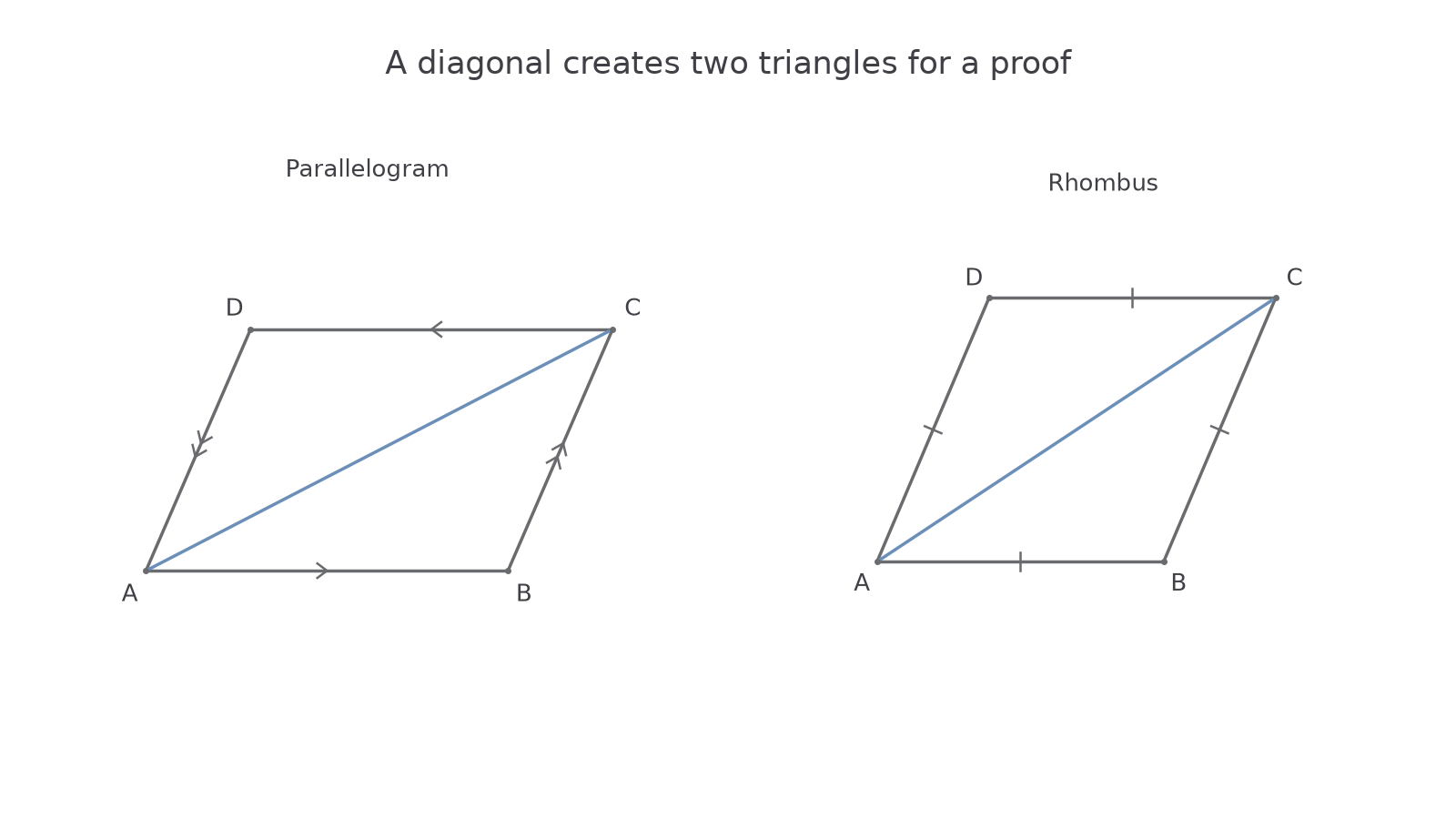
A geometric proof is a chain of justified statements: given facts lead to a congruence condition, then congruence gives a new fact about matching sides or angles.
Use three letters to identify an angle precisely. In , the middle letter is the vertex. If a diagonal splits an angle, its two pieces need separate names. A shared side can be used in both triangles: write, for example, , common side.
[DIAGRAM: asset_name: Proofs using diagonals; asset_slug: quadrilateral-proof-diagonals; caption: A diagonal creates two triangles whose matching information can be justified.; description: The left panel shows a non-rectangular parallelogram ABCD with diagonal AC and opposite sides marked parallel. The right panel shows a non-square rhombus ABCD with diagonal AC and all four sides marked equal.]
Continue this lesson.
You’re previewing NovaLearn without an account. Create a free account to read the rest.
Create free account