FG2, HG2 - Ruler and compass constructions
How can compass arcs locate a midpoint without measuring half the length? Use the constructions in FG2 and HG2 to draw perpendiculars, bisect angles and build accurate figures. The equal distances left by the compass explain why each construction works.
Perpendicular bisectors
A compass keeps a distance fixed while you move around its centre. Draw lightly, keep the compass setting unchanged when equal radii are required, and leave the construction arcs visible.
Perpendicular bisector
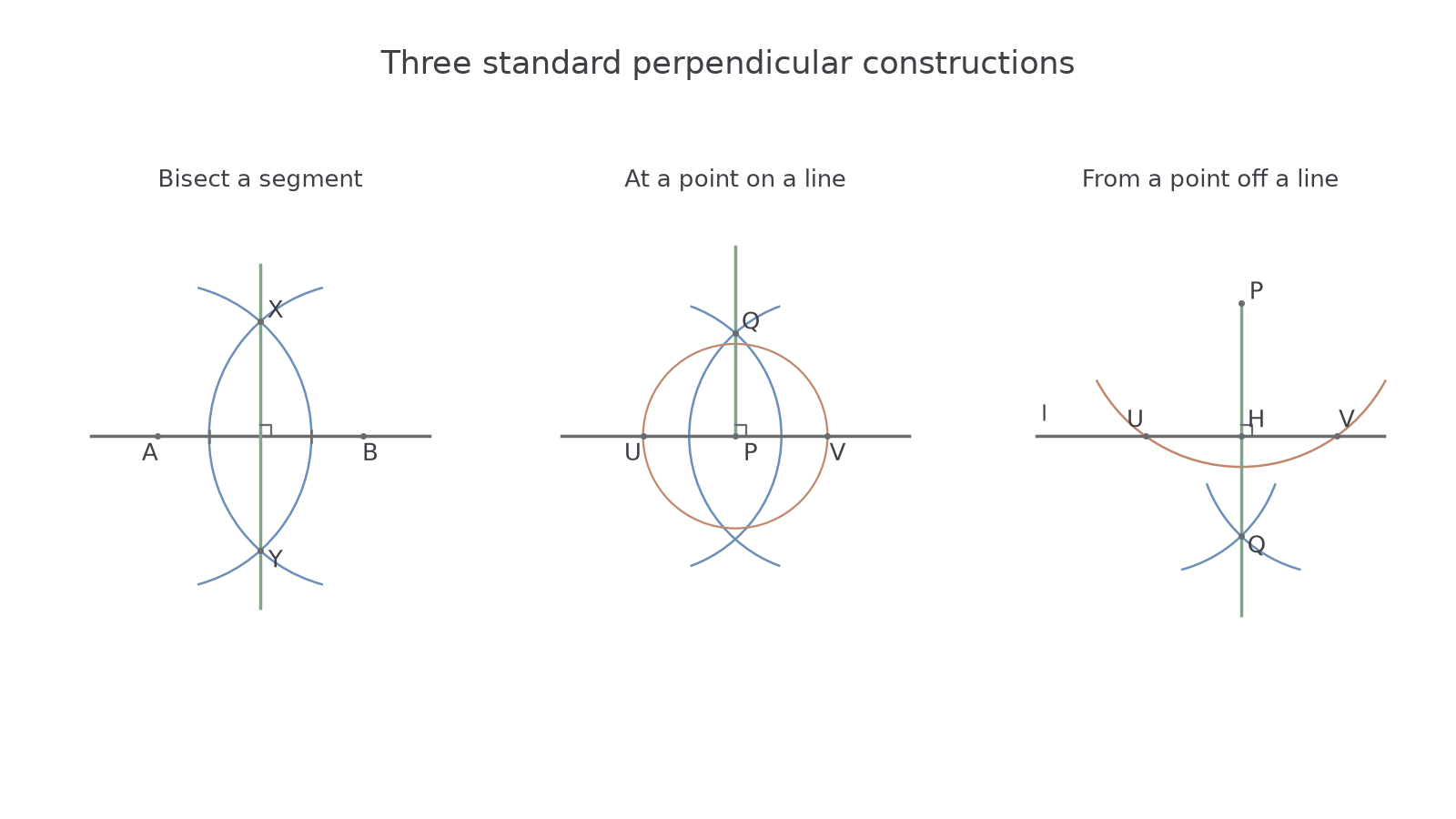
The perpendicular bisector of a segment crosses it at its midpoint at . Every point on this line is equally distant from the segment's two endpoints.
To bisect segment , open the compass to more than half its length. Draw arcs above and below from centre . Without changing the radius, repeat from , obtaining two intersections and . Draw the straight line . It crosses at its midpoint and is perpendicular to it.
Both and are equally distant from and . Joining these centres and intersections gives matching triangles, so the line through and divides the segment into equal halves at right angles. A radius equal to half the length gives only one meeting point; a smaller radius gives none. Neither locates the bisector line.
[DIAGRAM: asset_name: Perpendicular constructions; asset_slug: perpendicular-constructions; caption: Equal-radius arcs give a perpendicular bisector and perpendiculars through a specified point.; description: Three panels show equal intersecting compass circles about A and B with their perpendicular bisector XY, a point P on a line with equally spaced points U and V and arcs meeting above P, and a point P off a line with an arc cutting it at U and V and equal arcs below meeting at Q.]
Worked example 1: bisecting a segment
Question. Construct the perpendicular bisector of a segment of length .
Plan. Use equal compass radii greater than , then join the two intersections.
- Draw with a ruler.
- Set the compass to . Draw arcs above and below , centre .
- Keep the radius and repeat from . Label the two arc intersections and .
- Use the ruler's straight edge to draw , leaving the arcs.
Answer. is the required perpendicular bisector.
Check. After constructing, a ruler should show two halves, and a set square or protractor can check the right angle. These checks verify the drawing; they do not replace the compass construction.
To construct a perpendicular at a point on a line, first make that point the midpoint of a segment on the line.
Worked example 2: perpendicular at a point
Question. Construct a perpendicular to line through a point on .
Plan. Mark points equally far from , then construct their perpendicular bisector.
- With centre , draw an arc crossing at and . The compass makes .
- From and , use equal radii greater than to draw intersecting arcs above the line at .
- Draw . Since is the midpoint of , is perpendicular to .
Answer. The straight line is the required perpendicular.
Check. It passes through the original point , not merely a nearby point, and both angles next to it on should be .
For a point off the line, the first arc must cut the line twice. The same symmetry then puts the original point on a perpendicular bisector.
Worked example 3: perpendicular from a point
Question. Construct a perpendicular from a point above line to .
Plan. Use an arc centred at to create two points on equally distant from it.
- Open the compass far enough that an arc centred at cuts at two distinct points and . Extend the line first if needed.
- From and , use one equal radius large enough for the arcs to meet below at .
- Draw , crossing at .
Both and are equidistant from and , so is their perpendicular bisector.
Answer. is the perpendicular from to .
Check. The constructed line must go through , meet , and make a right angle there. The first compass arc need not have the same radius as the later pair; only the two arcs from and must share a radius.
The original segment or point matters as much as the right angle.
Watch out
Changing the radius between centres and breaks . Use one compass setting for the matched arcs. A line drawn through the estimated midpoint is not a ruler-and-compass construction.
Decide whether a proposed construction can locate the two intersections.
Angle bisectors
An angle bisector divides an angle into two equal angles, which is a different job from halving a segment.
Angle bisector
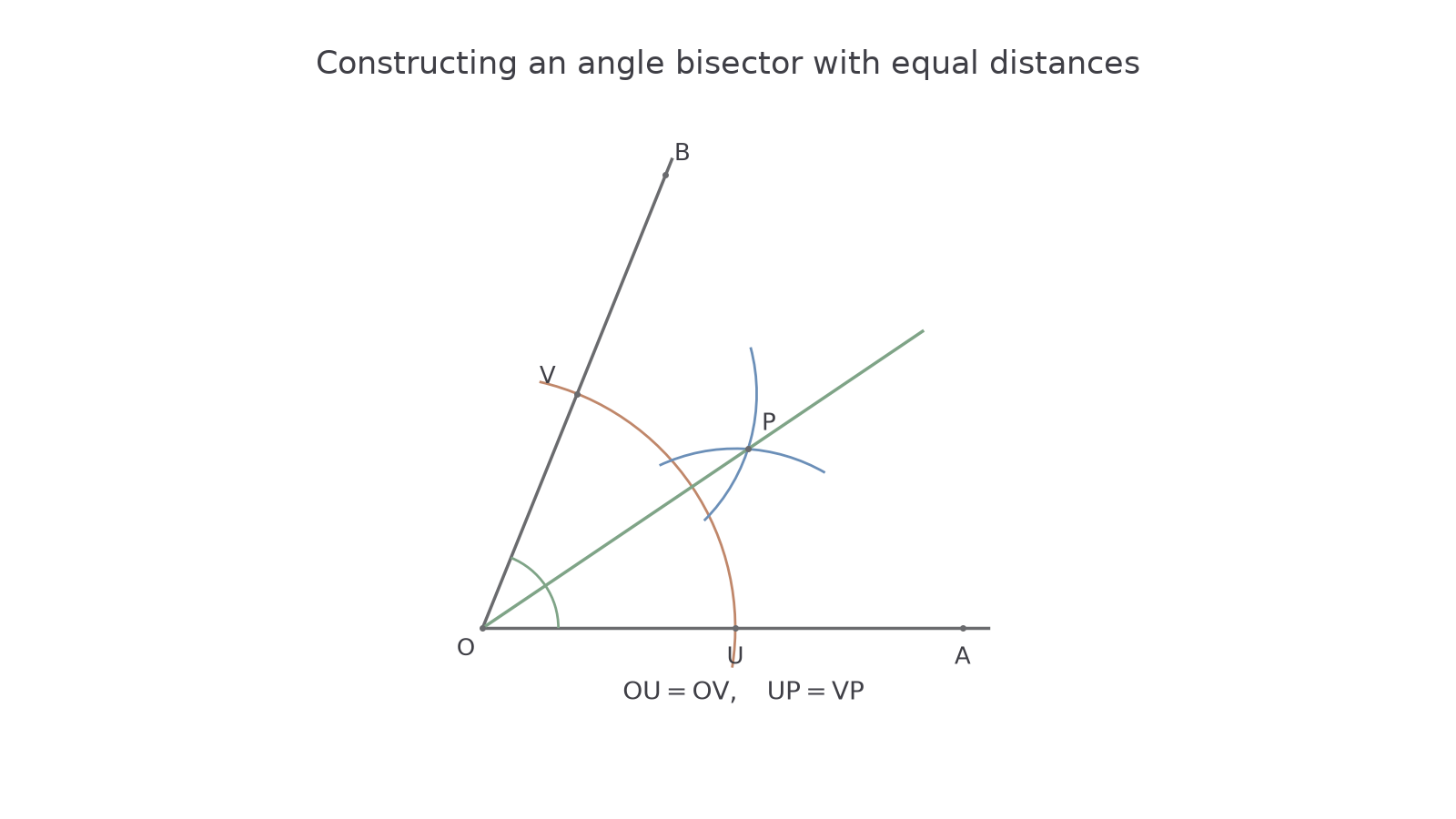
An angle bisector is a ray from the vertex that divides the angle into two equal parts. For example, it divides into and .
For angle , draw one arc centred at , meeting the arms at and . From and , draw arcs of the same radius that intersect at inside the angle. Draw the ray .
Why does it work? comes from the first arc, from the equal second arcs, and is common. Triangles and match by SSS, so . You can use this construction before learning the formal name of that congruence test: the three equal distances force the two halves to match.
[DIAGRAM: asset_name: Constructing an angle bisector; asset_slug: angle-bisector-construction; caption: Equal distances from the vertex and then the two arms locate the bisecting ray.; description: An acute angle AOB has an arc centred at O meeting its two rays at U and V. Equal arcs centred at U and V meet at P inside the angle; the ray OP is drawn with matching angle arcs at O.]
Continue this lesson.
You’re previewing NovaLearn without an account. Create a free account to read the rest.
Create free account