FA4, HA4 - Expanding two brackets
Learn to multiply two brackets, explain why a middle term sometimes disappears, and check an expansion before trusting it. This develops the two-binomial expansion skills in FA4 and HA4 and prepares you to reverse the process when factorising.
Two binomials
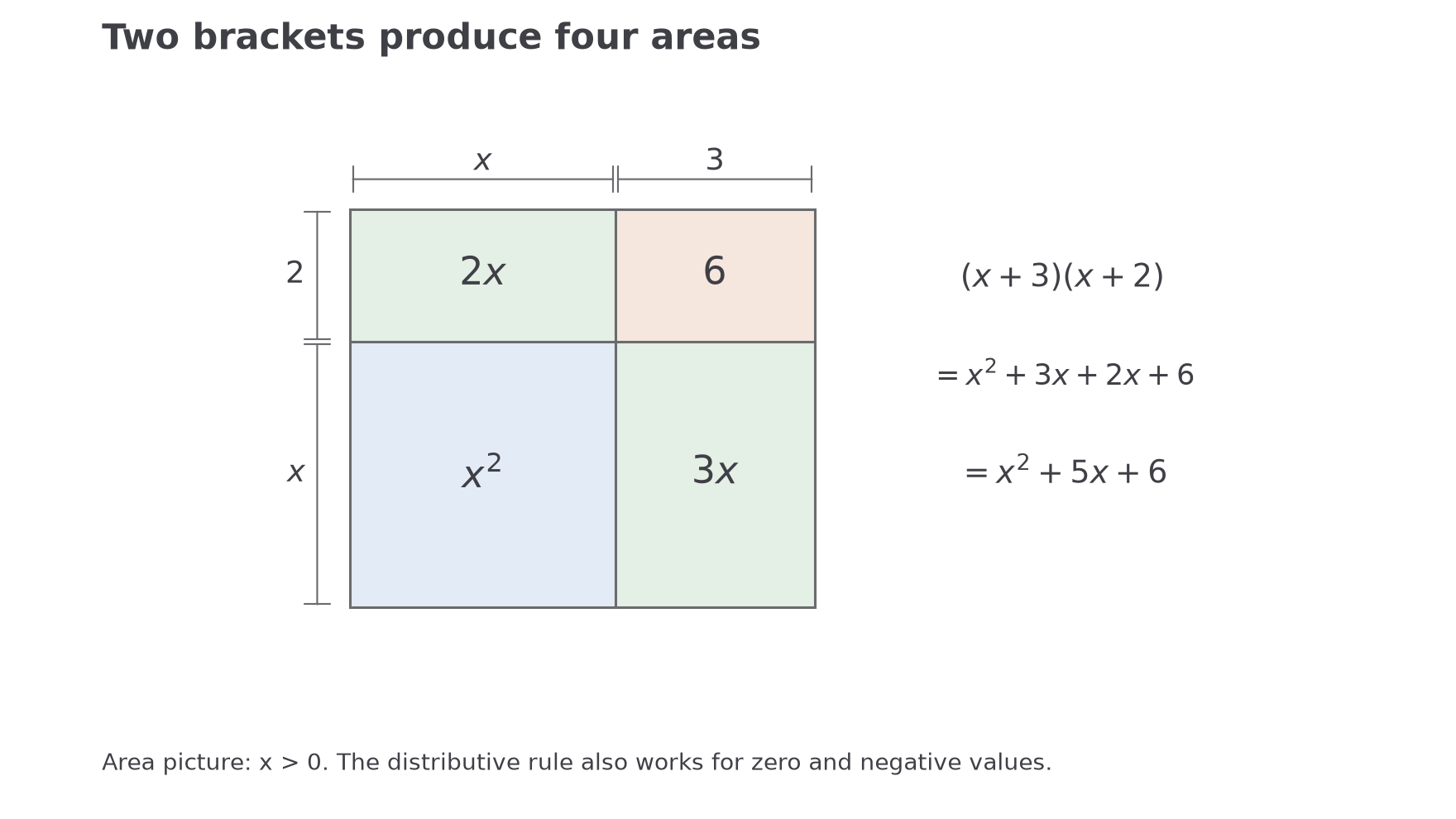
Does equal ? Multiplying the first terms and the last terms misses two products. A rectangle helps us see where they come from.
For positive , a rectangle with sides and splits into four smaller rectangles. Their areas are , , and . Adding all four gives the whole area.
[DIAGRAM: asset_name: Four products in two brackets; asset_slug: four-products-area; caption: Every part of one side multiplies every part of the other side.; description: An exact partitioned rectangle has horizontal side sections x and 3 and vertical sections x and 2. Its four regions are labelled x squared, 3x, 2x and 6, and the total area is x squared plus 5x plus 6. The area model assumes x is positive.]
Binomial
A binomial has two terms joined by addition or subtraction, such as or . To expand a product of two binomials, multiply each term in the first bracket by each term in the second, then collect like terms.
The same rule follows from distributing twice:
Although an ordinary area picture uses positive lengths, the distributive law works with negative terms too. Keep each sign attached to its term.
Worked example 1: four positive products
Question. Expand and simplify .
Plan. Multiply and by both terms of the second bracket.
Answer. .
Check. At , the brackets give . The expansion gives .
Now change only the sign before . Two of the four products change sign.
Worked example 2: a negative term
Question. Expand and simplify .
Plan. Treat the second bracket as and form all four products.
Answer. .
Check. At , the brackets give . The expansion gives .
The middle terms count different products even though both contain .
Watch out
omits and . Write all four products before collecting; the correct expansion is .
Keep the sign change in mind as you try a fresh pair.
Difference of two squares
When two brackets have the same terms but opposite signs between them, their middle products cancel.
Start with . The middle products are and , which add to zero. This leaves , a subtraction of two square terms.
Difference of two squares
The two brackets must have the same first term and the same second term, with opposite signs between them. This works for any real and .
Not in the formula booklet: learn it.
You can always expand all four products if you are unsure whether this structure applies.
Worked example 3: cancelling middle terms
Question. Expand and simplify .
Plan. Show the two equal and opposite middle products.
Answer. .
Check. At , the product is , and .
Next replace the first term by . The same cancellation occurs, but the whole first term must be squared.
Continue this lesson.
You’re previewing NovaLearn without an account. Create a free account to read the rest.
Create free account