HN8 - Working with surds
Keeping roots exact can turn an awkward decimal calculation into a short one. Learn to simplify square roots, calculate with surd expressions and remove roots from denominators. This develops the surd calculation, square-factor and rationalisation requirements of HN8.
Exact roots
Is a whole number? Both roots look awkward as decimals, but their exact forms reveal a simple relationship.
A rational number can be written as a fraction of integers with a nonzero denominator. For example, and are rational. Some roots are irrational: no fraction of integers equals them exactly.
Surd
A surd is an irrational root kept in exact root form, such as or . A surd expression may also contain rational numbers, as in . The root is not a surd, because its value is rational.
A decimal approximation such as is useful for checking size, but it is not equal to . Retain root notation when an exact answer is required.
Products and quotients of square roots
For ,
For and ,
These conditions keep the square roots real and the denominator nonzero. For example, both and are nonnegative and square to , so they are the same principal root.
Not in the formula sheets: learn these identities.
To simplify a square root, split off the largest square-number factor. Since , the square factor comes out as its root, .
[DIAGRAM: asset_name: A square factor inside a root; asset_slug: square-factor-surd; caption: Thirty-six equal tiles make a square with six tiles along each side.; description: One square tile has area 2 and side length square root of 2. A six-by-six arrangement of the same tiles has area 72 and side length 6 times square root of 2, showing square root of 72 equals 6 times square root of 2.]
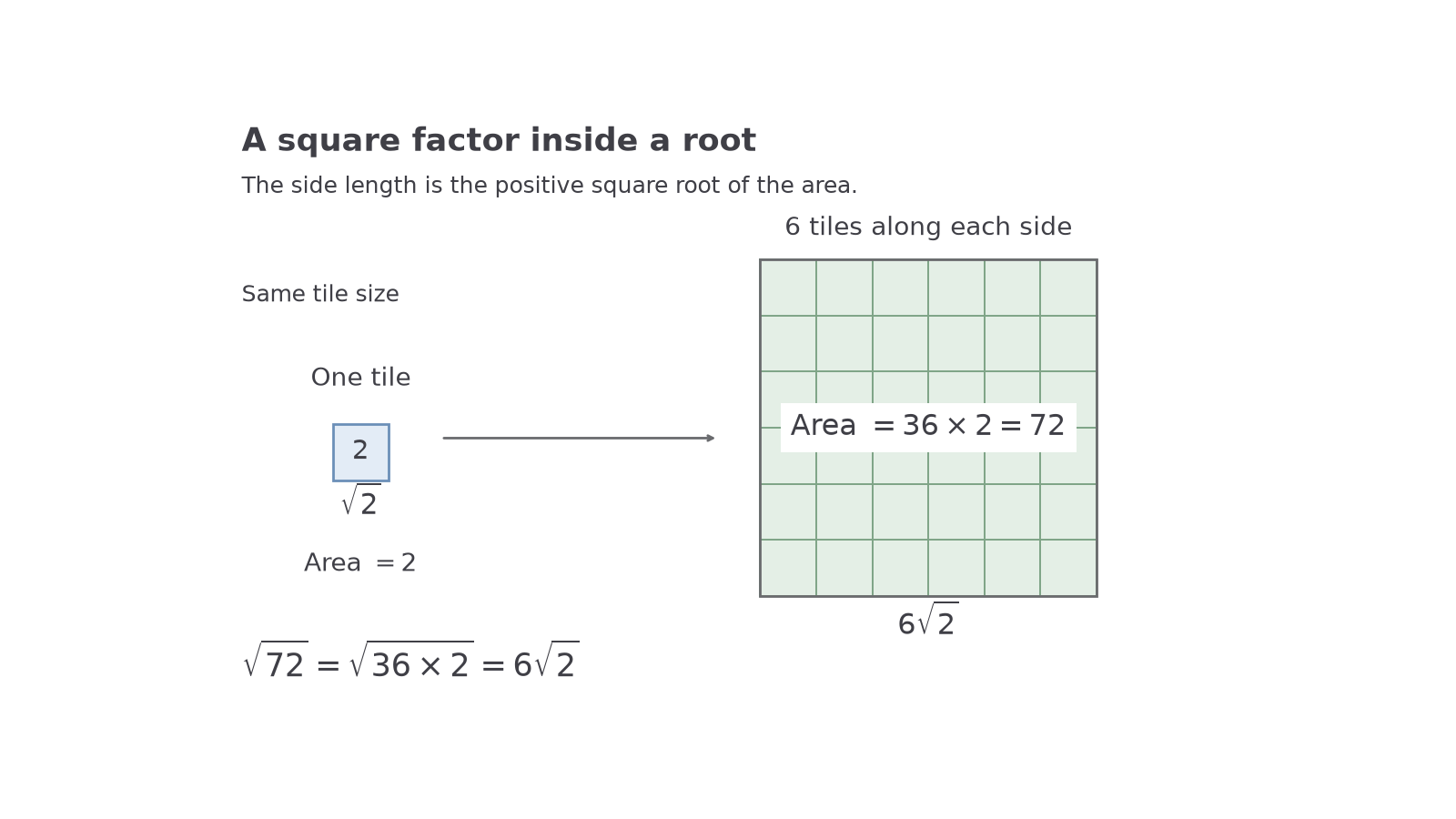
Worked example 1: extracting a square factor
Question. Simplify .
Plan. Write as a square number multiplied by a remaining factor.
Answer. .
Check. The answer is positive and , so it is the principal square root of .
Now put the same numerator over a square-number denominator. Simplify the two roots separately.
Worked example 2: a root of a fraction
Question. Simplify .
Plan. Take the root of the numerator and denominator, then simplify each.
Answer. .
Check. The positive answer squares to , the original fraction.
If you choose a smaller square factor, continue until no square factor greater than remains inside the root. For example, .
Watch out
The product rule does not work for addition: , whereas . Also, , not : the principal square root is nonnegative.
Simplify another fraction using square factors.
Surd arithmetic
Like surds combine in the same way as equal units. Three lots of plus two lots of make five lots: .
Simplify roots before deciding whether they are alike. For example, . But has unlike roots and stays as a sum.
For products, multiply rational factors and root factors separately: . In particular, . An exact integer can emerge from a product of irrational numbers.
To multiply brackets, distribute every term in the first bracket across every term in the second. With numbers, . The same distributive law works when a term contains a surd.
Worked example 3: a product of surd expressions
Question. Expand and simplify .
Plan. Form all four products, simplify the root product, then collect like terms.
Answer. .
Check. Using , the original is approximately . The answer gives , agreeing to the accuracy used.
Change the second plus sign to a minus sign. Two products become negative, so keep the signs attached to their terms.
Worked example 4: a negative surd term
Question. Expand and simplify .
Plan. Write all four signed products before collecting terms.
Answer. .
Check. The original factors are approximately and , with product . This agrees with .
Division by a rational number also acts on the coefficient: . We can now answer the opening question exactly: , since .
Watch out
, while . Addition counts equal root terms; multiplication squares the root. They are different operations.
Use four signed products in this new calculation.
Rationalising denominators
An exact fraction may have an irrational denominator. Rationalising the denominator rewrites it with a rational denominator while keeping its value unchanged.
Multiply numerator and denominator by the same nonzero expression. This multiplies the fraction by . For a denominator , multiplying by makes the denominator .
If the denominator has two terms, multiplying by itself usually leaves a surd. Instead, use the same two terms with the middle sign reversed. For example,
The root terms cancel. The paired expressions are called conjugates. Their product is rational; check that it is nonzero before using the pair as a fraction multiplier.
Worked example 5: a single-root denominator
Question. Rationalise the denominator of .
Plan. Multiply both parts of the fraction by .
Answer. .
Check. Multiply the answer by the original denominator: . It restores the original numerator.
Add to the denominator. A conjugate now removes the root without changing the fraction's value.
Worked example 6: a two-term denominator
Question. Rationalise the denominator of .
Plan. Multiply numerator and denominator by the conjugate .
Answer. .
Check. Multiplying by the original denominator gives
The exact numerator is restored, so the rewritten fraction is equal to the original.
A rational denominator does not require an integer answer. For example, , since the conjugate product is . The result may still contain a surd in its numerator.
Watch out
Changing only the denominator changes the value. Write the full multiplier on numerator and denominator. For a two-term denominator, check the cancellation rather than changing the sign and stopping there.
Use a conjugate with a denominator that does not become .
Quick Recap
- A surd keeps an irrational root exact; terminating decimal approximations lose that exact value.
- Extract square factors using their square roots: .
- Simplify before collecting like roots; multiply every signed pair in a product of brackets.
- Rationalise by multiplying numerator and denominator equally, using a conjugate for two-term denominators.
The opening quotient is the whole number . Keeping the roots exact makes that clear.