FN4, HN4 - Factors and prime numbers
Find factors and multiples systematically, and use factors to distinguish prime and composite numbers. You will break a whole number into prime factors and see why different routes lead to the same prime product.
Factors and multiples
How can you know that a list of factors is complete? Finding factor pairs gives both a method and a stopping point.
If counters make equal rows of , both and divide exactly. They form a factor pair because .
Factor and multiple
A factor, or divisor, divides a number exactly, with no remainder. A multiple of a number is made by multiplying it by an integer. Because , is a factor of , and is a multiple of .
When asked to list the factors of a positive integer, list its positive factors unless told otherwise. Test possible smaller factors in order and record each partner. Once the pairs start repeating in reverse, you have finished.
Worked example 1: listing factors in pairs
Question. Write down all the factors of .
Plan. Test , pairing each exact divisor with its quotient.
Five does not divide . The next exact divisor is , whose partner is already listed, so the pairs now reverse.
Answer. .
Check. Every listed number divides with no remainder. The ordered pair search leaves no untested smaller member of a new pair.
Now use a square number. One pair has two equal members, which must appear only once in the final list.
Worked example 2: a repeated factor pair
Question. Write down all the factors of .
Plan. List factor pairs until their members meet or begin to reverse.
Five does not divide . At , the members have met; any later pair would repeat one already found.
Answer. .
Check. There are four unequal pairs, contributing eight factors, and the single middle factor , giving nine factors altogether.
Multiples work in the other direction. The first four positive multiples of are , found from . Positive factors form a finite list; positive multiples continue without end. Zero is also a multiple because , but it is excluded when the question asks for positive multiples.
Watch out
is a multiple of , not a factor of . Ask which number divides into which: is a whole number.
Use the repeated-pair idea on a fresh square number.
Prime numbers
A prime number has no factor pair apart from one times itself.
For , the only positive factors are and . By contrast, has an extra factor, . Both numbers are odd, so oddness alone does not decide whether a number is prime.
Prime and composite numbers
A prime number is an integer greater than with exactly two positive factors: and itself. A composite number is an integer greater than with more than two positive factors. The number is neither prime nor composite because it has only one positive factor.
The first primes are . The number is the only even prime: every larger even number has as an extra factor. Zero and negative integers do not meet the definition of a prime number here.
Use quick divisibility tests before trying longer divisions.
| Divisible by | Test | Example |
|---|---|---|
| Last digit is even | ends in | |
| Digit sum is divisible by | : | |
| Last digit is or | ends in | |
| Last digit is | ends in |
Finding one extra factor proves a number is composite. To establish that it is prime, you must rule out all possible smaller factors in a pair. It is enough to test prime divisors: a composite divisor would itself contain a smaller prime divisor.
Worked example 3: showing a number is composite
Question. Is prime? Explain your reasoning.
Plan. Look for a divisor other than and , starting with small primes.
Answer. No. is composite because it has factors and , as well as and .
Check. ; the claimed extra factor divides exactly.
Change the number from to . The digit-sum test no longer finds a factor, so the remaining possible prime divisors must be checked.
Worked example 4: establishing that a number is prime
Question. Is prime? Explain your reasoning.
Plan. Test small prime divisors until the next possible smaller factor would be too large.
The next prime is . If both members of a factor pair were at least , their product would be at least , which exceeds . Any missing pair must therefore have had a smaller prime factor already tested.
Answer. Yes. The only positive factors of are and .
Check. A direct pair search through also finds no exact divisor; and need not be tested separately once and have failed.
One failed divisibility test does not prove primality: a number can fail the test for but still be divisible by , for example.
Watch out
“ is prime because it divides only by itself” misses the requirement for exactly two distinct positive factors. For , “one” and “itself” name the same factor.
Apply the same complete small-prime search to a new number.
Prime factorisation
Prime factorisation keeps splitting composite factors until every factor is prime.
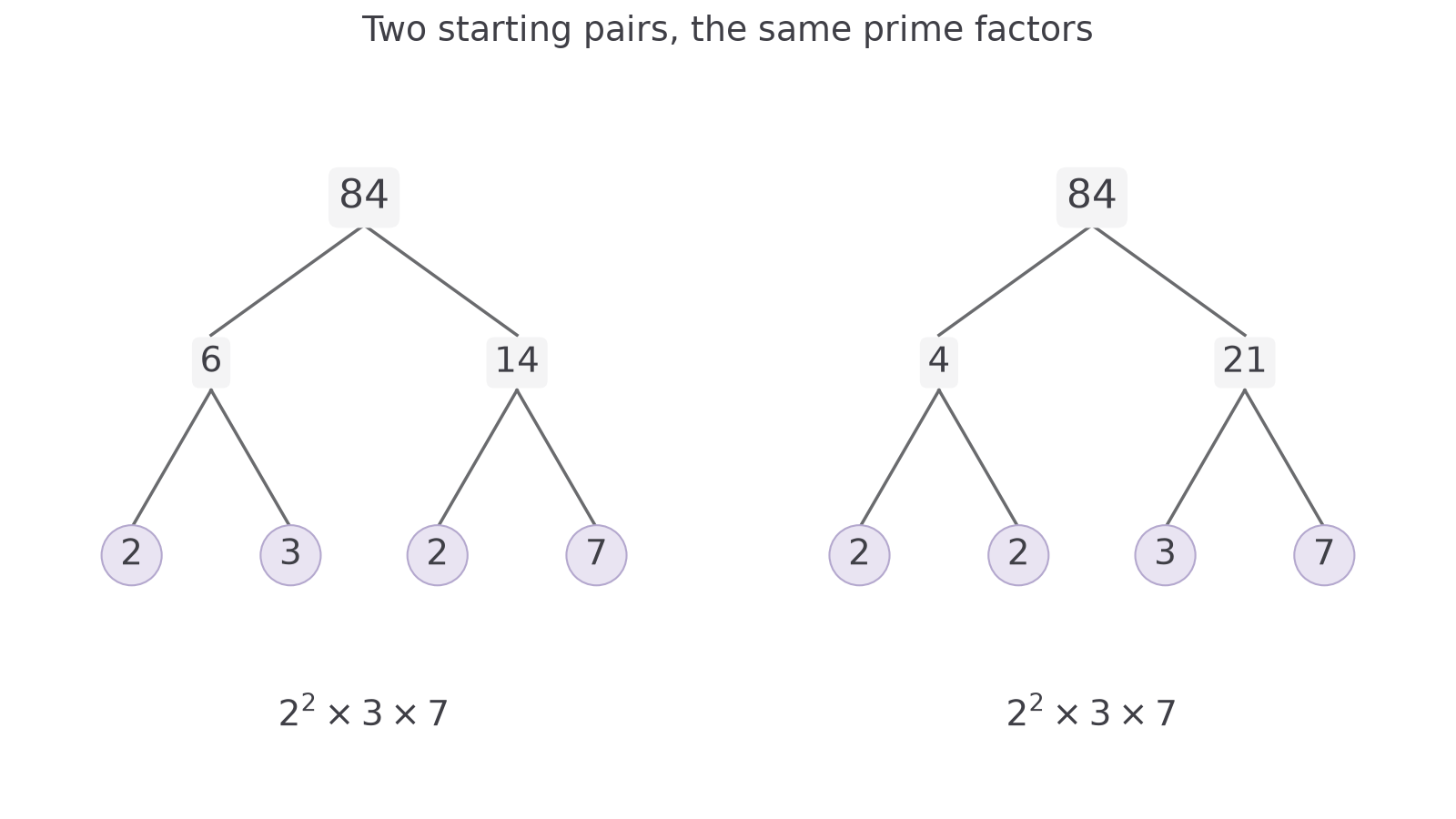
Start with any factor pair. If a factor is composite, split it again. In a factor tree, the branches record a multiplication, and the final prime factors are its leaves. Do not include intermediate composite numbers in the final product.
Worked example 5: a product of prime factors
Question. Express as a product of prime factors.
Plan. Split into factors and continue until all factors are prime.
Answer. .
Check. ; every factor in the uncollected product is prime.
The index in counts how often the prime occurs. You can use the expanded product if it makes the repeated factors clearer. A different first split of reaches the same prime factors.
[DIAGRAM: asset_name: Two routes to prime factors; asset_slug: prime-factor-trees; caption: Different starting factor pairs give the same prime factors of 84.; description: Two factor trees start at 84. The left splits into 6 and 14, then primes 2,3 and 2,7. The right splits into 4 and 21, then primes 2,2 and 3,7. Both end with product two squared times three times seven.]
Now change to a number with two different repeated primes.
Worked example 6: collecting repeated prime factors
Question. Express as a product of prime factors, using indices.
Plan. Split into , then factor each part completely.
Answer. .
Check. . No composite factor remains.
Every integer greater than has one prime factorisation, apart from the order of the factors. This is the unique factorisation theorem. Different factor trees rearrange the same prime building blocks; they cannot introduce a different prime or a different number of copies.
Watch out
is a factorisation, but not a prime factorisation. Both and must still be split. Likewise, write repeated factors as , not .
The opening list question has its answer: organised factor pairs ensure completeness, and prime factors describe what each number is built from. These ideas will next help find the largest common divisor of two numbers.
Quick Recap
- A factor divides exactly; a multiple is a whole-number product of the starting number.
- List factor pairs in order to ensure that none is missing.
- Primes have exactly two positive factors; is neither prime nor composite.
- Continue a prime factorisation until all factors are prime; collect repeated primes with indices.
A complete factor list comes from a systematic search, stopping when factor pairs meet or reverse.