FG1, FG4, HG1, HG4 - Describing shapes and symmetry
A square can be turned so that it looks like a diamond, but its properties stay the same. Learn the language and markings used to describe geometry in FG1 and HG1, then use the triangle and quadrilateral properties of FG4 and HG4 to recognise shapes, describe their symmetries and sketch them from words.
Geometric notation
If someone says “draw a diamond”, can you tell whether they mean a square or a rhombus with no right angles? A useful description must identify properties, rather than how a shape happens to sit on the page.
A point is a position, labelled with a capital letter such as . A straight line extends indefinitely in both directions. The line segment is the part between its endpoints and ; can also denote its length when the context is a measurement. A plane is a flat surface extending in every direction. A sheet of paper represents part of a plane.
Parallel and perpendicular
Parallel lines lie in the same plane and never meet, however far they are extended. Write . Perpendicular lines meet at a right angle, . Write .
Neither relationship depends on the page: parallel lines can slope, and perpendicular lines need not be horizontal and vertical. Matching arrow marks show parallel lines; a small square marks a right angle. Matching short ticks show equal lengths. Arrow marks and length ticks mean different things.
[DIAGRAM: asset_name: Triangle labels and line markings; asset_slug: geometric-notation; caption: Capital letters name vertices. The middle letter names an angle's vertex.; description: Triangle ABC has vertex A at the top, B lower left and C lower right. Lower-case a labels BC, b labels AC and c labels AB. Angle ABC is highlighted at B. Separate sloping lines carry matching parallel arrows, and another sloping pair meets with a right-angle square.]
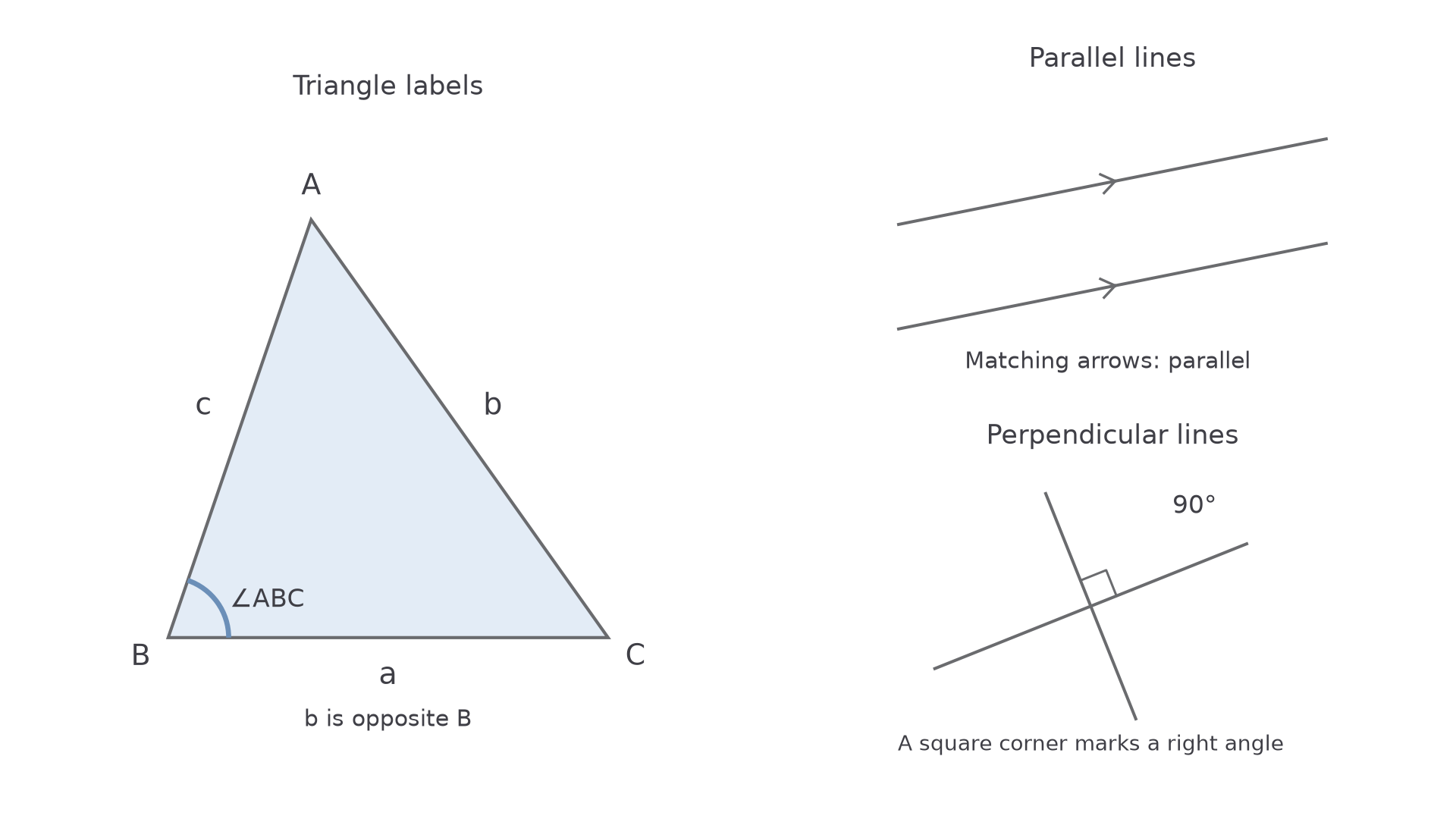
A vertex is a corner; the plural is vertices. A polygon has straight sides meeting at vertices. For a solid, an edge is where two faces meet; the solid's faces can lie in different planes. A triangle has three sides and three vertices.
Name a triangle by its vertices, for example triangle . In an angle name, the middle letter is the vertex: is the angle between and , at . The reversed name refers to the same angle. A single letter, such as angle , is enough only when it is unambiguous. The usual lower-case labels name the sides opposite , respectively; they are not extra vertices.
Worked example 1: reading an angle name
Question. In triangle , name the vertex and the opposite side of . Which side is conventionally labelled ?
Plan. Find the middle letter, then find the side that does not touch that vertex.
The middle letter of is , so the angle is at . The side joining the other two vertices is .
Answer. Vertex ; opposite side . Side is .
Check. Both and touch , so neither can be opposite . That leaves .
Changing the vertex changes the opposite side, even though the triangle stays the same.
Worked example 2: a different vertex
Question. In triangle , name the vertex and the opposite side of . Which side is conventionally labelled ?
Plan. Apply the same middle-letter rule to the new angle name.
The middle letter is , so the angle is at . Side does not touch .
Answer. Vertex ; opposite side . Side is .
Check. Reversing the angle name to still puts in the middle, so it identifies the same corner.
Use the written information and markings before trusting a sketch's appearance.
Watch out
“The lines do not meet in the picture, so they are parallel” is insufficient. Extend them mentally: they must never meet and must lie in the same plane. Likewise, a corner that looks square is not evidence of unless a property, measurement or marking establishes it.
Try the notation with different letters.
Triangles and quadrilaterals
Describe a shape by facts that remain true when it is moved, turned or reflected.
A polygon is a closed plane figure whose boundary consists of straight line segments. A triangle has three sides; a quadrilateral has four. A circle is not a polygon because its boundary is curved. The ordinary polygons considered here have no crossing sides. A polygon can be concave, with a corner pointing inward, or convex, with every corner pointing outward.
Special triangles
An equilateral triangle has three equal sides and three equal angles of . An isosceles triangle has at least two equal sides; the angles opposite those sides are equal. A scalene triangle has no equal sides. A right-angled triangle has one angle of .
These descriptions answer different questions. A triangle can be both right-angled and isosceles. Under the “at least two” definition, an equilateral triangle is also a special isosceles triangle. An acute-angled triangle has three angles below ; an obtuse-angled triangle has one angle between and .
Why do equal sides give equal opposite angles? Fold an isosceles triangle along the line from the vertex between the equal sides to the midpoint of its base. The equal sides fit onto each other and the base ends swap, so the two base angles fit too. With three equal sides, the same reasoning applies at every vertex. The triangle angle sum, developed in the polygon-angles lesson, then gives each.
[DIAGRAM: asset_name: Special triangles and quadrilaterals; asset_slug: shape-properties; caption: Equal-length ticks, parallel arrows and right-angle squares record properties, regardless of orientation.; description: An equilateral triangle, a right-angled isosceles triangle and a scalene triangle appear above examples of a square, rectangle, parallelogram, rhombus, kite and trapezium. Matching ticks distinguish equal side sets, arrows identify parallel opposite sides and small squares mark right angles. The rectangle is not a square, the rhombus has no right angles, the kite has two unequal pairs of adjacent equal sides and the trapezium has exactly one parallel pair.]
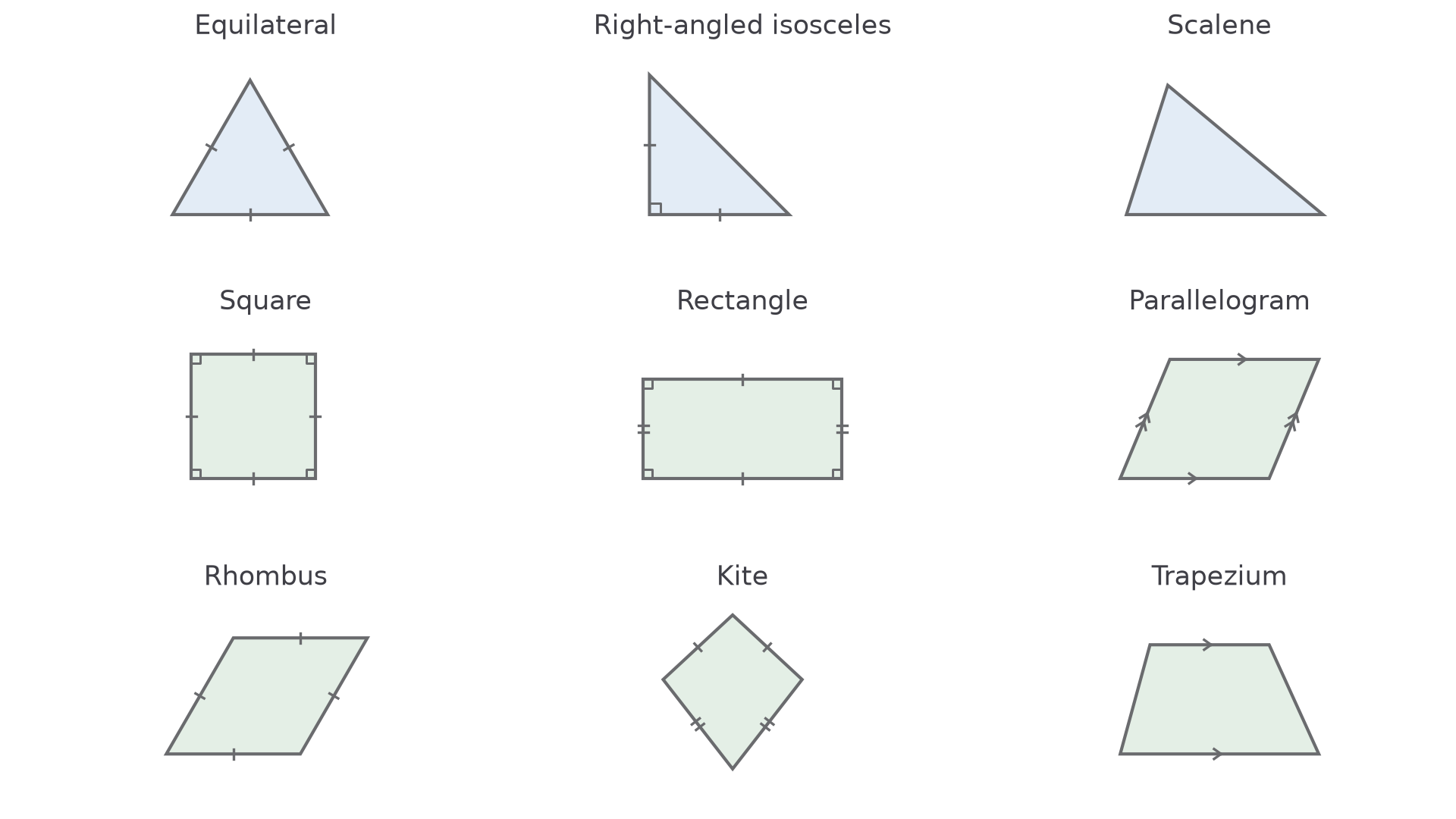
The word adjacent means next to each other, sharing a vertex. Opposite sides do not share a vertex. A diagonal joins two non-adjacent vertices. Use these distinctions in the quadrilateral definitions.
| Shape | Defining properties | Further useful properties |
|---|---|---|
| Parallelogram | Both pairs of opposite sides parallel | Opposite sides equal; opposite angles equal; diagonals bisect each other |
| Rectangle | Four right angles | Opposite sides parallel and equal; diagonals equal and bisect each other |
| Rhombus | Four equal sides | Opposite sides parallel; opposite angles equal; diagonals bisect each other at right angles |
| Square | Four equal sides and four right angles | All rectangle and rhombus properties |
| Kite | Two pairs of equal adjacent sides | The diagonal joining the vertices where equal sides meet is a symmetry line and perpendicularly bisects the other diagonal |
| Trapezium | One pair of parallel opposite sides | A trapezium with equal non-parallel sides is an isosceles trapezium |
Here a trapezium means a quadrilateral with exactly one parallel pair. Some definitions allow “at least one”; when a question gives a property explicitly, follow that wording. A kite drawn with two distinct side lengths has just one symmetry line. A rhombus also satisfies the adjacent-equal-pair condition, but has additional symmetry.
Bisect means divide into two equal parts. The diagonals of a parallelogram bisect each other; they do not necessarily meet at right angles. You can see the bisection by a half-turn about their crossing: opposite vertices exchange places, so each half of a diagonal matches the other half. For a rectangle, folding along either line through the midpoints of opposite sides also shows its opposite sides are equal. For a rhombus or kite, folding along the appropriate diagonal swaps the two matching sides, so it halves the other diagonal at right angles. Later geometric proofs turn these observations into formal arguments.
Continue this lesson.
You’re previewing NovaLearn without an account. Create a free account to read the rest.
Create free account