FG15, HG17 - Surface area and curved solids
Calculate the area exposed on a solid and distinguish it from the volume inside. FG15 and HG17 cover surface areas of prisms and cylinders, formulae for cones, spheres and pyramids, and solids formed by joining or removing these shapes. You will track which faces remain exposed and choose perpendicular or slant heights correctly.
Surface areas
A hemisphere is joined to the top of a cylinder, with their circular faces fitting exactly. Can you add the two original total surface areas to find the outside area? Some faces become hidden inside the join.
Surface area
The surface area is the total area of the surfaces being counted, in squared units. A closed solid includes every outer face. An open container omits its opening; an exposed inner wall can still count when the question asks for all exposed surfaces.
A net unfolds flat faces so their areas can be added. A cuboid has three equal pairs of rectangular faces. A right prism has two end faces of area , plus a rectangle for each edge of its end: each rectangle has the prism's length and one end-edge length. Thus its closed surface area is , where is the end's perimeter.
[DIAGRAM: asset_name: Cuboid and cylinder surface nets; asset_slug: surface-nets; caption: Count each face once; the cylinder's curved surface opens into a rectangle.; description: Exact cuboid net for dimensions 5 cm by 3 cm by 2 cm, with faces of areas 15, 15, 10, 10, 6, 6 square cm. Beside it a cylinder net for radius 3 cm and height 5 cm has two circles of area 9 pi square cm and a rectangle of width 6 pi cm, height 5 cm and area 30 pi square cm.]
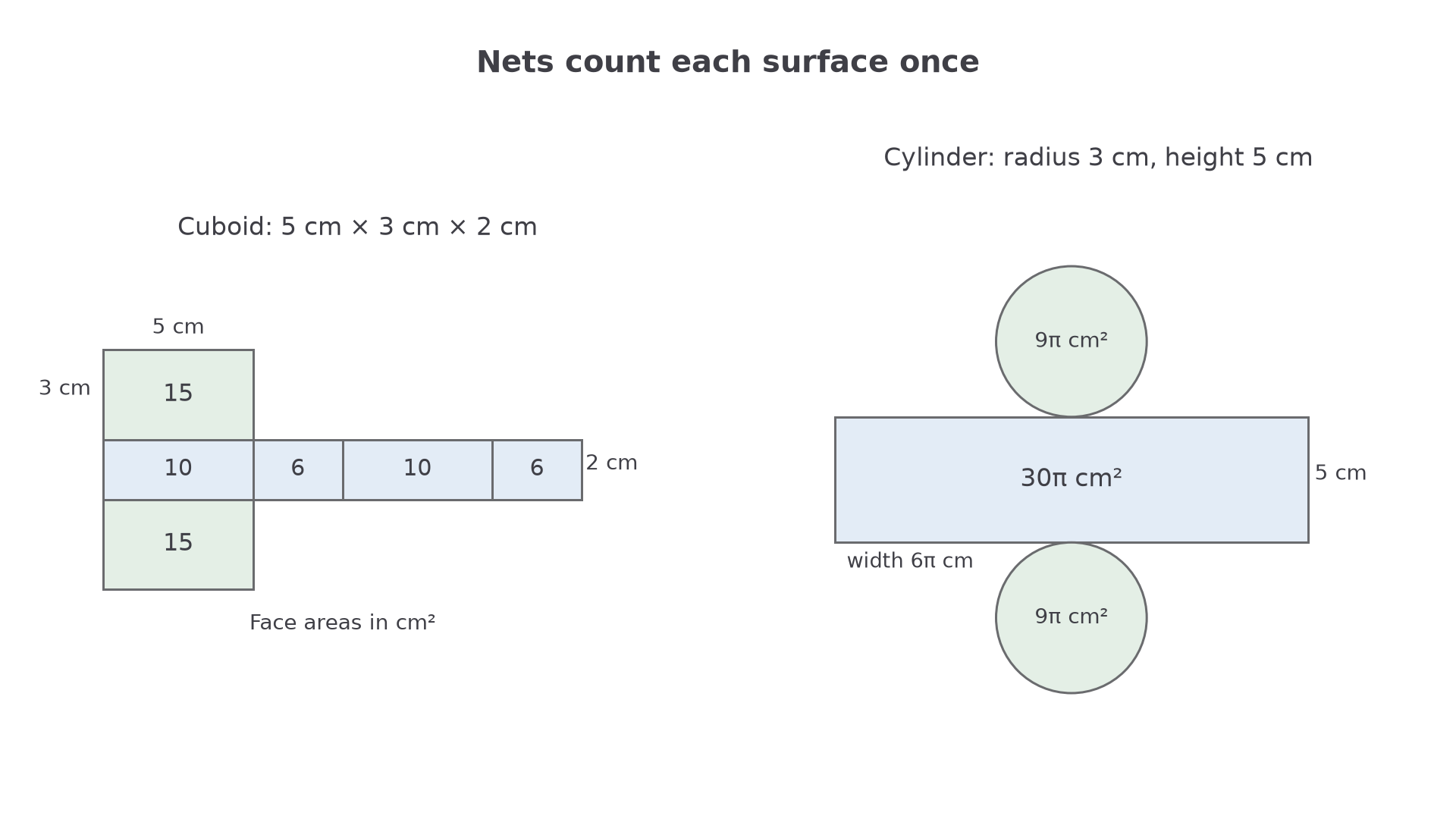
A cylinder's curved wall unrolls to a rectangle of width and height , so its area is . A closed cylinder also has two circular ends, giving total area . These surface formulae follow from the component areas; they are not separately listed on the formula sheets.
Worked example 1: a cuboid's six faces
Question. Find the total surface area of a cuboid of dimensions , , .
Plan. Find the three different face areas, then count two of each.
Answer. .
Check. The net's six areas sum to . Multiplying all three lengths would instead give volume.
Change the end from a rectangle to a triangle, keeping the same face-by-face reasoning.
Worked example 2: a triangular prism
Question. A right triangular prism has a right-angled end with perpendicular sides and ; its third side is . The prism length is . Find its total surface area.
Plan. Add two triangular ends and the three rectangular side faces.
Answer. .
Check. Listing every face separately gives . The triangular third side was supplied; no unknown side is needed.
The cylinder uses the same idea: two ends and one unrolled curved wall.
Worked example 3: a closed cylinder
Question. A closed cylinder has radius and height . Find its total surface area exactly.
Plan. Add two circles to the unrolled rectangular wall.
Answer. .
Check. The net contains . With the top removed, the exposed outside area would be , since one disc would be absent.
Decide from the wording whether a top or base is present before adding it.
Watch out
Curved surface area and total surface area are different. omits both cylinder ends; a closed cylinder needs two extra discs.
Add all exposed faces of a fresh closed cylinder.
Cones, spheres and pyramids
A cone or pyramid narrows to an apex, while a sphere has one continuous curved surface. Their volumes need different formulae from a constant-section prism.
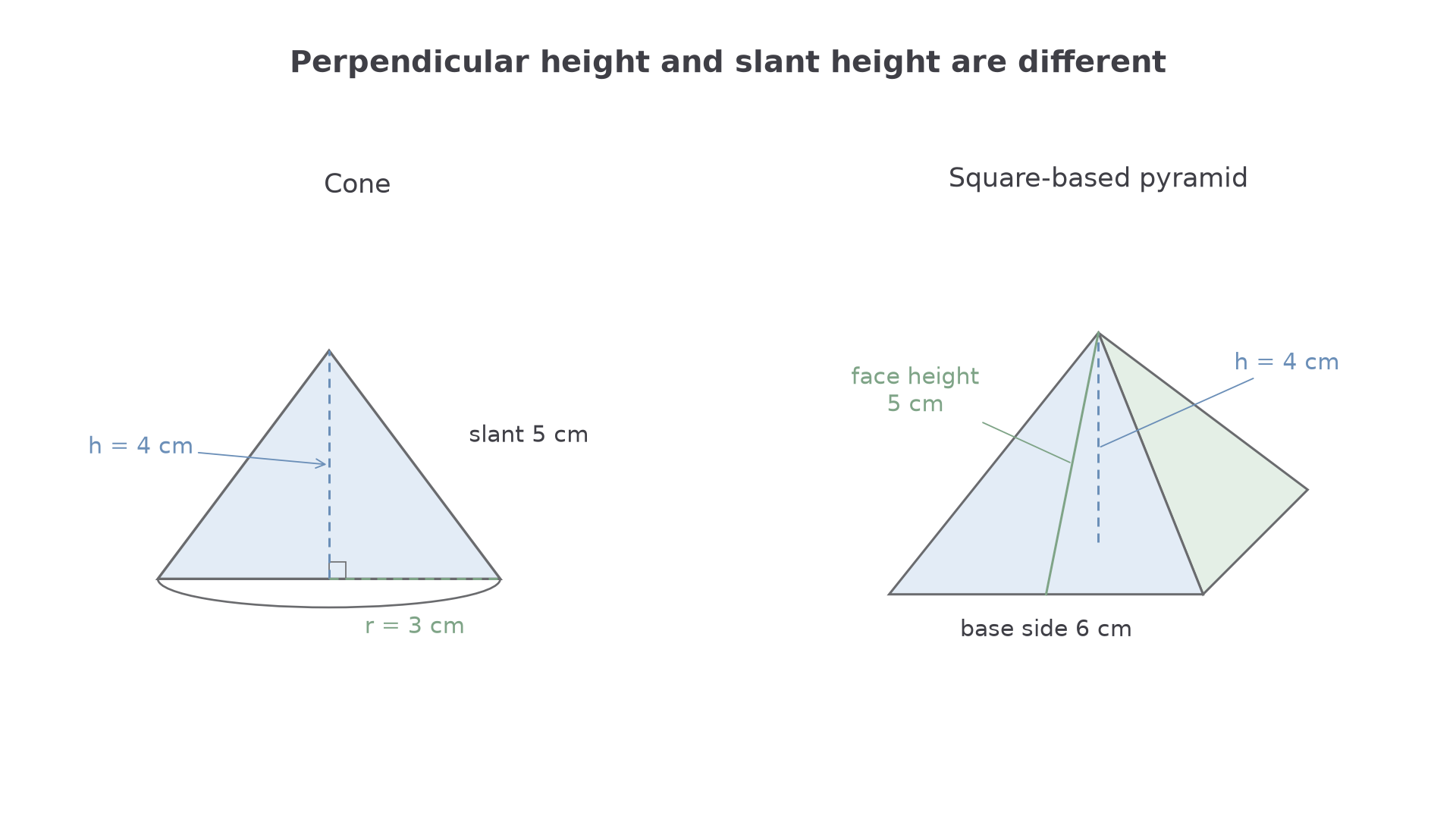
For a cone, perpendicular height is the distance from the apex to the base plane; slant height runs from the apex along the curved surface to the base rim. On a pyramid, each triangular face has its own perpendicular height measured within that face. This face height is different from the pyramid's height above the base plane.
[DIAGRAM: asset_name: Perpendicular and slant heights; asset_slug: solid-heights; caption: Use the height above the base for volume and the height along a surface for its area.; description: A cone with radius 3 cm, perpendicular height 4 cm and slant height 5 cm; a square-based pyramid with side 6 cm, perpendicular height 4 cm and triangular-face slant height 5 cm. Dashed internal heights are distinguished from lengths along faces.]
Cones and spheres
These four formulae are supplied on the ordinary formula list. The cone's is perpendicular; its is slant height. A closed cone's total area also includes its circular base, . A hemisphere has half the sphere's curved area and volume; include its flat circular face if that face is exposed.
A pyramid has volume , with perpendicular height . This formula is not listed on the formula sheets. Its one-third factor accounts for the sections shrinking towards the apex; using the prism rule without the factor would count the full base area at every height. For surface area, add the base and each triangular face.
Worked example 4: a cone's two heights
Question. A closed cone has radius , perpendicular height and slant height . Find its volume and total surface area.
Plan. Use for volume and for curved area, then include the base.
Answer. Volume ; total area .
Check. A cylinder with the same base and perpendicular height has volume , three times the cone. The base contributes to the total area, leaving the calculated curved area.
Continue this lesson.
You’re previewing NovaLearn without an account. Create a free account to read the rest.
Create free account