HG22 - Sine and cosine rules
Find sides and angles in triangles which need not contain a right angle. The sine rule links opposite side–angle pairs; the cosine rule uses two sides and their included angle, or all three sides. This is Higher content.
Sine rule
A triangle has angles and , with side opposite . How can you find the side opposite without a right angle?
Label vertices and their opposite sides : , , . The letters are a pairing convention, not a requirement that is a hypotenuse. Only a right-angled triangle has a hypotenuse.
[DIAGRAM: asset_name: Opposite pairs and obtuse angles; asset_slug: general-triangle-pairs; caption: Match each side to the angle opposite it; reflected unit-circle points explain supplementary-angle signs.; description: An exact scalene triangle labelled A B C with opposite sides a b c, beside a unit semicircle showing 60 and 120 degree radii with equal positive heights and opposite horizontal coordinates.]
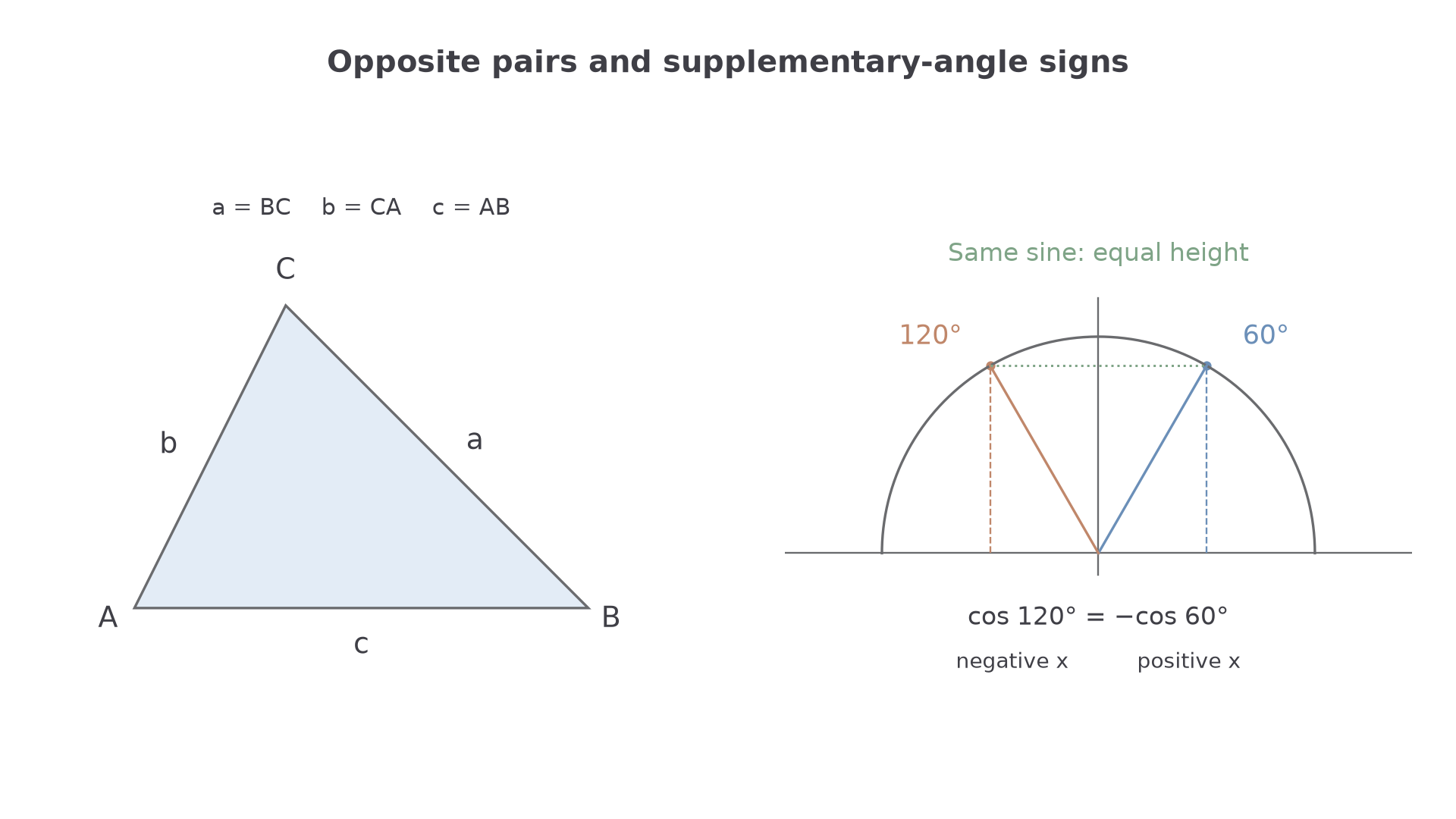
For an acute triangle, dropping a perpendicular from to gives the same height as and . Thus , which rearranges to . Repeating with another height brings in the third pair.
For angles between and , use the unit-circle interpretation: sine is the vertical coordinate, cosine the horizontal coordinate. Reflecting a radius across the vertical axis gives the supplementary angle . Its height is unchanged and its horizontal coordinate changes sign:
So a triangle's obtuse angle has positive sine and negative cosine. An outside altitude and the equal supplementary sines extend the sine rule to obtuse triangles too.
Sine rule
Use two opposite pairs, including one complete known pair. Angles are interior angles of a nondegenerate triangle: positive and summing to ; side lengths are positive. The rule is supplied on the current Higher additional formula sheet.
A complete opposite pair provides the common ratio; use it to calculate the missing member of a second pair.
Worked example 1: finding a side
Question. In triangle , , , and . Find to significant figures.
Plan. Pair with , and with , then isolate .
Answer. to significant figures.
Check. The remaining angle is . Its side is . The ordering matches , and the two shorter sides sum to more than the longest.
Change to finding an angle. Inverse sine returns the acute candidate; an obtuse supplement may need checking, as the third part explains.
Worked example 2: finding a specified acute angle
Question. , , , and is acute. Find to decimal place.
Plan. Isolate , then use inverse sine in degree mode.
Answer. .
Check. requires , which holds. The alternative would already give , so it cannot form this triangle even without the stated acute condition.
The side ordering and angle sum give geometric checks on an inverse-sine result.
Watch out
Do not pair adjacent sides and angles. Write the opposite pairings before substituting, and use the unrounded sine value inside inverse sine.
Use a fresh complete pair.
Cosine rule
If no complete opposite pair is known, the sine rule may not start the problem. SAS means two sides and their included angle; SSS means all three sides. The cosine rule handles both.
The included angle lies between the two known sides. In , is between and , and lies opposite . You may relabel the formula to fit any vertex.
Cosine rule: side or angle
Take the positive square root for a length. Use inverse cosine for an angle in . The side formula is supplied on the Higher additional sheet; the angle form is its rearrangement.
The correction term explains the link to Pythagoras. At , cosine is zero. For an acute included angle, subtract a positive quantity; for an obtuse angle, its cosine is negative, so the correction increases the opposite side's square.
Worked example 3: SAS to a side
Question. Two sides are and , with included angle . Find the third side to significant figures.
Plan. Put the unknown side opposite the known included angle.
Answer. to significant figures.
Check. Place the side horizontally. The side projects along it and upwards. Pythagoras gives .
Continue this lesson.
You’re previewing NovaLearn without an account. Create a free account to read the rest.
Create free account