FG18, HG20 - Right-angled trigonometry
Use an acute angle and a side ratio to solve a right-angled triangle. FG18 and HG20 define sine, cosine and tangent and apply them to missing lengths and angles in two dimensions. You will label sides relative to the chosen angle, choose a suitable ratio and use a calculator in degree mode.
Trigonometric ratios
From a point on level ground horizontally from a vertical wall, the line to the top makes angle above the ground. How could you find the wall's height without climbing it? The angle fixes the ratio between the height and the horizontal distance.
First locate the right angle and the acute angle you are using, labelled . The hypotenuse is opposite the right angle. The opposite side is across from and does not touch it. The adjacent side meets and is not the hypotenuse.
[DIAGRAM: asset_name: Sides relative to an acute angle; asset_slug: trig-side-roles; caption: Changing the chosen acute angle swaps opposite and adjacent; the hypotenuse stays fixed.; description: Two exact copies of a right triangle ABC with right angle B, AB 8 cm, BC 6 cm and AC 10 cm. Left selects angle A: BC opposite, AB adjacent. Right selects angle C: AB opposite, BC adjacent. AC is the hypotenuse in both.]
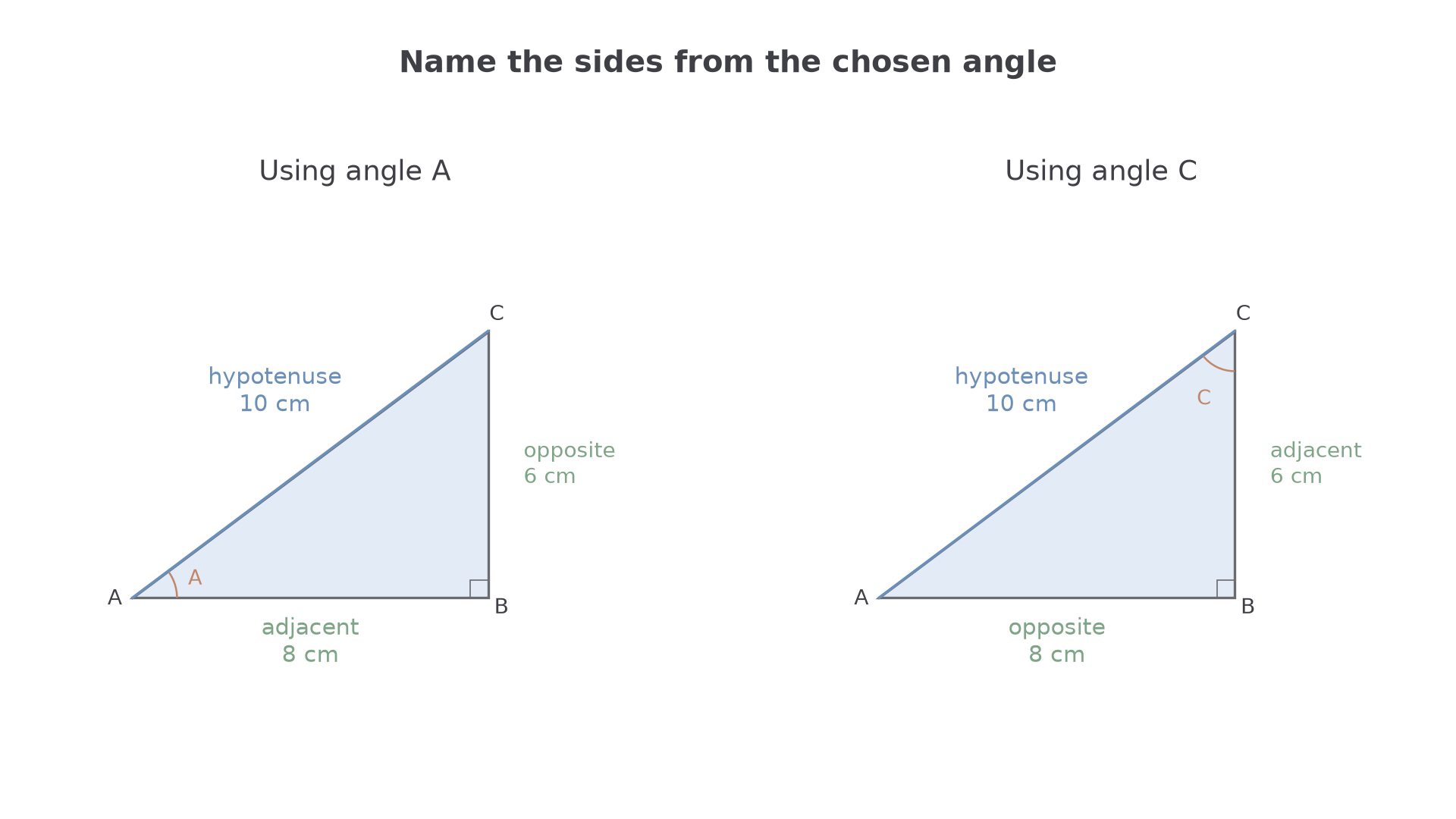
Right triangles with the same acute angle are similar: enlarging one multiplies all three lengths by the same factor. Their side ratios therefore stay unchanged. Sine, cosine and tangent name three of those ratios.
Right-angle trigonometric ratios
For an acute angle in a right-angled triangle,
The ratios have no units. “SOH, CAH, TOA” recalls the three pairs. The ratios are supplied on the additional formulae sheet.
Choose the ratio using the two sides relevant to the problem. Label those sides from the chosen angle before using a mnemonic.
Worked example 1: ratios from one angle
Question. Triangle is right-angled at , with , , . Find .
Plan. Relative to , identify opposite , adjacent , and hypotenuse .
Answer. , respectively.
Check. Halving every length gives ; the ratios are unchanged, as similarity predicts.
Keep the triangle but choose its other acute angle.
Worked example 2: the side roles change
Question. For the same triangle, find .
Plan. Keep as hypotenuse, but relabel the shorter sides relative to .
Now is opposite , while is adjacent.
Answer. , respectively.
Check. The opposite and adjacent roles swapped, so the sine/cosine results swapped and the tangent ratio became the reciprocal. The hypotenuse remained .
An adjacent side is not simply any side touching the chosen angle: the hypotenuse touches it too, but is excluded.
For acute angles, sine and cosine are positive and less than , because their denominators are the longest side. Tangent can exceed , as shows.
Watch out
“Opposite” is relative to the acute angle being used. A fixed vertical side is not always opposite; changing the angle can make it adjacent.
Label a fresh triangle from its named angle.
Finding lengths
Use the known side and unknown side to choose the ratio. A calculator evaluates the sine, cosine or tangent of the given angle; set it to degrees first.
| Relevant sides | Ratio |
|---|---|
| Opposite and hypotenuse | Sine |
| Adjacent and hypotenuse | Cosine |
| Opposite and adjacent | Tangent |
Write the ratio equation before rearranging. If the unknown is on top, multiply by the known denominator. If the unknown is the denominator, multiply both sides by it, then divide by the trigonometric value. Keep full calculator precision until the final answer.
Worked example 3: opposite from adjacent
Question. In the opening wall problem, the horizontal distance is and the angle above the horizontal is . Find the wall height to three significant figures, assuming the sightline starts at ground level.
Plan. Height is opposite and horizontal distance adjacent, so use tangent.
Answer. to three significant figures.
Check. The height-to-distance ratio is about , agreeing with . Since , the opposite side is shorter than the adjacent side, consistent with .
Now the known side is the hypotenuse and the required side is adjacent.
Continue this lesson.
You’re previewing NovaLearn without an account. Create a free account to read the rest.
Create free account