FG14–FG15, HG16–HG17 - Perimeter and polygon areas
Measure the distance around a shape and the space it covers. FG14 and HG16 supply area methods for rectangles, triangles, parallelograms and trapezia; FG15 and HG17 extend these to perimeters and composite figures. You will choose useful lengths, explain the formulae and keep length units separate from area units.
Perimeters
A rectangle is wide and high. A by rectangle is cut from its top-right corner. Does removing that corner make the perimeter smaller?
Perimeter
The perimeter is the total length of a shape's boundary. Trace around the outside once and include every boundary edge. Perimeter is measured in length units, such as centimetres.
Opposite sides of a rectangle are equal. For rectilinear figures, horizontal lengths can be added or subtracted to find other horizontal lengths; do the same separately for vertical lengths. A line used to split the interior is not part of the outer boundary.
Worked example 1: a rectangle
Question. Find the perimeter of a rectangle of width and height .
Plan. Add two widths and two heights.
Answer. .
Check. Grouping equal sides gives .
Keep the outer dimensions, but remove the stated corner. The boundary now has six edges.
[DIAGRAM: asset_name: Perimeter of a corner-cut rectangle; asset_slug: corner-cut-rectangle; caption: Match horizontal lengths with horizontal lengths and vertical lengths with vertical lengths.; description: Exact L-shaped polygon from a 12 cm by 9 cm rectangle with a 5 cm wide, 4 cm deep top-right corner removed. Boundary labels show bottom 12 cm, left 9 cm, top 7 cm and lower right 5 cm; the two notch edges are 5 cm and 4 cm.]
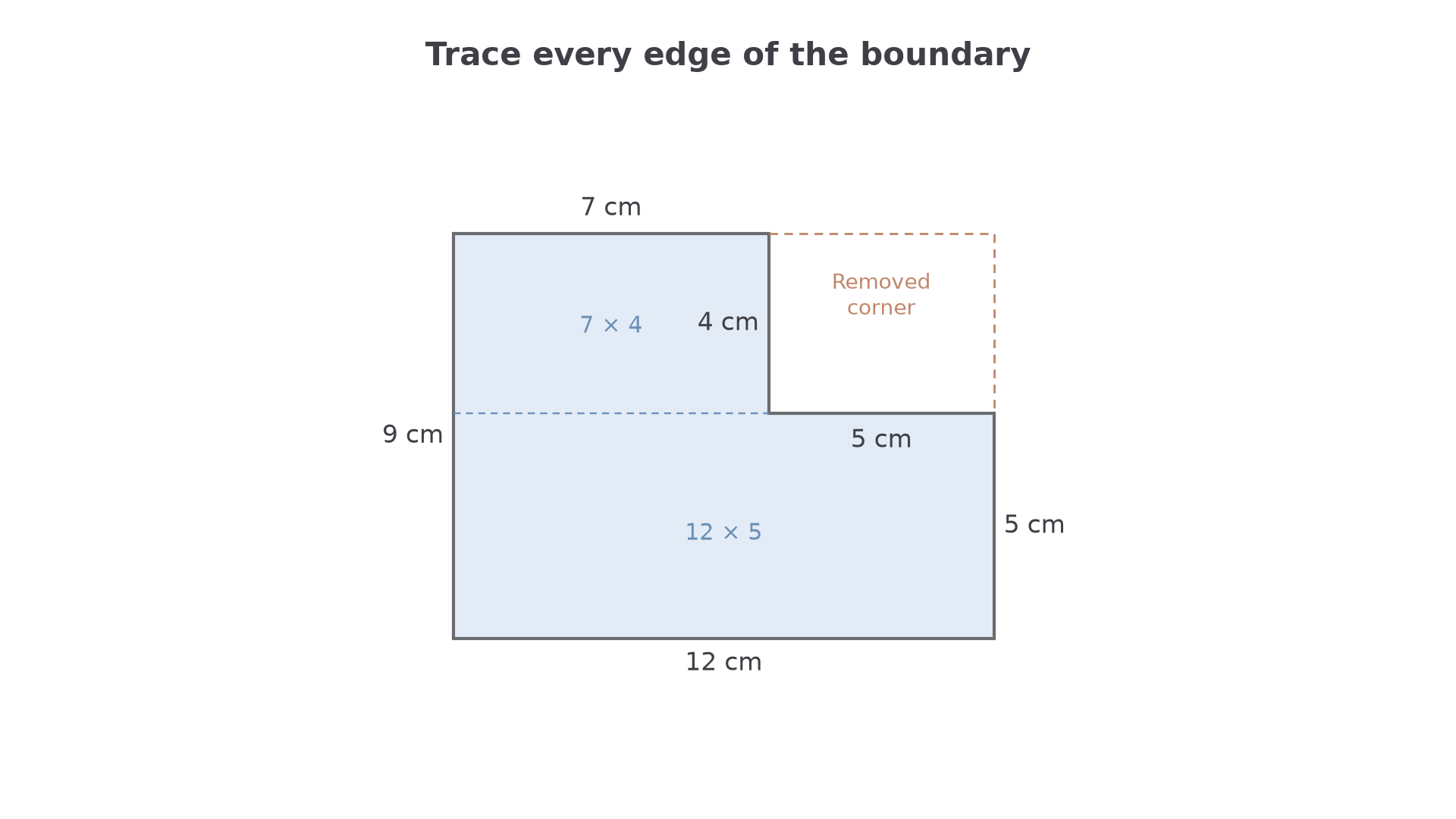
Worked example 2: a stepped boundary
Question. Find the perimeter after the by corner is removed.
Plan. Find the shortened outer edges, then walk around all six edges.
Answer. , unchanged from the rectangle.
Check. Cutting removed from the original outer edges, but introduced notch edges of the same lengths. The boundary length is unchanged.
This conclusion applies to this rectangular corner cut. A hole or a curved cut can change the boundary differently; trace the actual edges rather than assume that removing material always reduces perimeter.
Watch out
Adding only misses the two notch edges. Every exposed boundary edge counts, including an edge that turns into an indentation.
Try a new corner cut.
Area formulae
Area counts how many unit squares cover a flat region, so it uses squared units. A by rectangle contains three rows of four unit squares: .
A perpendicular height is measured at right angles to the chosen base. It is the separation between parallel lines containing the base and the opposite edge or vertex. A sloping side is usually a different length.
[DIAGRAM: asset_name: Polygon bases and perpendicular heights; asset_slug: polygon-area-heights; caption: The height meets the base direction at a right angle; a sloping side is not the height.; description: Four exact labelled panels show rectangle length and width, triangle base and perpendicular height, parallelogram base and perpendicular separation, and trapezium parallel sides a and b with perpendicular height h. Right-angle markers distinguish heights from sloping edges.]
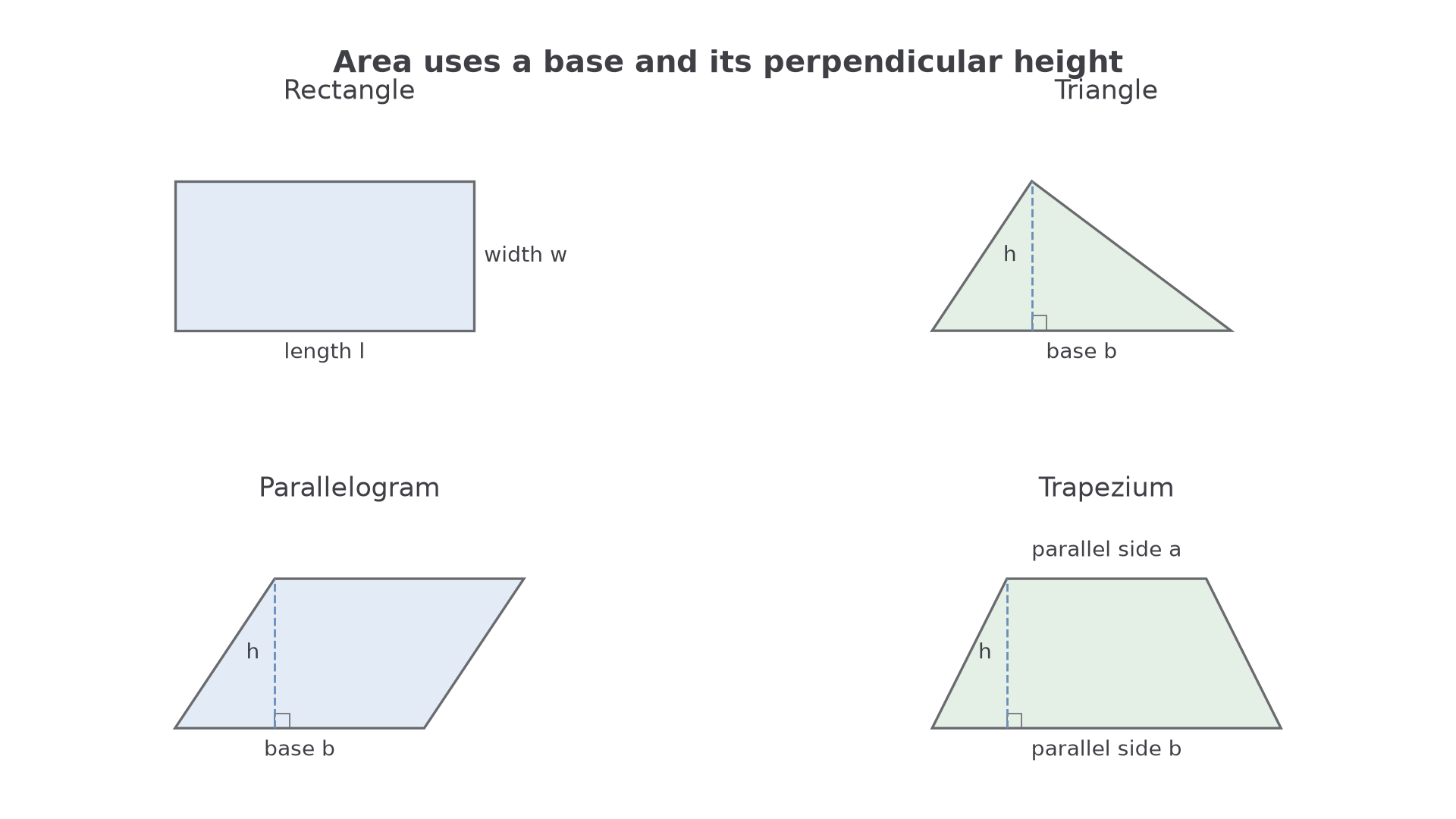
Cutting a triangle from one end of a parallelogram and moving it to the other makes a rectangle of the same base and height, so its area is . Two identical triangles can make a parallelogram, so one triangle has half that area. Two identical trapezia can make a parallelogram with base and height , giving half of for each trapezium.
Polygon areas
For the last three formulae, is perpendicular to the base. In a trapezium, are the parallel side lengths. Use one length unit throughout. The trapezium formula is supplied on the additional formulae sheet; the rectangle, triangle and parallelogram formulae are not listed there.
Continue this lesson.
You’re previewing NovaLearn without an account. Create a free account to read the rest.
Create free account