FN2–FN3, HN2–HN3 - Calculating with integers
Calculate accurately with positive and negative integers, including using written methods. You will use place value to explain carrying and exchanging, choose what a remainder means, and check an answer by reversing the operation.
Written addition and subtraction
How can you tell whether a long calculation is correct without doing exactly the same work again? Addition and subtraction undo each other, so they can check each other.
You already know that a digit's value depends on its column. In a written calculation, put ones beneath ones, tens beneath tens, and so on. Work from the right because a column can send an extra ten into the next column.
Inverse operations
Inverse operations undo each other. Addition and subtraction are an inverse pair: if , then . Multiplication and division are another inverse pair, provided you do not divide by zero.
When a column totals at least ten, exchange ten of its units for one unit in the column to the left. For subtraction, an exchange goes the other way: one hundred becomes ten tens, for example. The total value stays the same.
Worked example 1: adding with carrying
Question. Work out .
Plan. Align the place values and add each column, carrying any extra ten.
- Ones: . Write ones and carry ten.
- Tens: . Write tens and carry hundred.
- Hundreds: . Write hundreds and carry thousand.
- Thousands: .
Answer. .
Check. Subtract the second amount: , which recovers the first amount.
Now change the operation. A zero in a subtraction column may mean exchanging through more than one column.
Worked example 2: subtracting across zeros
Question. Work out .
Plan. Exchange place-value units until each subtraction column has enough.
To obtain that exchange, turn one thousand into ten hundreds, one of those hundreds into ten tens, and one of those tens into ten ones. The columns are now:
The separate column differences are , , , and .
Answer. .
Check. . The answer and the amount removed rebuild the starting amount.
Exchanging changes the way a number is written, not its value.
Watch out
Do not subtract the smaller digit from the larger digit in each column. That would give , which fails the addition check. Keep the top number minus the bottom number, exchanging when necessary.
Use the inverse operation to check a fresh subtraction.
Written multiplication and division
Written multiplication splits a number into place-value parts; written division rebuilds the dividend in groups of the divisor.
For , the in means , so its partial product is ten times . This is why the second row starts in the tens column.
Worked example 3: multiplying by a two-digit integer
Question. Work out .
Plan. Multiply by and by , then add the two partial products.
In the first row, : write , carry ; : write , carry ; . The second row is .
Answer. .
Check. Split the other factor instead: .
Division asks how many groups fit. Use multiplication facts to select each quotient digit, subtract the groups used, and bring down the next digit. The leftover amount must be smaller than the divisor.
Quotient and remainder
The quotient gives the number of complete groups. The remainder is what is left. For positive whole-number division,
where the remainder is at least zero and less than the divisor.
The next calculation uses division instead of multiplication. Its remainder also requires a decision about the context.
Worked example 4: division with a remainder
Question. A club takes people to an event. Each coach holds people. Work out the minimum number of coaches needed.
Plan. Divide by , then decide whether the leftover people need another coach.
The is the tens digit of the quotient because the first working used the tens in . Thus remainder . After coaches, three people still need seats.
Answer. coaches.
Check. , which is too few seats; , which is enough.
Context decides what to do with a remainder. If the same numbers describe sweets packed into full boxes of , there are full boxes and loose sweets. If an amount can be shared into fractional pieces, the remainder may instead become part of a group.
Watch out
remainder does not mean . The leftover amount is out of another group of , not three tenths of a group.
Decide how many vehicles a new journey needs.
Calculating with negatives
For signed integers, decide what the signs mean before calculating with their sizes.
Adding a positive number moves right on a number line; adding a negative number moves left. Subtracting reverses the corresponding addition. In particular, subtracting a negative moves right: removing a loss increases the total.
[DIAGRAM: asset_name: Adding and subtracting a negative; asset_slug: negative-integer-moves; caption: Adding negative four moves left; subtracting negative four reverses that move.; description: Two number lines from minus twelve to zero start at minus seven. The top has an arrow left to minus eleven for minus seven plus negative four; the lower has an arrow right to minus three for minus seven minus negative four.]
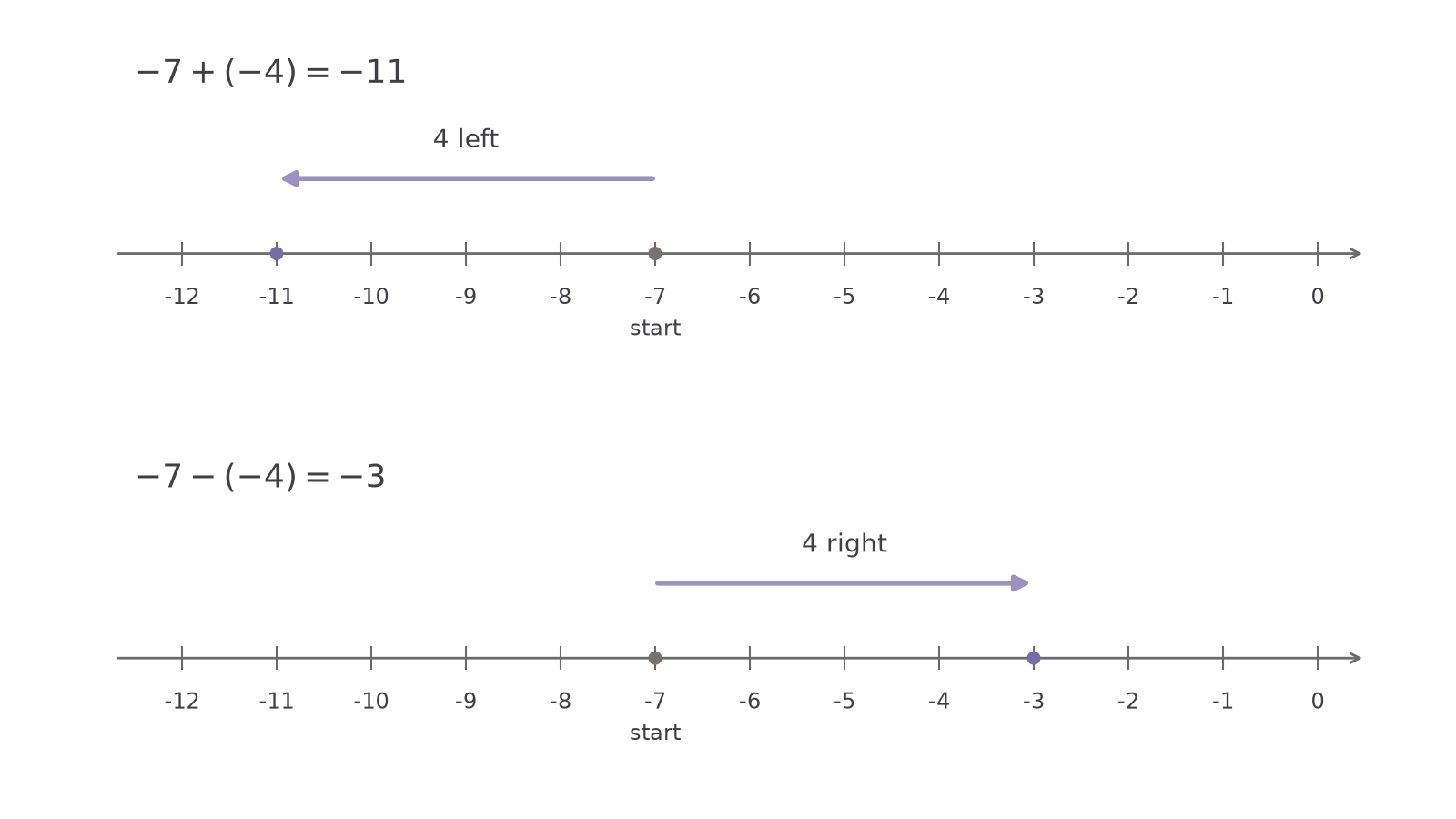
Worked example 5: addition and subtraction with signs
Question. Work out (a) and (b) .
Plan. Start at ; use the operation to choose the direction of the move.
Answer. (a) ; (b) .
Check. Reverse each operation: and . Both return to the starting value.
For addition with different signs, the moves oppose each other: , because moving right from passes zero by . For subtraction of a positive, move left: . “Two negatives make a positive” is therefore not a rule for every calculation containing two minus signs.
For multiplication, one negative factor makes the product negative. Two negative factors give a positive product. You can see why by keeping the steps consistent:
Each time the second factor decreases by one, the product increases by . The pattern continues through zero. Division must obey the same signs because it reverses multiplication: because .
The second example changes from adding or subtracting signed amounts to multiplying or dividing them.
Worked example 6: multiplication and division with signs
Question. Work out (a) , (b) , and (c) .
Plan. Calculate the positive-number fact first, then choose the sign for multiplication or division.
Answer. (a) ; (b) ; (c) .
Check. For (a), seven lots of total . For (b), . For (c), .
Zero has no positive or negative sign: and . Division by zero is undefined: no number multiplied by zero can give , and would not select a unique answer.
Watch out
, not . Matching signs give a positive result for multiplication and division; addition combines the signed amounts. Always identify the operation first.
The opening question now has a practical answer: use an inverse operation. With negative numbers as well as positive ones, a proposed quotient should multiply back to the dividend.
Quick Recap
- Align place values; carrying and exchanging preserve the total value.
- Multiply by each place-value part, and interpret a division remainder in its context.
- Adding a negative moves left; subtracting a negative reverses that move.
- Matching signs give positive products and quotients; different signs give negative ones.
To check a calculation without repeating it, use the inverse operation and recover the starting value.