FN2–FN3, FN8, FN12, HN2–HN3, HN8, HN12 - Multiplying and dividing fractions
Can multiplying make a number smaller, and dividing make it larger? Learn to use fractions as operators, multiply signed fractions and mixed numbers, and explain division using reciprocals. This develops FN12 and HN12 on fraction operators, with the fraction operations, cancellation and exact calculation in FN2–FN3, FN8, HN2–HN3 and HN8.
Fraction operators
A fraction can tell you what to do to a quantity: divide it into equal shares, then take a specified number of those shares.
For example, to find of , split into five equal shares and take three. Each share is , so three shares total . Here “of” means multiply: .
Fraction operator
A fraction operator acts on a quantity by dividing by and multiplying by , where stands for its numerator and for its nonzero denominator. For a positive quantity, an operator between and gives a smaller result; an operator greater than gives a larger result.
You can divide then multiply, or multiply then divide: both give . Dividing first often keeps the working smaller. Keep the unit: a fraction of a length is still a length.
Worked example 1: taking less than the whole
Question. Find of .
Plan. Find one fifth of the length, then take three fifths.
Answer. .
Check. , so the answer is the requested fraction of the starting length.
Change only the numerator of the operator. Seven fifths requires more than the original five fifths, so it will exceed the starting length.
Worked example 2: taking more than the whole
Question. Find of .
Plan. Use the same fifth-sized share, but take seven shares.
Answer. .
Check. , so the result is one whole length plus two fifths: .
The operator leaves a quantity unchanged; the operator gives zero. A fraction operator can also give a non-integer result: of is . Do not round an exact fraction just to make the calculation look like a decimal calculation.
Watch out
Finding of means , not . The denominator gives the number of equal shares; the numerator gives how many shares to take.
Apply an improper fraction operator to a new quantity.
Multiplying fractions
Taking a fraction of another fraction uses the same operator idea: subdivide the selected amount again.
In the rectangle below, three of four equal columns make of the whole. Taking two of three equal rows of that selected region picks out six of the twelve equal cells. Therefore of is .
[DIAGRAM: asset_name: A fraction of a fraction; asset_slug: fraction-of-fraction-grid; caption: Two thirds of three quarters selects six of twelve equal cells.; description: A rectangle is split into four columns and three rows. The first three columns are selected in pale blue, with their lower two rows highlighted in lavender. The six lavender cells occupy one half of the twelve-cell whole.]
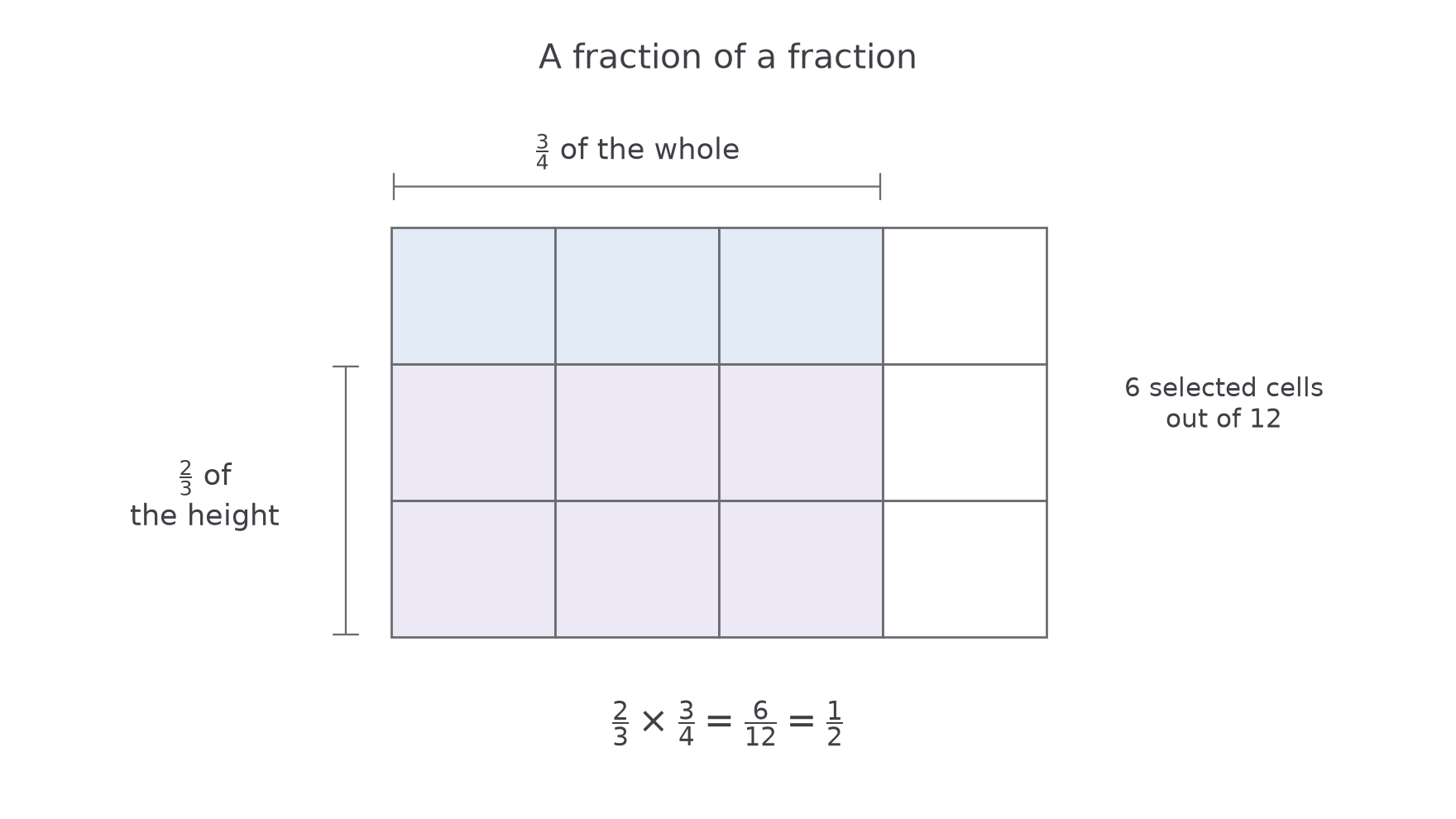
The denominators multiply because each of the original pieces is subdivided again. The numerators multiply because you take that many of the new pieces. In this general rule, and stand for the two numerators, and and for their denominators:
Cancellation divides a numerator and a denominator of the product by the same nonzero common factor. It simplifies the product without changing its value. You may cancel before multiplying; common denominators are unnecessary for multiplication.
For signs, use the integer rule: one negative factor gives a negative product; two negative factors give a positive product. Convert mixed numbers to improper fractions first. In particular, , because the minus sign applies to the entire mixed number.
Worked example 3: a signed product
Question. Work out . Give your answer in its simplest form.
Plan. Keep the negative sign, cancel the factor between the numerator and denominator, then multiply.
Answer. .
Check. Five equal copies of the answer make . Five copies of the original product are two copies of , also .
Now replace the first proper fraction by a mixed number. The cancellation is similar, but convert the whole mixed number before multiplying.
Worked example 4: a negative mixed number
Question. Work out . Give your answer in its simplest form.
Plan. Write the mixed number as , then cancel and multiply.
Answer. .
Check. Since , the answer's magnitude must be less than half of , which is . Indeed, ; its negative sign also agrees with the one negative factor.
Two negative signs cancel as signs, not as numerical factors. For example, . A zero factor always makes the product zero.
Watch out
Cancel factors in a product, not terms joined by addition. In , the and share a factor. You cannot cross out the and merely because they sit in the same fraction.
Convert the negative mixed number before choosing a cancellation.
Dividing fractions
Division asks how many groups of one size fit into another amount. For example, , because two quarters fit into one half. A small group size can produce a larger number of groups.
To undo multiplication by a nonzero number, multiply by a number that makes its product .
Reciprocal
The reciprocal of a nonzero number is divided by that number. A number multiplied by its reciprocal gives . For , with and , the reciprocal is . The reciprocal of is , and the reciprocal of is .
Suppose a division asks for the number which, multiplied by , gives . Multiplying by undoes that factor. This explains the rule
Only the divisor, the number after the division sign, is replaced by its reciprocal. Convert any mixed numbers before applying the rule.
Worked example 5: dividing by a proper fraction
Question. Work out .
Plan. Convert the mixed number, then multiply by the reciprocal of .
Answer. .
Check. Two groups of contain , the original amount.
Change only the sign of the divisor. The quotient changes sign, while its magnitude stays the same.
Worked example 6: a negative divisor
Question. Work out .
Plan. Use the reciprocal , keeping its negative sign.
Answer. .
Check. . Multiplying quotient by divisor recovers the dividend.
Zero has no reciprocal: is , never . Division by zero is undefined. But , because . Check that the divisor is nonzero before using a reciprocal.
Watch out
A reciprocal is not the same as changing a sign. The reciprocal of is , not . Check by multiplication: a reciprocal gives product .
The opening question has two “yes” answers. Multiplying a positive number by a fraction between and makes it smaller. Dividing it by such a fraction makes it larger, because the reciprocal is greater than .
Quick Recap
- A fraction operator divides into shares, then selects the numerator's number of shares.
- For multiplication, multiply numerators and denominators; cancel common factors first when helpful.
- Convert mixed numbers before multiplying or dividing, and apply signed-number rules.
- Divide by a nonzero fraction by multiplying by its reciprocal. Division by zero is undefined.