FG21, HG25 - Calculating with vectors
Learn to represent directed movements with arrows and column vectors, combine routes, and multiply vectors by numbers. This develops the addition, subtraction, scalar and representation skills shared by FG21 and HG25.
Vector representations
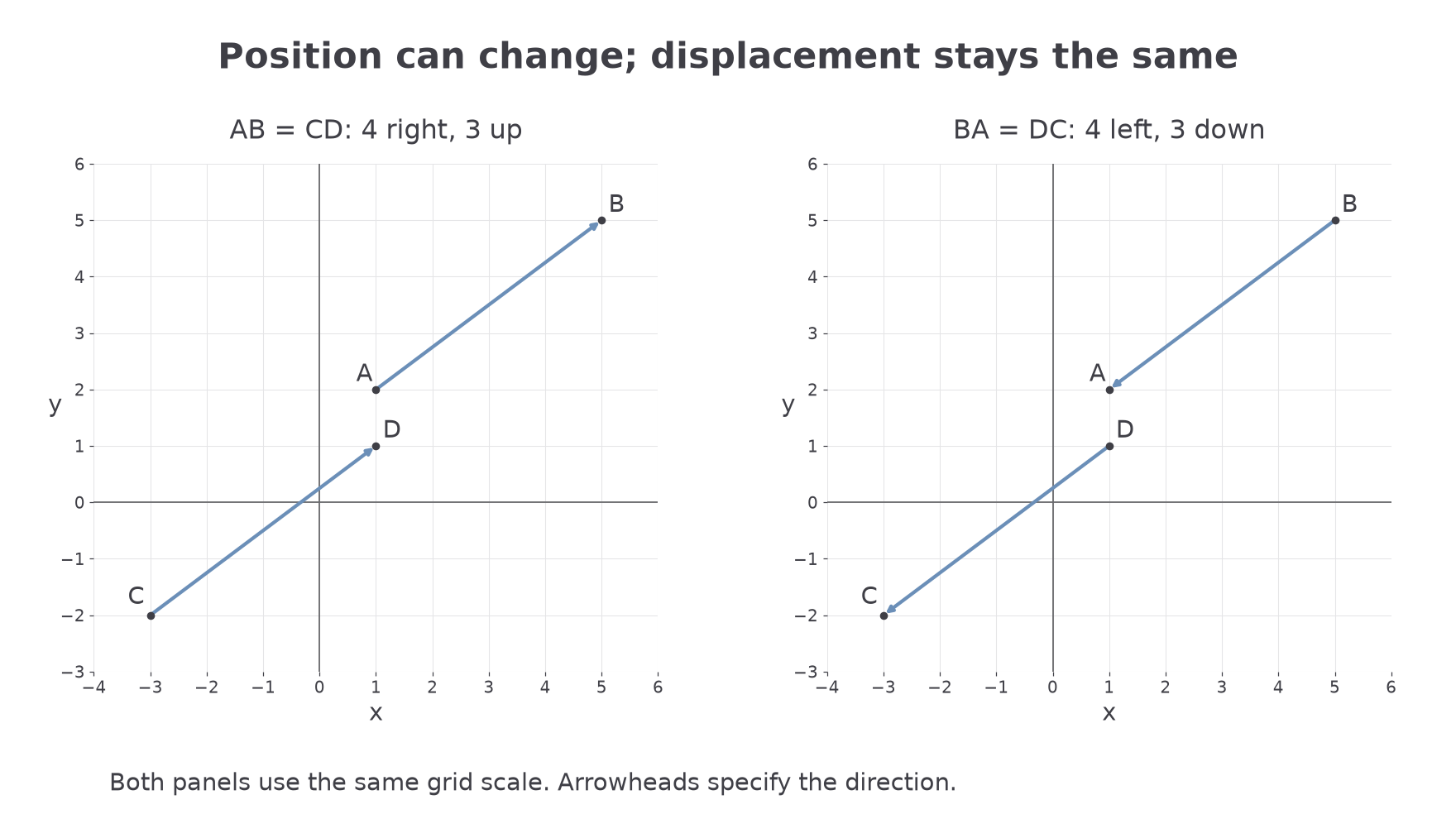
Can two arrows in different places represent the same vector? Yes: what matters is their displacement, not their starting position. Reversing an arrow, however, changes the vector.
Vector
A non-zero vector has magnitude (length) and direction. An arrow represents its directed displacement. The column vector records horizontal and vertical components: right/up are positive, left/down negative. The vector starts at and ends at .
Two arrows represent equal vectors when they have the same length and direction, even if they begin at different points. Bold letters such as can name vectors. A point is a position; a vector describes a change of position.
To find , subtract start coordinates from end coordinates, keeping the order the same in both components.
Worked example 1: from start to finish
Question. Given , , find .
Plan. Find the horizontal and vertical changes from to .
Answer. : four right and three up.
Check. Starting at and adding gives , the stated endpoint.
Keep the endpoints but reverse the arrow. Both components change sign.
Worked example 2: reversing direction
Question. Find for the same points.
Plan. Subtract the coordinates of the new start from the new end .
Answer. : four left and three down.
Check. has zero horizontal and vertical change: travelling out and directly back returns to the start.
An equal arrow can be placed elsewhere without changing the vector. In the diagram, to also moves four right and three up.
[DIAGRAM: asset_name: Equal vectors and reversed arrows; asset_slug: vector-directions; caption: Equal displacements can start at different points; reversing them changes both signs.; description: Two coordinate panels show AB from (1,2) to (5,5) and CD from (-3,-2) to (1,1), both (4,3), then their reversed arrows BA and DC, both (-4,-3).]
Watch out
and have equal lengths but opposite directions. End minus start is for , not .
Keep the directed order explicit for a fresh pair of points.
Adding and subtracting
Vector addition combines consecutive movements. Put the tail of the second arrow at the head of the first; the resultant arrow runs from the original start to the final endpoint.
Horizontal movements combine with horizontal movements, and vertical movements with vertical movements. This gives component addition. Subtracting means adding its opposite, , reversing both of its components.
Worked example 3: a head-to-tail sum
Question. Let , . Find .
Plan. Combine the horizontal changes and then the vertical changes.
Answer. .
Check. From the origin, reaches . Following from there reaches , matching the resultant.
Keep the same vectors and change addition to subtraction. Reverse the second movement before combining.
Worked example 4: subtracting a vector
Question. Find for the same vectors.
Plan. Add .
Answer. .
Check. Add back: , recovering the original vector.
The second route uses , so it points opposite to .
[DIAGRAM: asset_name: Adding a vector and its opposite; asset_slug: vector-routes; caption: Addition follows the second arrow; subtraction follows its reversed direction.; description: Exact grids show a=(3,1) followed by b=(-1,4), giving resultant (2,5), and a followed by -b=(1,-4), giving resultant (4,-3). Arrowheads show every route from its start to its endpoint.]
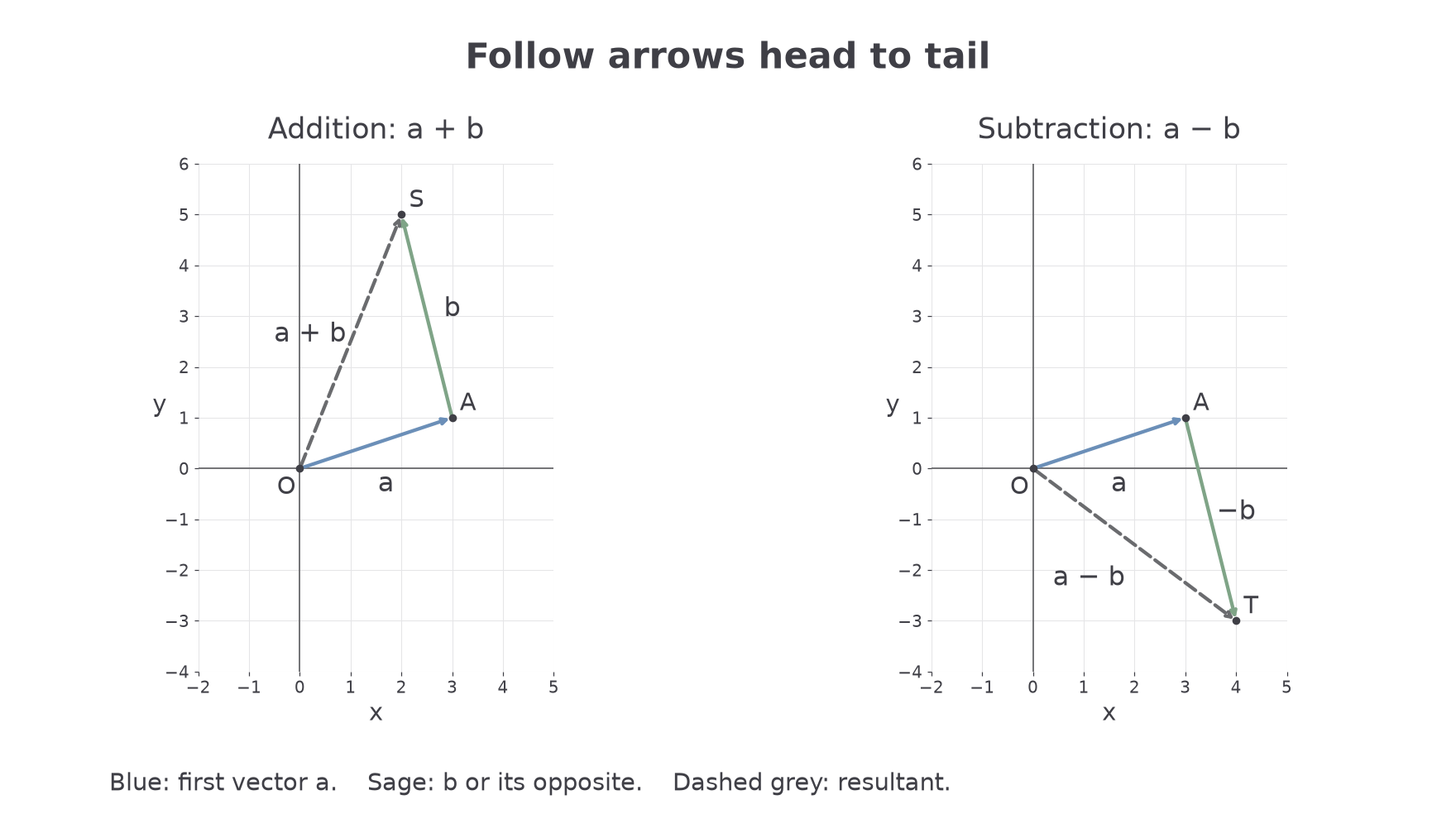
For named points, : the end of the first arrow is the start of the second. If and , travelling from to via gives . Reversing that route gives .
In named-vector expressions, means ; similarly, means four copies of added together.
Continue this lesson.
You’re previewing NovaLearn without an account. Create a free account to read the rest.
Create free account