HG10 - Angles in circles
Learn to prove and use angle theorems in a circle, then connect them in reasoned angle chains. HG10 requires the geometry that justifies an answer as well as its numerical value.
Centre and circumference
If you move a point along one arc of a circle, can the angle it makes with a fixed chord stay unchanged? The answer depends on which side of the chord the point stays.
A chord joins two points on a circle. An arc is a portion of its circumference. Two distinct endpoints divide the circumference into two arcs. For a third circle point , angle stands on the arc that does not contain . The corresponding central angle follows that same arc; it may be reflex.
Centre and circumference theorem
The angle at the centre is twice the angle at the circumference standing on the same arc:
Here is the centre and are distinct points on the circle. Choose the central angle belonging to the arc away from , rather than automatically choosing the smaller angle.
Why it is true. Join , and extend through to a second circle point . First suppose neither nor is . In isosceles triangle , let . Its other base angle is also , so the external angle is . Similarly, writing gives external angle .
If ray lies inside , add the two pieces: the circumference angle is and the central angle along the arc away from is . This central angle can be reflex. If lies outside, subtract the smaller piece from the larger at both vertices. Again the central angle is twice the circumference angle. If one arm or is the diameter , the one remaining isosceles triangle gives the result directly by its external angle.
The auxiliary diameter lets the same proof cover both positions of the centre.
[DIAGRAM: asset_name: Proving the centre theorem; asset_slug: centre-theorem-proof; caption: Equal radii make isosceles triangles; add or subtract their external angles.; description: Two exact unit-circle configurations join C through O to its opposite point D and join A and B to C and O. In the first, CO is inside angle ACB and external angles at O add; in the second CO lies outside angle ACB and the external angles subtract. All named points and radii are explicit.]
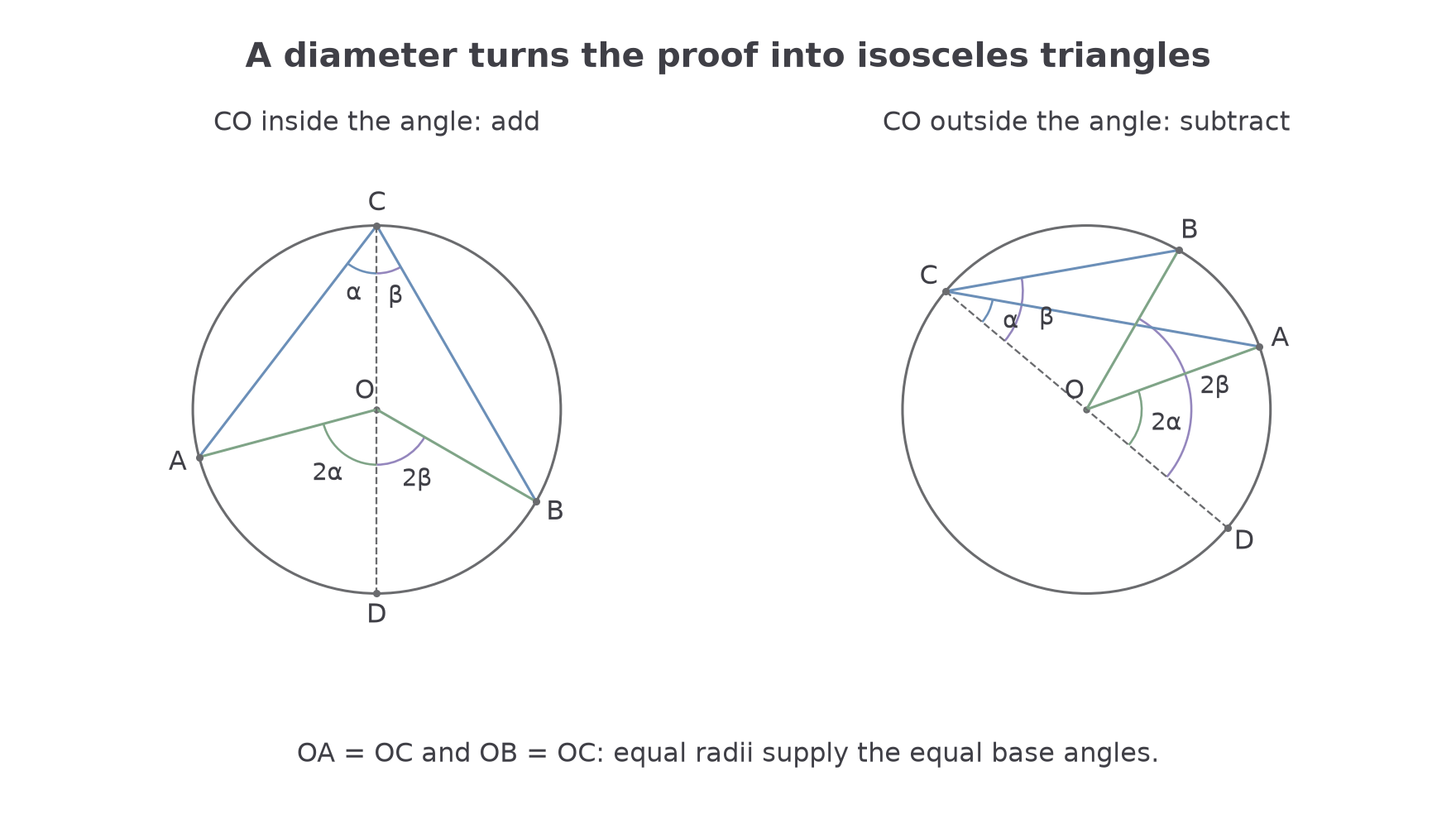
Angles in the same segment now follow. If and lie on the same arc between chord endpoints , both and are half the same central angle. Therefore they are equal. The vertices must lie on the same side of chord ; merely sharing the chord is insufficient.
Worked example 1: a non-reflex central angle
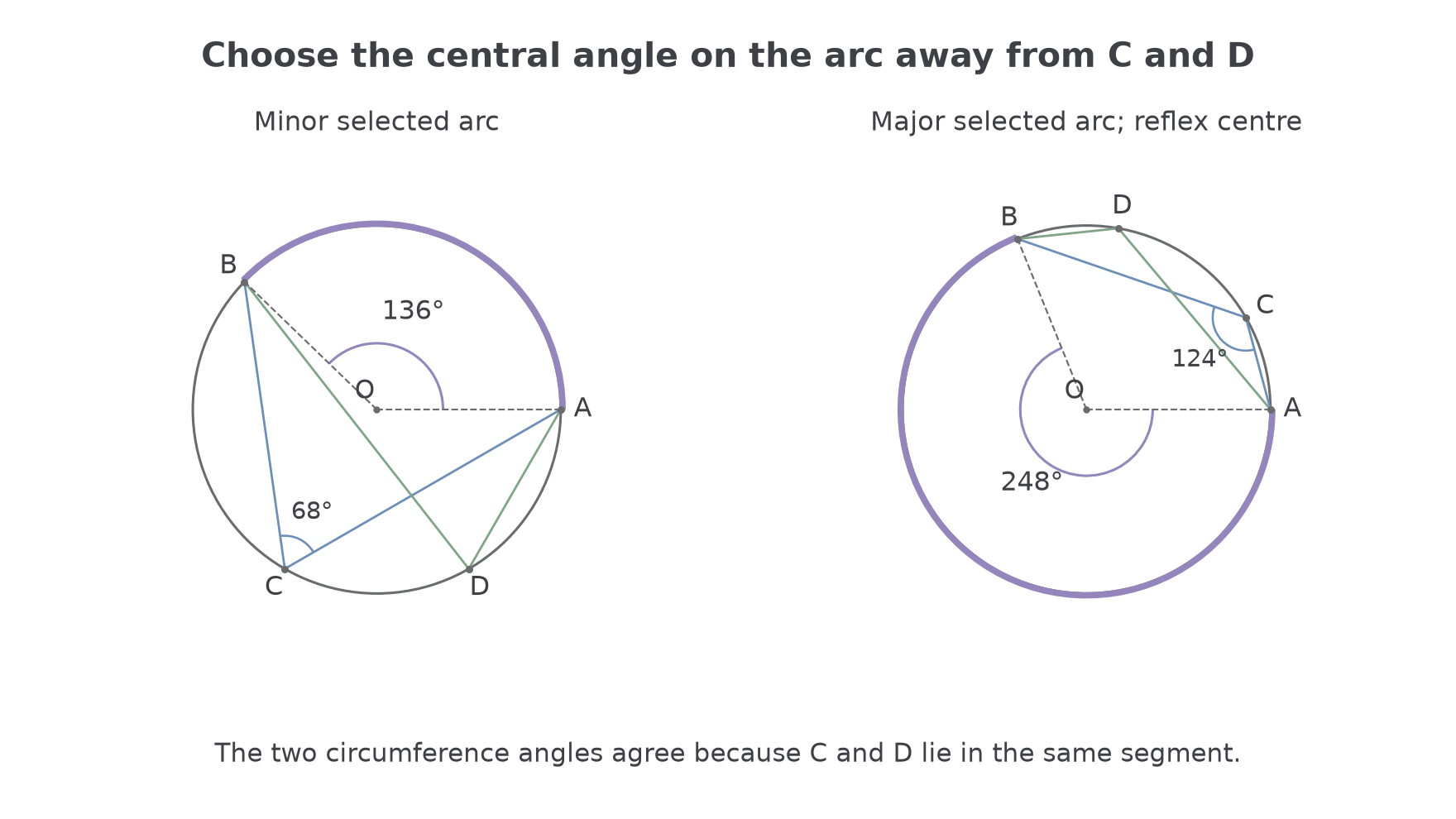
Question. is the centre. The minor central angle is . Points lie on the major arc . Find and .
Plan. Both circumference vertices are away from the minor arc, so use the given minor central angle, then the same-segment theorem.
Answer. Both angles are .
Check. Doubling either gives the selected . The alternative central angle belongs to the arc containing , so it is not the angle for these vertices.
Change the selected arc to a major arc and put both circumference vertices on the other, minor arc. The central angle is now reflex.
Worked example 2: a reflex central angle
Question. The reflex central angle is . Points lie on the minor arc . Find and .
Plan. The arc away from is the major arc, so halve the reflex angle.
Answer. Both angles are .
Check. Doubling gives , and an obtuse circumference angle is consistent with standing on a major arc. Halving the other central angle would give the angle for a vertex on the other side of the chord.
The point positions determine which central angle belongs to the theorem.
[DIAGRAM: asset_name: Minor and reflex central angles; asset_slug: selected-circle-arcs; caption: Both central and circumference angles must stand on the same selected arc.; description: Exact unit-circle panels show central angles136 and reflex248 with two circumference vertices on the opposite arc. Their corresponding inscribed angles are68 and124. The selected arc is highlighted, with centre O and all endpoint labels.]
Watch out
Do not halve a central number before checking the arc. Do not claim two angles are equal just because they stand on the same chord: check that their vertices lie in the same segment.
Use a fresh reflex angle.
Semicircles and cyclic quadrilaterals
Two useful results follow from the centre theorem. Their hypotheses are essential: a chord drawn almost through the centre is not a diameter, and an arbitrary quadrilateral is not cyclic.
Angle in a semicircle
If is a diameter and is any other point on the circle, then .
Proof. The central angle standing on either semicircular arc is . The circumference angle is half of it: . The right angle is at , opposite the diameter, not at an arbitrary circle point or at an endpoint of the diameter.
A cyclic quadrilateral has four distinct vertices on one circle, named in order around its circumference.
Opposite angles of a cyclic quadrilateral
For cyclic quadrilateral ,
Proof. Opposite vertices stand on the two complementary arcs with endpoints . Their corresponding central angles together make a full turn of . Each circumference angle is half its own central angle, so their sum is . Repeat for the other opposite pair. Consequently an exterior angle of a cyclic quadrilateral equals the opposite interior angle: both supplement the same interior angle.
Now combine a diameter, a triangle angle sum and a cyclic angle sum in one configuration.
Worked example 3: diameter and cyclic angles
Question. lie in that order around a circle. is a diameter, , and . Find , and .
Plan. Use the diameter for the first right angle; find the triangle angle and the whole angle at before using cyclic opposites.
Answer. , , .
Check. Triangle also has , hence . The whole angle at is , agreeing by a different route.
Continue this lesson.
You’re previewing NovaLearn without an account. Create a free account to read the rest.
Create free account