FA4, HA4 - Collecting terms and expanding brackets
Different expressions can describe exactly the same calculation. Learn to collect like terms, multiply a single term over brackets, and combine these methods while keeping every sign. These are the collecting and single-bracket skills in FA4 and HA4.
Collecting like terms
If one person writes for a length and another writes , can both be right? We will connect the two forms, starting with the terms we are allowed to combine.
Three bags containing counters each, together with two more identical bags, contain counters. This is addition of five copies of the same quantity. It is different from , where the extra two counters are loose: there are not five bags.
Like terms
Like terms have exactly the same variable part, including every power. Their coefficients can differ. Thus , and are like terms; , and are not like one another.
Collect like terms by adding their signed coefficients. Constants collect with constants. In , the second coefficient is , so . A missing coefficient is , and has coefficient .
Worked example 1: two groups of terms
Question. Simplify .
Plan. Group matching variable parts without losing their signs.
Answer. .
Check. At , , the original is , and the answer gives .
The rule is unchanged when the coefficients are fractions. Keep them exact and use a common denominator.
Worked example 2: fractional coefficients
Question. Simplify .
Plan. Collect the same two groups, adding fractional coefficients in the -group.
Answer. .
Check. At , , the original gives . The answer gives .
Powers remain part of the label you match. For instance, ; the -terms combine, but the -term stays separate.
Watch out
is wrong: addition of unlike terms does not create a product. At , both happen to give , so that single numerical check would miss the error. At , , the values are and .
Use a fresh pair of fractional coefficients.
Single brackets
Multiplying a bracket means multiplying every term inside it.
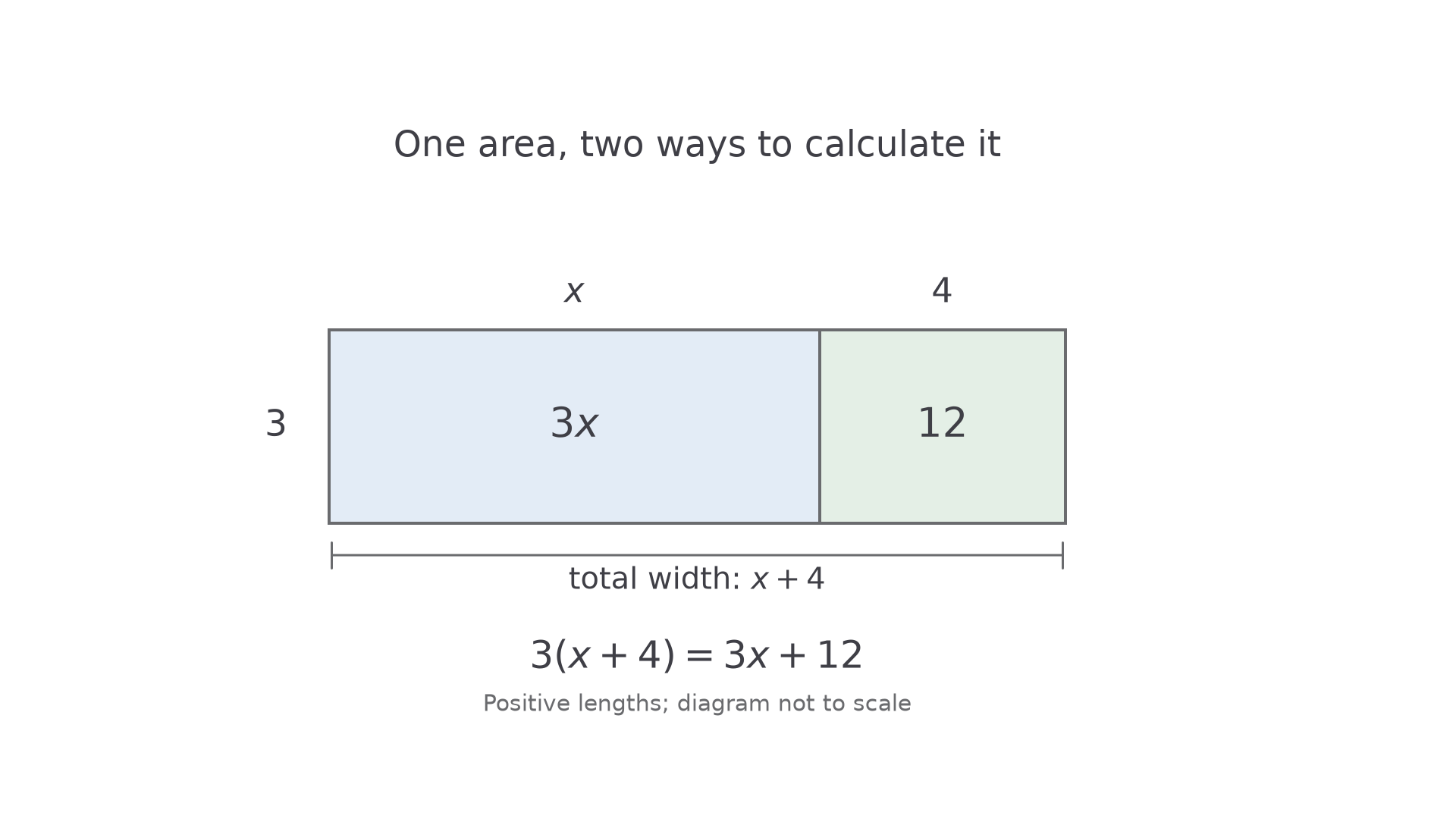
A rectangle with height and width has area . Split its width into and : the two areas are and . Adding those areas gives , the same total.
[DIAGRAM: asset_name: Splitting a product into two areas; asset_slug: distributing-area; caption: Splitting the width shows why both terms are multiplied by 3.; description: A rectangle of height 3 and total width x plus 4 is split into a blue region of width x and area 3x and a sage region of width 4 and area 12. Length x is positive in this area model.]
Expanding a bracket
To expand a bracket, distribute the outside multiplier to every term inside. For any numbers for which the expressions are defined,
The same distributive rule works with subtraction and negative numbers.
The rectangle explains the rule for positive lengths. The algebraic rule also works when a letter or multiplier is negative; negative numbers do not need to represent physical lengths.
Worked example 3: a positive multiplier
Question. Expand .
Plan. Multiply both the -term and the -term by .
Answer. .
Check. At , , and .
Now change only the outside sign. A negative times a negative is positive.
Worked example 4: a negative multiplier
Question. Expand .
Plan. Include the minus sign in the multiplier for both terms.
Answer. .
Check. At , the original is . The expanded form gives .
A lone minus sign before brackets means multiplication by : .
Watch out
misses the second sign change. Write before collecting anything.
Apply a negative multiplier to a new bracket.
Combined expressions
When an expression contains brackets and several terms, expand first and collect afterwards.
Keep each term's sign attached while expanding. In particular, the expression means : the multiplier of the whole bracket is .
Worked example 5: two positive multipliers
Question. Expand and simplify .
Plan. Expand each bracket, then collect the -terms and constants separately.
Answer. .
Check. At , the original gives . The answer gives .
Change the join between brackets from addition to subtraction. This changes the multiplier of the second bracket, including its constant.
Worked example 6: subtracting a bracket
Question. Expand and simplify .
Plan. Treat the second multiplier as , then collect.
Answer. .
Check. Use , so the second bracket is negative. The original gives . The answer gives .
A numerical check can catch an error but cannot establish equality for every value. Expansion and collection explain why the forms agree for every allowed . Avoid choosing a check value that makes the term you are checking disappear.
Exam tip
For “Expand and simplify”, finish both jobs. A correct line of expanded terms makes your method visible; your final expression must also collect the like terms.
The opening expressions and agree because multiplying the bracket produces exactly those two terms.
Quick Recap
- Collect terms only when their variable parts and powers match.
- Add signed coefficients; fraction coefficients stay exact.
- Multiply every term in a bracket by the signed outside multiplier.
- Expand first, collect second, then check at a useful numerical value.
Both expressions in the opening question are correct: .