HA22 - Quadratic and graphical inequalities
An equation may give just two boundary values. An inequality can ask for every value between them, outside them, or throughout a region. HA22 uses signs and graphs to identify the complete solution set, including whether its boundaries belong.
Quadratic intervals
For , finding the roots minus two and three is only a starting point. Which x-values make the expression negative?
A quadratic solution set
A quadratic inequality compares a quadratic expression with another value. Rearrange it with zero on one side. Its real roots divide the number line into intervals; determine the expression's sign on each interval, then include exactly those intervals that satisfy the inequality. Include a root for or , and exclude it for or .
Use a sign table or a quadratic sketch. For distinct roots, an upward-opening quadratic is negative between them and positive outside them. A downward-opening quadratic has the opposite signs. This follows from its factors or from where the curve lies below or above the x-axis; the roots alone do not specify the required intervals.
Worked example 1: negative between two roots
Question. Solve .
Plan. Factorise, find the boundaries, then test the signs in the three intervals.
so the roots are and .
| Interval | Sign of | Sign of | Product |
|---|---|---|---|
| negative | negative | positive | |
| positive | negative | negative | |
| positive | positive | positive |
The expression must be negative, so choose the middle interval. The strict sign excludes the zero values at its endpoints.
Answer. .
Check. Test values give , respectively. These agree with positive outside and negative inside. At the two endpoints the expression is zero, which does not satisfy .
On a number line, use open endpoint circles for excluded values and shade between them. For unbounded intervals, draw a ray in each permitted direction.
Worked example 2: downward-opening and non-strict
Question. Solve .
Plan. Either reverse the sign pattern of the previous quadratic, or multiply by minus one and reverse the inequality sign.
The upward quadratic is non-negative outside the roots, including the roots themselves.
Answer. or .
Check. In the original expression, give . The outside test values satisfy , the middle one fails, and both boundary values give zero and are included.
The two rays are joined by “or”: a value may belong to either interval. In set notation this can be written , where the colon means “such that” and means union, or membership in either set. Filled circles show included endpoints.
[DIAGRAM: asset_name: Signs select quadratic intervals; asset_slug: quadratic-sign-intervals; caption: Roots mark boundaries; the inequality selects intervals and open or filled endpoints.; description: Two scaled quadratic graphs with corresponding number lines. The left shows y equals x squared minus x minus 6 below zero between minus 2 and 3, with open endpoints for a strict inequality. The right shows y equals minus x squared plus x plus 6 below or equal to zero outside the same roots, with filled endpoints and outward rays.]
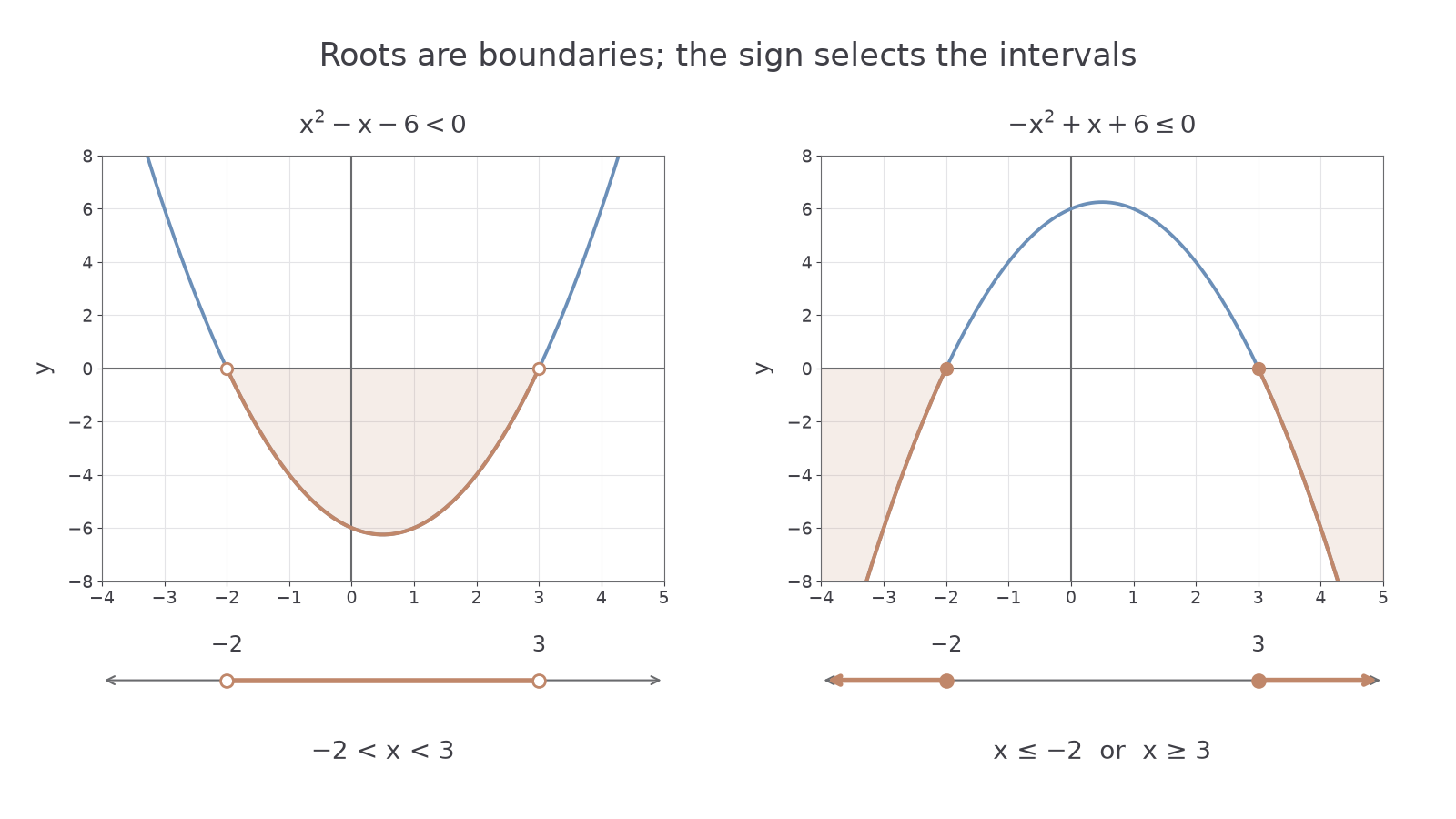
The simple between/outside pattern needs two distinct real roots. For a repeated root, has no real solution, has only , and allows all real values except one. A quadratic such as has no real roots and is positive everywhere. Always check the sign, rather than inventing intervals from missing or repeated roots.
Watch out
Do not divide an inequality by an expression such as without knowing its sign. Division by a negative reverses the inequality, and division at zero is undefined. A sign table handles these cases safely.
Find a new complete solution set.
Two-variable inequalities
With two variables, a solution is a point . A linear equality gives a boundary line; an inequality selects one side of it.
Boundary and half-plane
A half-plane is the region on one side of a straight boundary line. Draw a solid boundary for or , because equality is included; draw a dashed boundary for or , because equality is excluded. Substitute a test point off the line to decide which side satisfies the inequality.
Writing as the subject helps: selects points above the line, and selects points below it. “Above” compares heights at the same x-value. For a vertical boundary, means to the right and to the left. A test point must not be on the boundary, where equality cannot distinguish the two sides.
Worked example 3: a strict half-plane
Question. Describe and represent the region .
Plan. Draw its equality boundary, decide whether to include it, and test a point.
The line passes through and . Draw it dashed, since is strict. At , the inequality becomes , which is true. Choose the side containing that point: above the line.
Answer. Shade the half-plane above the dashed line ; exclude the line itself.
Check. At , the boundary height is one. Point satisfies , whereas fails. The boundary point also fails the strict inequality.
For a non-strict condition, equality must remain part of the region.
Continue this lesson.
You’re previewing NovaLearn without an account. Create a free account to read the rest.
Create free account