HG23 - Area of any triangle
Calculate a triangle's area from two sides and their included angle, even when its perpendicular height is unknown. Rearrange the same formula for a side or angle, and use a justified triangle split in larger shapes. This is Higher content.
The sine-area formula
Two sides of a triangle are and . Their included angle is . How can you find the area without being given a height?
The included angle is the angle between the two sides used in the formula. Label , , and their included angle . If is the base, drop the perpendicular from to its line. For acute , , so the height is .
[DIAGRAM: asset_name: Acute and obtuse triangle heights; asset_slug: sine-area-heights; caption: The perpendicular height is b sin C, including when its foot lies outside the triangle.; description: Two exact triangles with base BC 9 cm and side CA 8 cm, included angles C 30 and 150 degrees. Both heights are 4 cm; the obtuse triangle's altitude meets an extension of BC.]
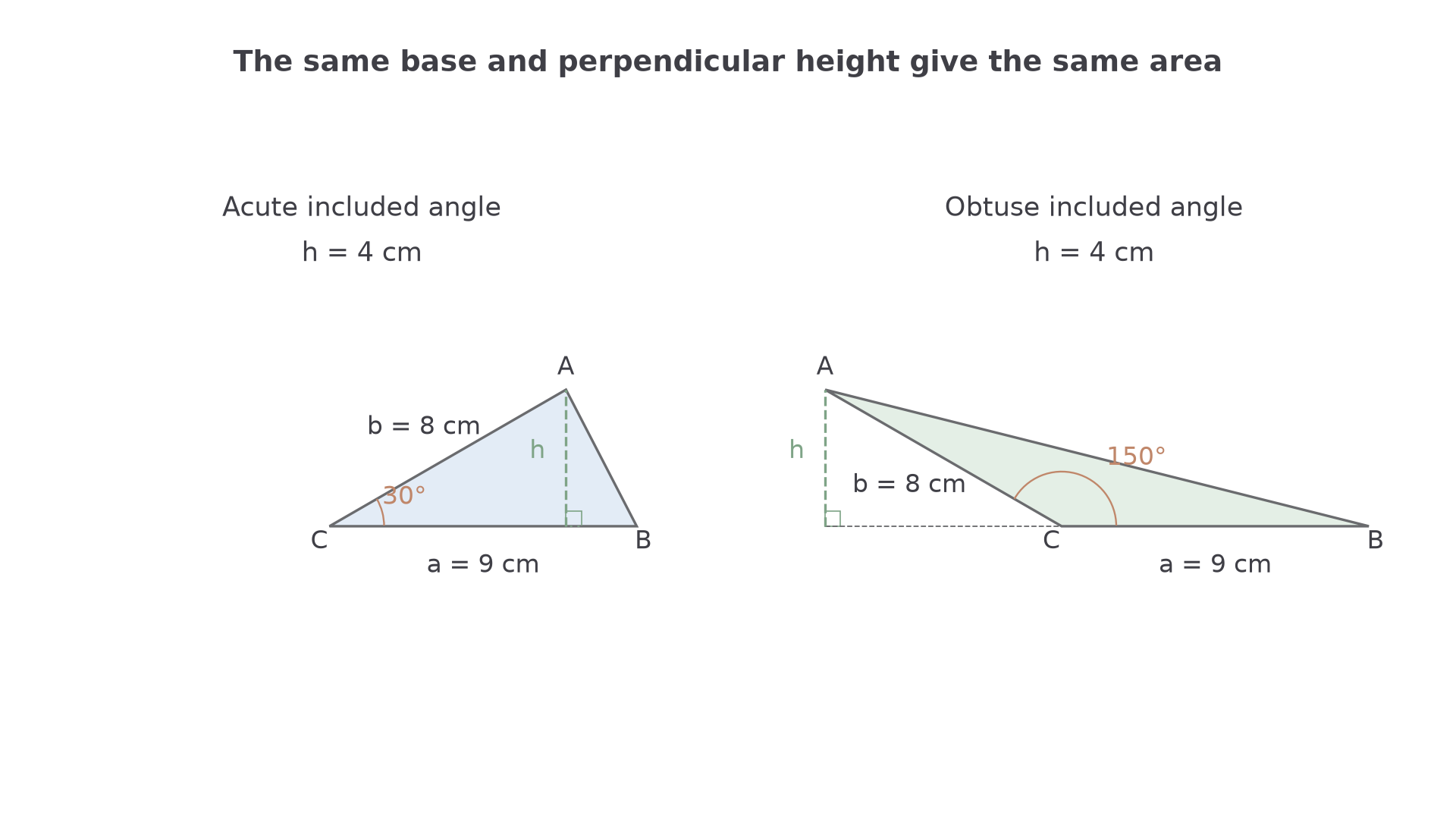
For obtuse , the foot lies on the base line extended. The small right triangle uses , giving . Thus the same area formula works. At , sine is , recovering half the product of the perpendicular sides.
Triangle area from an included angle
denotes area; are side lengths and is their included angle. Use consistent length units; area has squared units. The formula is supplied on the current Higher additional formula sheet.
Choose the two sides enclosing the given angle, then substitute their lengths before evaluating the sine.
Worked example 1: an acute included angle
Question. Find the area when two sides are and , with included angle .
Plan. Use these two sides and the angle between them.
Answer. .
Check. The perpendicular height is . Base–height area is .
Keep the side lengths but open the included angle.
Worked example 2: an obtuse included angle
Question. Find the area when two sides are and , with included angle .
Plan. Use the actual included angle, retaining its positive sine.
Answer. .
Check. The external right triangle has angle and height . The same base and perpendicular height explain why the two differently shaped triangles have equal area.
For fixed sides, supplementary included angles have equal sine and hence equal area. The greatest possible area is , when the included angle is .
Watch out
The angle must sit between the chosen sides. A side opposite the given angle cannot simply be substituted as one of the two enclosing sides.
Use new lengths and a different angle.
Unknown measures
The area formula also determines an enclosing side when the area, other enclosing side and included angle are known. Divide by the entire coefficient of the unknown.
Rearranging the area formula
For an angle, first evaluate , then apply inverse sine in degree mode and check the supplementary candidate. The letters must describe the same two sides and their included angle throughout.
For a nondegenerate triangle, the known side and the sine of its included angle are positive, so dividing by their product is valid.
Worked example 3: finding an enclosing side
Question. A triangle has area , one side , and included angle between that side and side . Find .
Plan. Write the area equation and isolate .
Answer. .
Check. Using as the sloping side gives height . Then .
An unknown angle can have two candidates because supplementary angles have the same sine.
Worked example 4: selecting an obtuse angle
Question. A triangle has sides and , area , and an obtuse included angle . Find .
Plan. Isolate sine, then use the stated obtuse condition.
Inverse sine gives . The other candidate is .
Answer. .
Check. With base , the altitude must be . A sloping side reaches that height with the external angle, consistent with the interior angle.
Continue this lesson.
You’re previewing NovaLearn without an account. Create a free account to read the rest.
Create free account