HG19, HR13 - Area and volume scale factors
Learn why similar figures have different scale factors for length, area and volume, and how to work backwards from an area or volume ratio. HG19 supplies the similarity relationships; HR13 expresses them as ratios and uses them in context.
Area factors
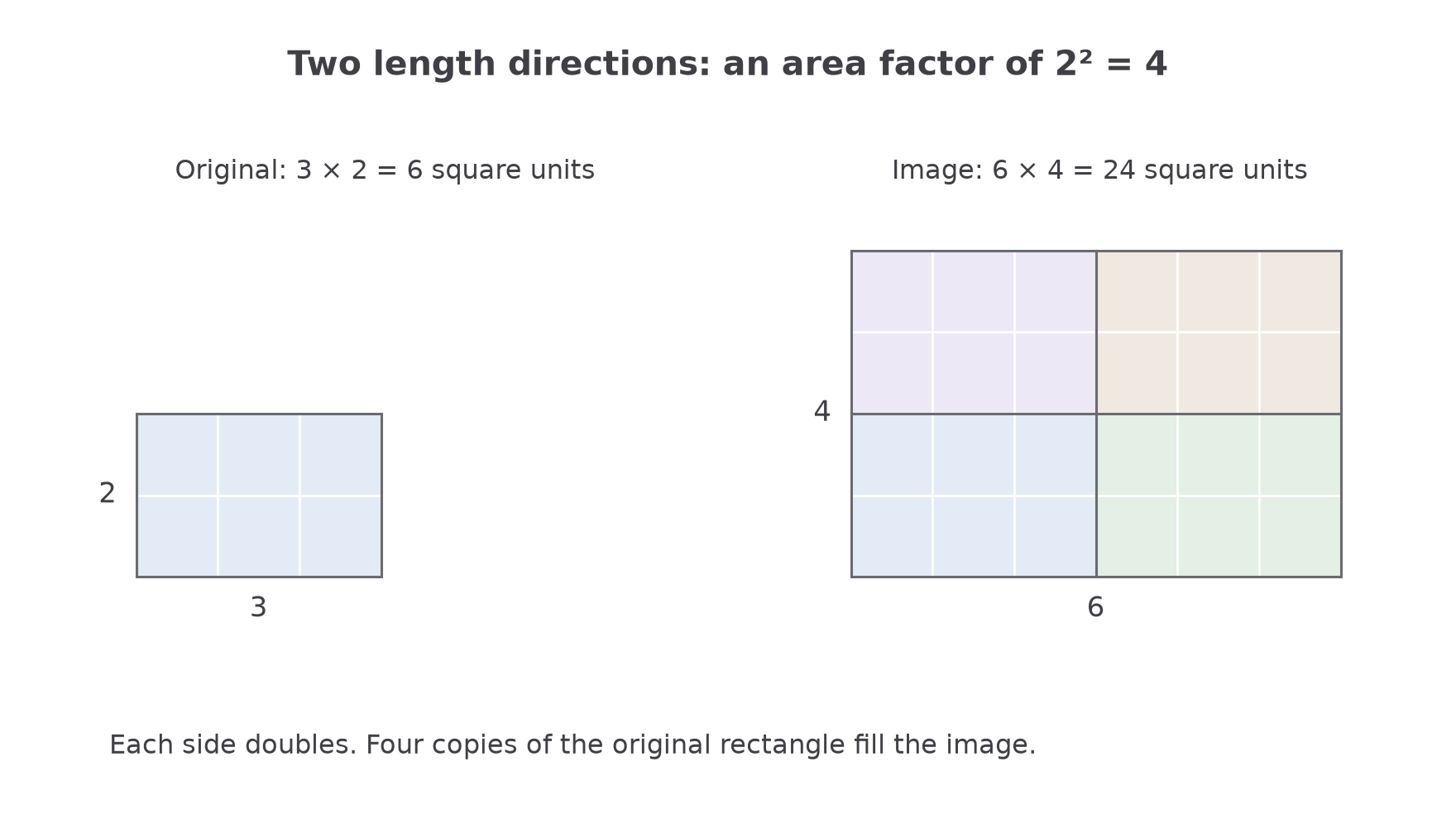
If every length doubles, does the area merely double? A rectangle twice as long and twice as wide contains four copies of the original area.
Similar figures have equal corresponding angles and one common positive ratio between corresponding lengths. Use corresponding measurements in the same direction, such as small to large. An area ratio by itself does not establish that two figures are similar.
For a rectangle of sides , multiplying lengths by gives area
A triangle has the same factor because its base and perpendicular height both multiply by , while its remains. Splitting other polygons into corresponding triangles gives the same result; circles also agree because .
Area scale factor
For similar figures with positive length scale factor , the area scale factor is . Conversely, an area factor gives length factor . Lengths use the positive root.
Here the two length directions each contribute a factor of .
[DIAGRAM: asset_name: Two length directions make an area factor; asset_slug: squared-area-factor; caption: Doubling both dimensions makes four times the area.; description: Exact unit-grid rectangles measure 3 by 2 and 6 by 4. The larger rectangle is divided into four 3 by 2 copies; both corresponding dimensions have factor two and area changes from six to twenty-four square units.]
Worked example 1: from length to area
Question. Two similar signs have length scale factor from the smaller to the larger. The smaller area is . Find the larger area.
Plan. Square the length factor before multiplying the area.
Answer. .
Check. In the reverse direction the length factor is , so . A factor in each direction must produce more than times the area.
Keep the same similar signs and areas, but recover the length ratio instead. This requires undoing a square.
Worked example 2: from area to length
Question. Similar signs have areas and . Find their smaller-to-larger corresponding length ratio.
Plan. Simplify the area ratio, then take positive square roots of its terms.
Answer. ; the scale factor from smaller to larger is .
Check. Squaring the length ratio gives . Taking as the length ratio would instead imply area ratio .
A reduction uses exactly the same law: length factor gives area factor . Surface areas of similar solids also multiply by , because each corresponding surface patch scales in two directions.
Watch out
Use the factor for the quantity being changed. Multiplying by scales a length, not the area. First write which direction and which kind of measurement the factor describes.
Try a different pair of similar figures.
Volume factors
A solid has three length directions. For a cuboid of dimensions , a similar cuboid has volume
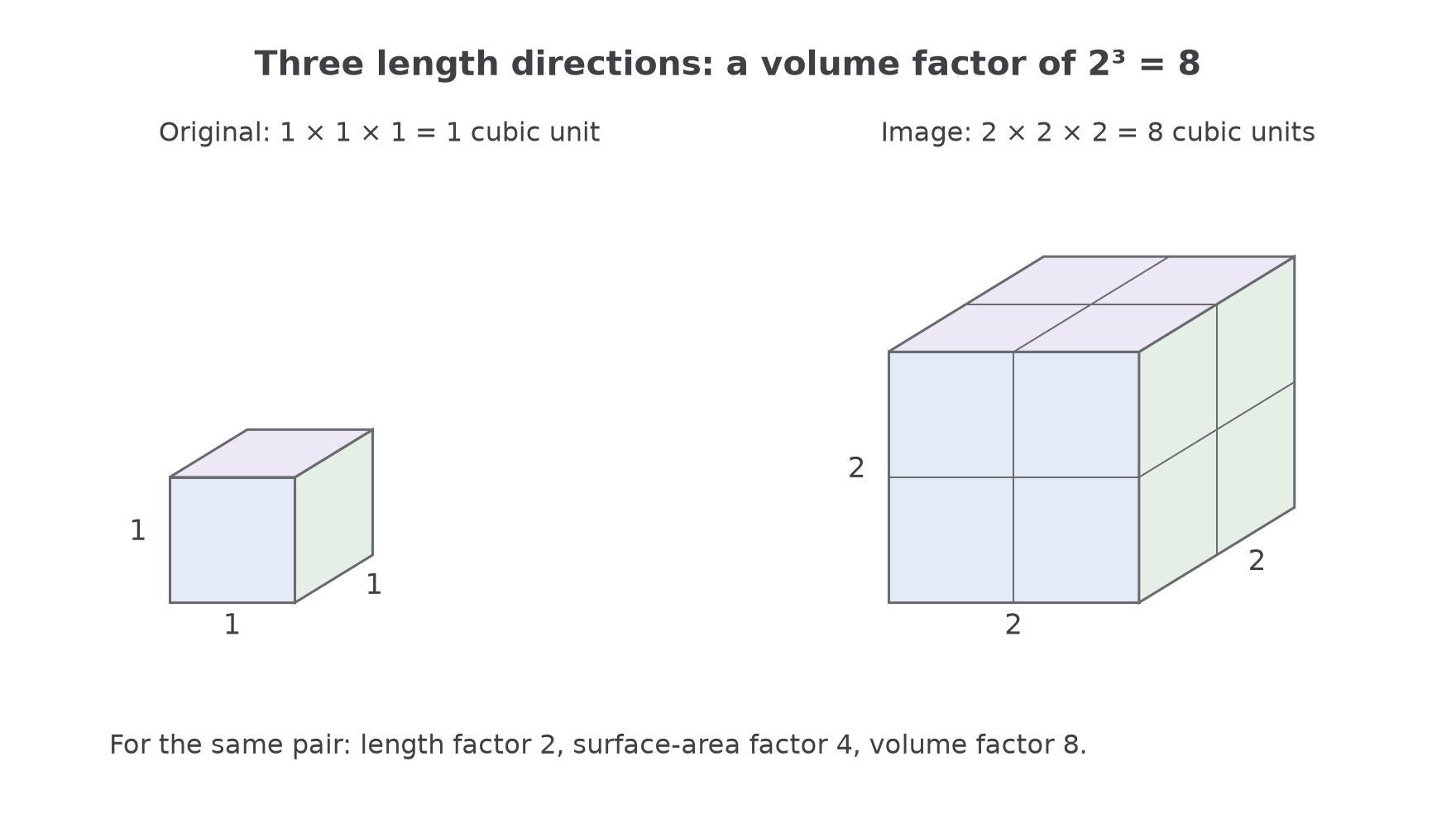
For any prism, its cross-sectional area scales by and its length by , so its volume scales by . The same three-dimensional scaling law applies to all similar solids. A cube doubled in every direction contains original cubes, not just two.
Volume scale factor
For similar solids with positive length scale factor , the volume scale factor is . Conversely, a volume factor gives length factor . Do not use a square root to undo a cube.
The area and volume factors differ even for the same pair of solids.
[DIAGRAM: asset_name: Three dimensions make a volume factor; asset_slug: cubed-volume-factor; caption: Factor two in each length direction gives eight times the volume.; description: Exact axonometric cube views show a unit cube and a cube of side two subdivided into eight unit cubes. Labels distinguish length factor two, surface-area factor four and volume factor eight.]
Continue this lesson.
You’re previewing NovaLearn without an account. Create a free account to read the rest.
Create free account