FR8, FR11, FR14–FR15, HR8, HR11, HR14–HR15 - Direct and inverse proportion
Use equal ratios for direct proportion and a constant product for inverse proportion, then interpret their equations and graphs. This is shared Foundation and Higher content; constructing more general power models is treated separately.
Direct proportion
If one quantity goes up while another goes down, must they be inversely proportional? A direction of change alone is not enough: proportion describes a precise multiplicative relationship.
Direct proportion
Two quantities are directly proportional when multiplying one by a factor multiplies the other by the same factor. Their ratio , for , is constant. The relationship has form , where is that constant.
For positive quantities, doubling one doubles the other. A directly proportional graph is a straight line through the origin. Its gradient is the constant rate . Equal ratios such as express the same relationship.
Worked example 1: scaling equal ratios
Question. Identical notebooks have a constant unit price. Three cost £. How much do eight cost?
Plan. Find the cost of one, then scale to eight; assume no discount or fixed charge.
Answer. £.
Check. : both purchases have the same cost-to-number ratio. Scaling quantity by also scales to .
A straight line need not represent direct proportion if there is a fixed starting charge.
Worked example 2: interpreting a fixed charge
Question. Two supplied fare models use distance in kilometres and fare in pounds:
Which is directly proportional to distance, and what does the gradient mean?
Plan. Check the origin as well as the constant increase per kilometre.
A gives at and the ratio for positive . B starts at £; at , , but at , .
Answer. A is directly proportional. Both gradients are , meaning an extra £ per kilometre; B also has a fixed £ charge.
Check. Doubling distance from to doubles A's fare from £ to £. B's fare changes from £ to £, which is not double.
[DIAGRAM: asset_name: Direct proportion and a fixed charge; asset_slug: proportional-fares; caption: Equal gradients do not establish direct proportion: the graph must also pass through the origin.; description: On common axes of distance d in kilometres and fare C in pounds, exact lines C equals three d and C equals three d plus four have equal gradients. Only the first passes through the origin.]
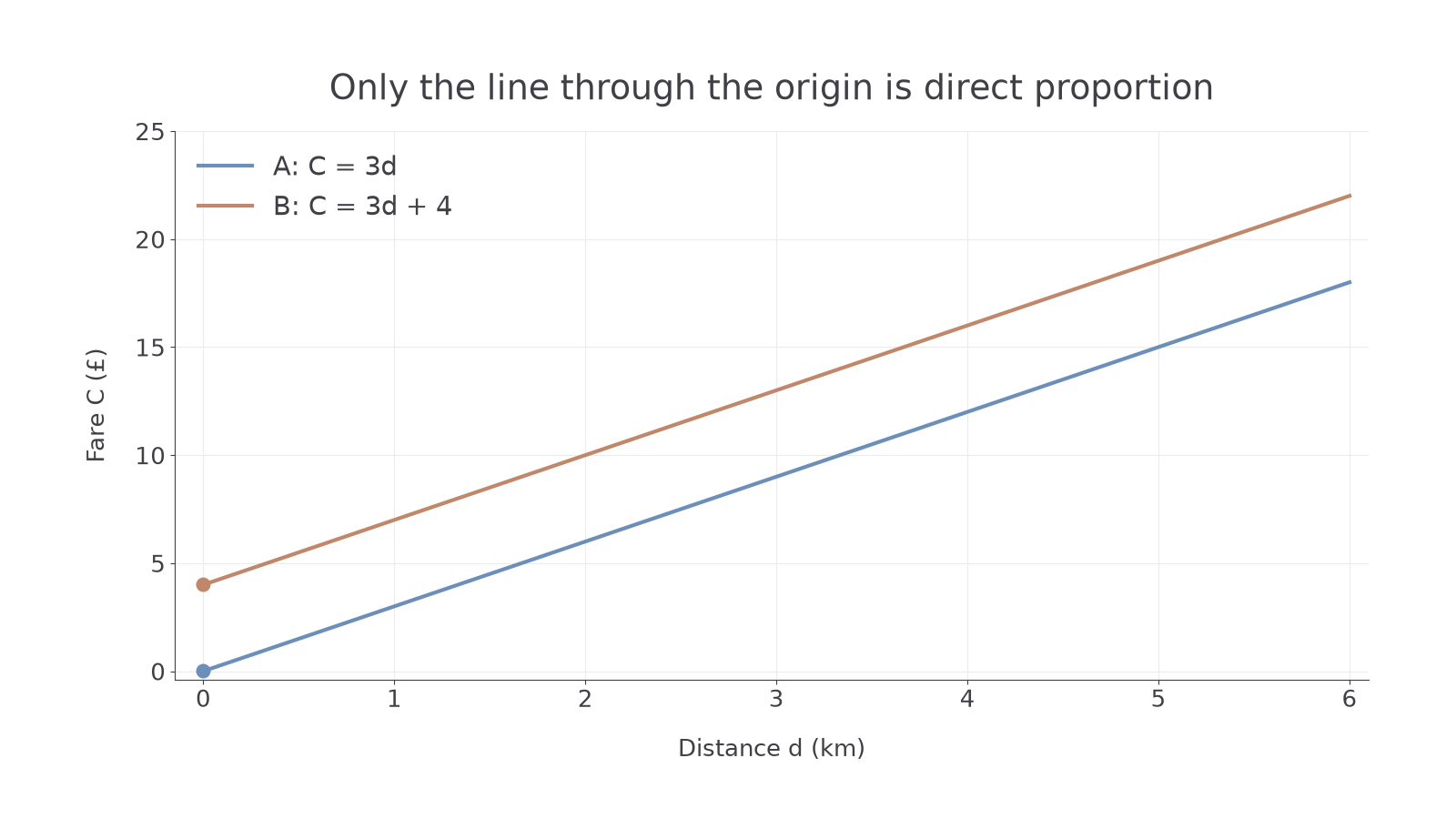
Check the model's conditions. A bulk discount, delivery charge or minimum fare can break direct proportionality even if costs generally increase with quantity.
Watch out
“Both increase” is weaker than “directly proportional”. Test a constant ratio or the same multiplicative scale factor.
Scale a fresh directly proportional cost.
Inverse proportion
For a fixed job, more equally effective workers may mean less time. Doubling the number halves the time only if the model's assumptions hold.
Inverse proportion
Two quantities are inversely proportional when multiplying one by a factor divides the other by that factor. Their product is constant:
Thus is directly proportional to the reciprocal .
For positive quantities, the inverse graph is a decreasing curve rather than a straight line. It does not meet either axis when : zero input is excluded, and the output approaches zero without becoming zero.
Worked example 3: a fixed amount of work
Question. Six equally effective workers complete a job in hours. How long would ten workers take, assuming the same working rate per person and no interference?
Plan. Keep total worker-hours constant because the job is unchanged.
The hour is minutes.
Answer. hours minutes.
Check. Worker count increases by factor ; time decreases by the reciprocal factor , giving hours.
Continue this lesson.
You’re previewing NovaLearn without an account. Create a free account to read the rest.
Create free account