FA4, HA4 - Taking out common factors
Expanding turns a product into a sum; factorising reverses that process. Learn to find common numerical and algebraic factors, take out the greatest common factor, and check whether your factorisation is complete. This teaches the common-factor method in FA4 and HA4.
Common numerical factors
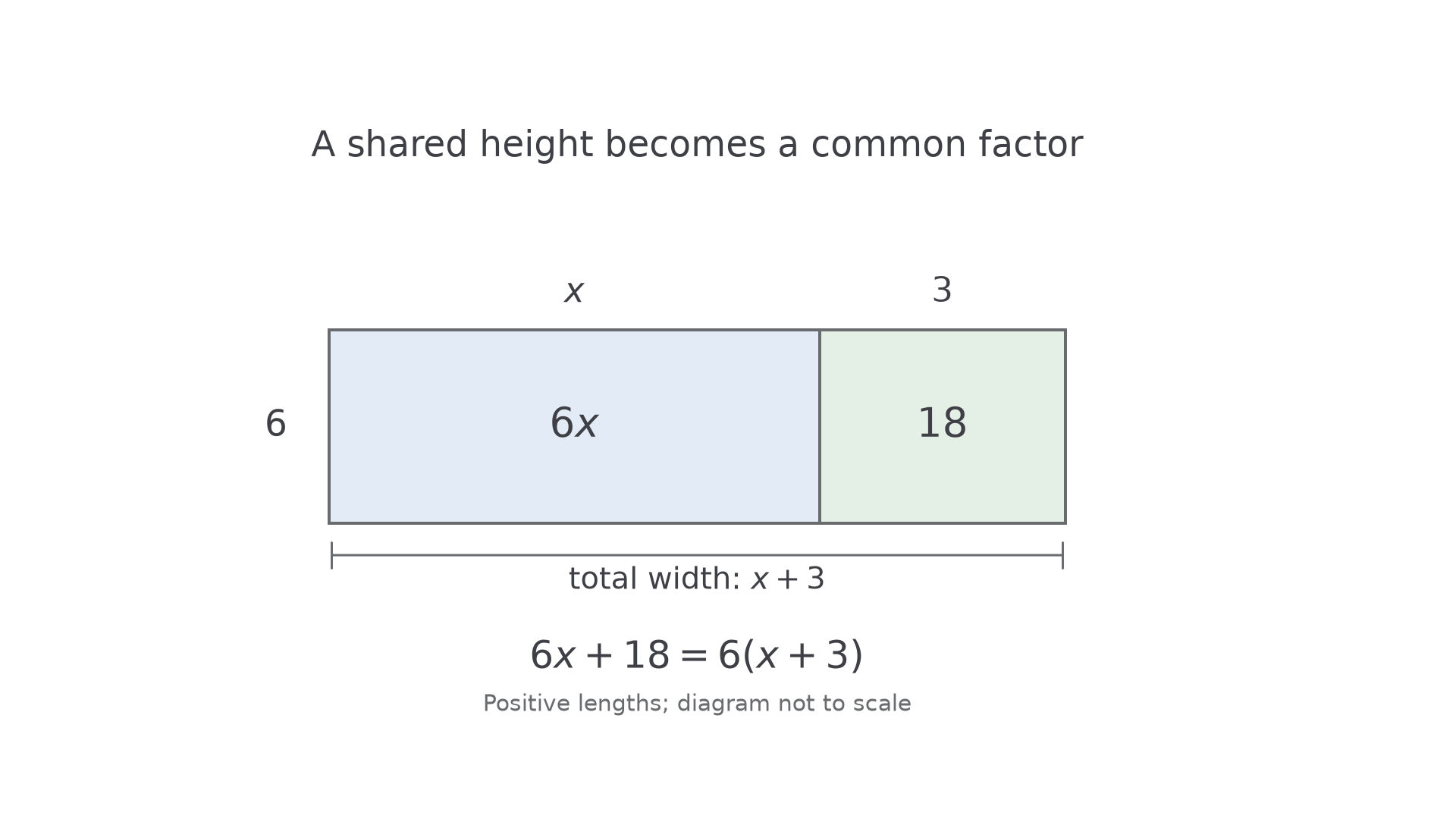
Can be written as one multiplication? Think of six identical rows, each containing objects and another three objects.
Six rows of objects give , while six rows of three give . So . The outside factor is shared by both terms.
Factorising
To factorise an expression is to write it as a product of factors. Taking out a common factor reverses expansion: .
To factorise using the greatest common numerical factor, find the highest common factor of the coefficients. Divide each entire term by that factor to find what remains inside the bracket.
[DIAGRAM: asset_name: A common height for two areas; asset_slug: common-factor-area; caption: The two areas share height 6, giving the combined product 6(x + 3).; description: A rectangle of height 6 is split into a blue area 6x of width x and a sage area 18 of width 3. The total width is x plus 3. The positive-length model shows six times x plus eighteen equals six times the quantity x plus three.]
Worked example 1: adding two terms
Question. Factorise fully .
Plan. Take out the highest common factor of and , which is .
Why divide? Expanding will multiply by , so division finds the terms that must be inside.
Answer. .
Check. Expanding gives .
Change only the sign between the terms. The second quotient must keep its negative sign.
Worked example 2: subtracting a term
Question. Factorise fully .
Plan. Again take out , dividing the signed terms by it.
Answer. .
Check. . At , both forms also give .
The expression has no common factor , because the constant contains no .
Watch out
divides only the first term. The second term inside must be , since .
Take out the greatest common number from a new expression.
Common algebraic factors
A letter can be a common factor as well as a number.
In , both terms contain a factor . Write them as and : only one copy of appears in both terms. Their numerical coefficients share , so the greatest common factor is .
Common algebraic factor
A common algebraic factor contains only letters and powers present in every term. For each letter, use the smallest power shared by all the terms. Combine this with the highest common factor of the numerical coefficients.
Find the contents of the bracket by removing those shared factors. This is an equality of expressions even at : the factorised form can be expanded without dividing by a value of .
Worked example 3: a shared letter
Question. Factorise fully .
Plan. Take out : the coefficients share , and both terms contain at least one .
One copy of remains inside the first term.
Answer. .
Check. .
Add one copy of a second letter to both terms. It now belongs in the common factor too.
Worked example 4: two shared letters
Question. Factorise fully .
Plan. Take out , leaving the same bracket as before.
Answer. .
Check. Expanding gives . With , , both forms give .
The rule also handles higher powers. In , the shared powers are and ; the greatest common factor is . Removing it leaves , so the expression is .
Watch out
Every term must divide exactly by the proposed common factor. Taking out of would leave a fraction in the second term and miss the intended common-factor form. The greatest shared power here is .
Factorise with two letters, keeping the minus sign.
Checking factorisation
A factorisation has two tests: it must expand to the original expression, and “fully” means no common factor remains to be taken from its bracket.
For instance, expands correctly to , but and still share . Continuing gives . A correct partial factorisation is a useful step, not the finished result.
If the factor removed equals one of the original terms, the corresponding bracket term is . For example, : omitting the would lose the second term entirely.
Worked example 5: a correct but incomplete answer
Question. Jo writes . Is this fully factorised? Give a full factorisation.
Plan. Expand to check equality, then look for a common factor inside Jo's bracket.
Answer. No. Jo's answer is equivalent but not fully factorised. The full factorisation is .
Check. . The bracket's terms have no common numerical factor greater than and no shared letter.
Change one sign inside Jo's answer. This time the expression is not even equivalent.
Worked example 6: finding a wrong sign
Question. Jo writes . Identify the error and give the correct full factorisation.
Plan. Expand the proposed product and compare each term with the original.
The second term should be . The bracket needs a minus sign; it also has a common factor still to remove.
Answer. The sign of the second term is wrong. The correct full factorisation is .
Check. At , the original and corrected form both give . Jo's proposed form gives , confirming the mismatch.
A negative common factor is also valid. For example, . Choose a form whose expansion you can check confidently.
Exam tip
For “Factorise fully”, finish with a product such as . An expanded sum may be equal to the original but does not answer the factorisation instruction.
The opening expression is one multiplication: . Expanding it gives both original terms, and the bracket has no further common factor.
Quick Recap
- Factorising reverses distribution: a sum becomes a product.
- Use the highest common factor of the coefficients and the smallest shared power of each letter.
- Divide every signed term by the factor removed; a term can leave inside.
- Expand back to check equality, then check that no common factor remains in the bracket.
The opening sum is the product .