FA19–FA20, HA23–HA24 - Recognising number patterns
Some sequences grow by changing amounts, while others multiply or combine earlier terms. FA20 and HA24 cover triangular, square, cube, quadratic, Fibonacci-type and simple geometric patterns. FA19 and HA23 also let you generate terms from stated rules. Learn to recognise the pattern and justify each continuation.
Figurate sequences
The lists and both increase, but neither adds the same number every time. What shape can explain each pattern?
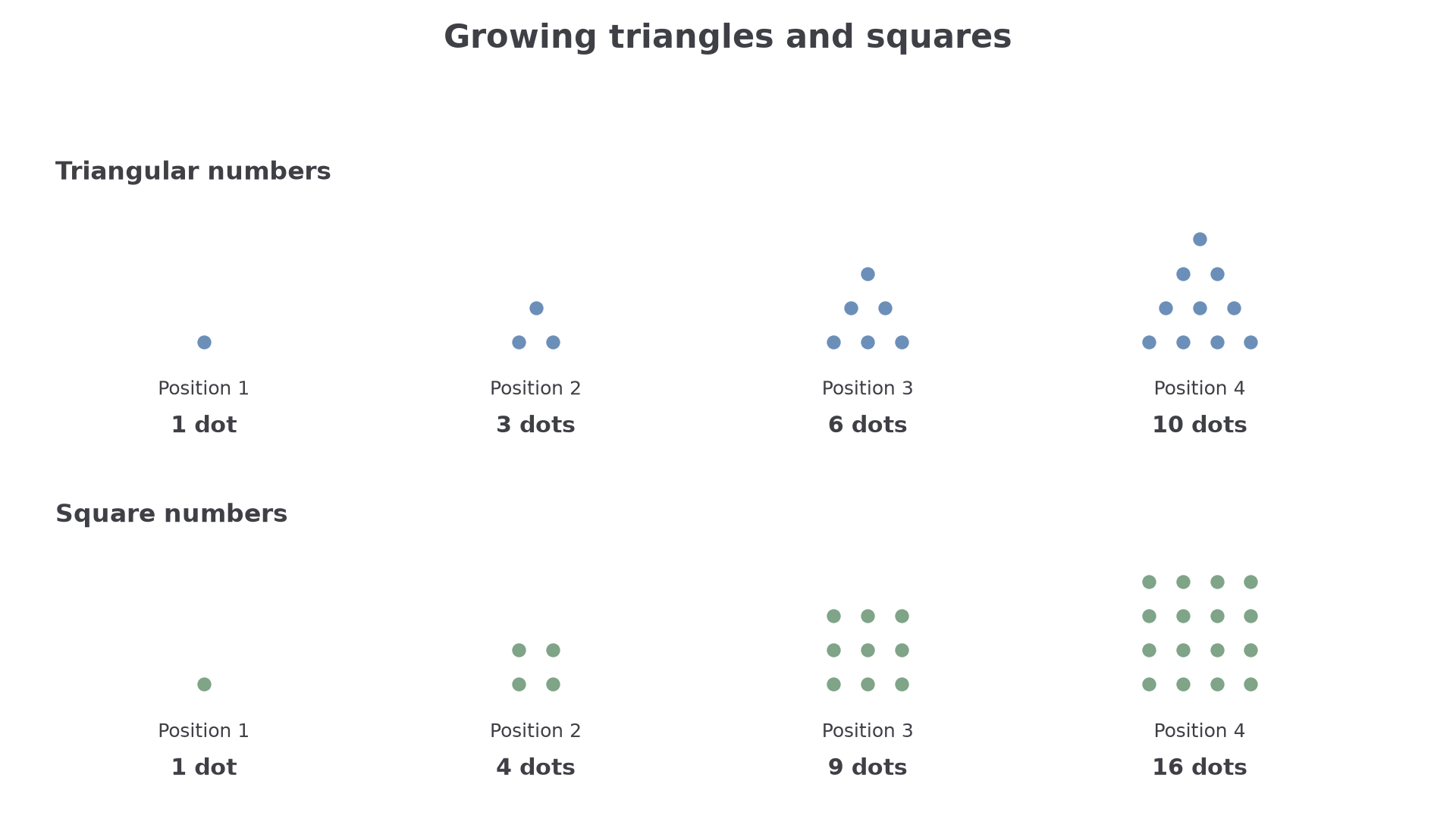
Dots arranged in rows of , then , then , and so on make a triangle. Each larger triangle gains a new row. Square arrangements instead have the same number of rows and columns.
[DIAGRAM: asset_name: Triangular and square numbers; asset_slug: figurate-dots; caption: A triangle gains a new row; a square gains a new row and column.; description: Exact dot arrangements for the first four triangular numbers 1, 3, 6, 10 and first four square numbers 1, 4, 9, 16, with position and total labels.]
Triangular, square and cube numbers
Triangular numbers count the dots in these growing triangles: . Square numbers are , counting a square of rows and columns: . Cube numbers are , counting a cube with layers of unit cubes: , for .
For triangular numbers, the increases are . For square numbers, the increases are . Cubing is different from tripling: a cube of side has unit cubes, not .
Worked example 1: continuing familiar shapes
Question. Write down the next term of each sequence.
(a)
(b)
(c)
Plan. Identify the shape pattern and use its next size.
Answer. (a) , (b) , (c) .
Check. ; ; . Each count matches its arrangement.
A pattern can be related to square numbers without being the square-number sequence itself.
Quadratic sequence
A quadratic sequence has a non-zero constant second difference. First find the differences between consecutive terms; then find the differences between those differences. The first differences change by a constant amount instead of staying constant.
For squares, first differences have second difference . Triangular numbers have second difference , so they are quadratic too. Cube numbers have changing second differences and are not quadratic. We will recognise and continue quadratic patterns here; finding their general nth-term expressions comes later.
Worked example 2: a shifted square pattern
Question. A quadratic sequence begins . Find the next two terms and describe its connection to square numbers.
Plan. Continue the first differences using their constant change, then compare with squares.
Answer. The next terms are . Each term is more than the square number at the same position.
Check. , , , , , . A different route confirms every term.
Changing all square terms by the same amount leaves their differences unchanged. This is why both the square sequence and the shifted sequence above have second difference .
Watch out
Continuing by adding again gives , but it breaks the quadratic pattern. Increase the difference to , giving .
Try a different shifted square pattern.
Fibonacci-type rules
A Fibonacci-type rule uses two earlier terms, rather than a fixed increase or multiplier.
Fibonacci-type sequence
In a Fibonacci-type sequence, each new term is the sum of the two immediately preceding terms. Two starting values are needed. Changing either starting value can change every later term.
Starting with gives . To find the term after , use . Do not add every term written so far: only the last two enter the rule.
Continue this lesson.
You’re previewing NovaLearn without an account. Create a free account to read the rest.
Create free account