FP6, FP8, HP6, HP8 - Combined events and tree diagrams
Use tree diagrams to calculate probabilities across several stages, keeping track of whether earlier results change later chances. FP8 and HP8 cover independent and dependent events; FP6 and HP6 organise alternative complete paths without missing or double-counting outcomes.
Independent events
A counter is drawn, put back and mixed in before another draw. What changes if it is kept out instead? A tree makes each stage's available outcomes visible.
Independent events
Events are independent when knowing whether one occurred does not change the probability of the other. They can have different probabilities; independence does not mean equal chances.
For independent events and :
Why multiply? If occurs in a fraction of trials, and the unchanged chance of among those trials is , the fraction satisfying both is .
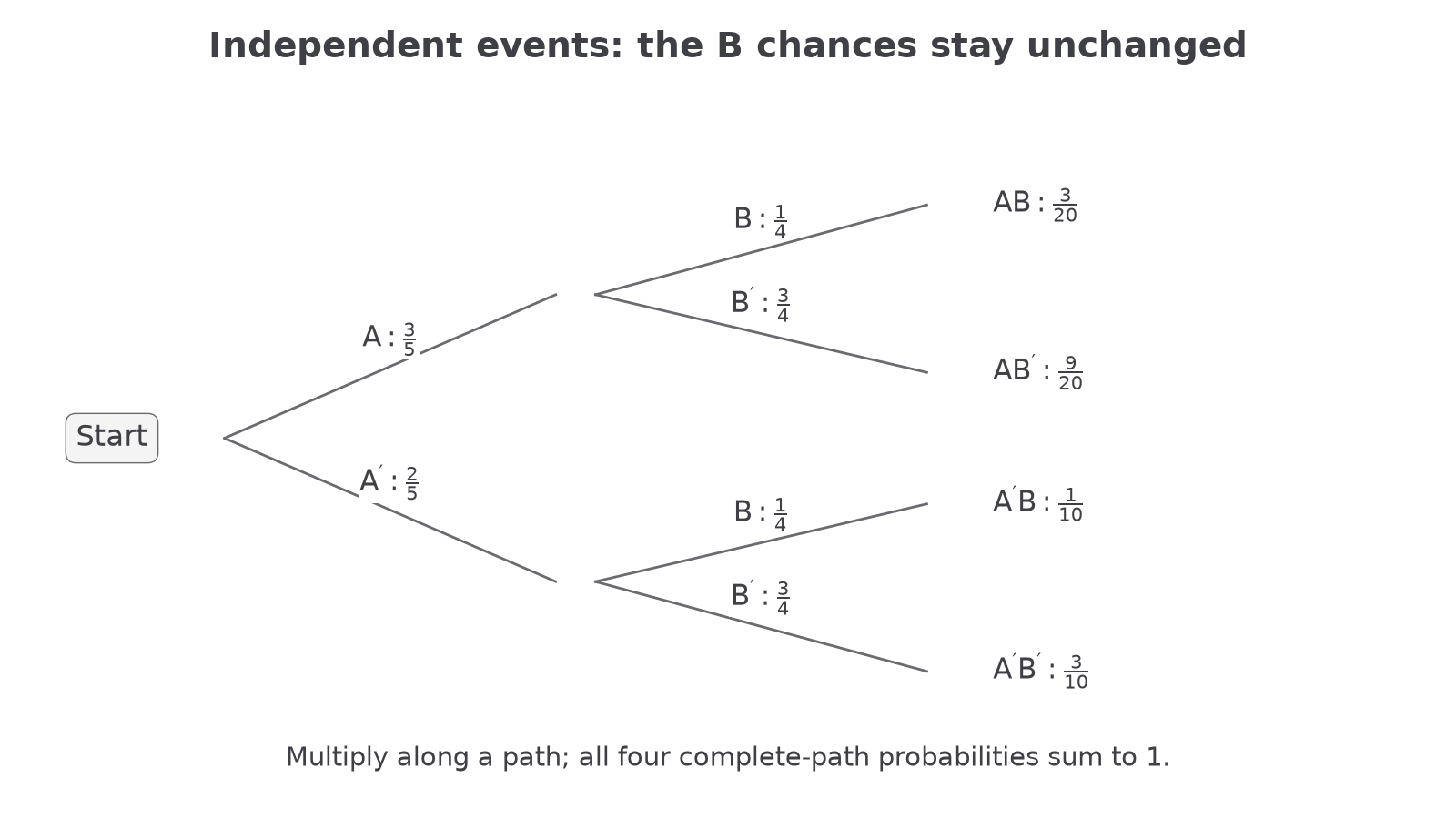
At each tree split, the outgoing probabilities describe all possible results at that stage and sum to . Multiply along a complete path to find its probability.
Worked example 1: two independent successes
Question. Events and are independent, with and . Find the probability that both occur.
Plan. Follow the -then- path and multiply.
Answer. .
Check. Among model trials, are expected to have , and a quarter of those, , have both. The proportion is .
The diagram uses and for the complementary events. The two -stage branch pairs agree because does not alter 's chances.
[DIAGRAM: asset_name: Independent probability branches; asset_slug: independent-probability-tree; caption: The second event has probability one quarter after either first-stage result.; description: A two-stage tree has A probability three fifths and not A two fifths. After either first event, B has probability one quarter and not B three quarters. The four complete-path probabilities are three twentieths, nine twentieths, one tenth and three tenths.]
Now make the second event's probability the unknown.
Worked example 2: recovering a branch probability
Question. and are independent. and . Find .
Plan. Undo the multiplication by .
Answer. .
Check. . The recovered branch probability lies in .
Drawing from a bag with replacement and remixing, using the same uniform selection procedure each time, restores the composition and gives unchanged probabilities. With red and blue counters, two reds have probability .
Mutually exclusive is different from independent. On one die roll, odd and even are mutually exclusive; if odd occurs, even becomes impossible, so these positive-probability events are not independent.
Watch out
Do not multiply the unconditional probabilities merely because a question has two stages. First establish that the second chance is unchanged, or use the probability appropriate to the first result.
Use different independent chances.
Dependent events
When an earlier result changes the remaining possibilities, the later probability depends on the path taken. Update the available objects before writing the next fraction.
Without replacement
Sampling without replacement means the selected object is not put back before the next selection. The total falls by one, and the chosen category's count falls by one.
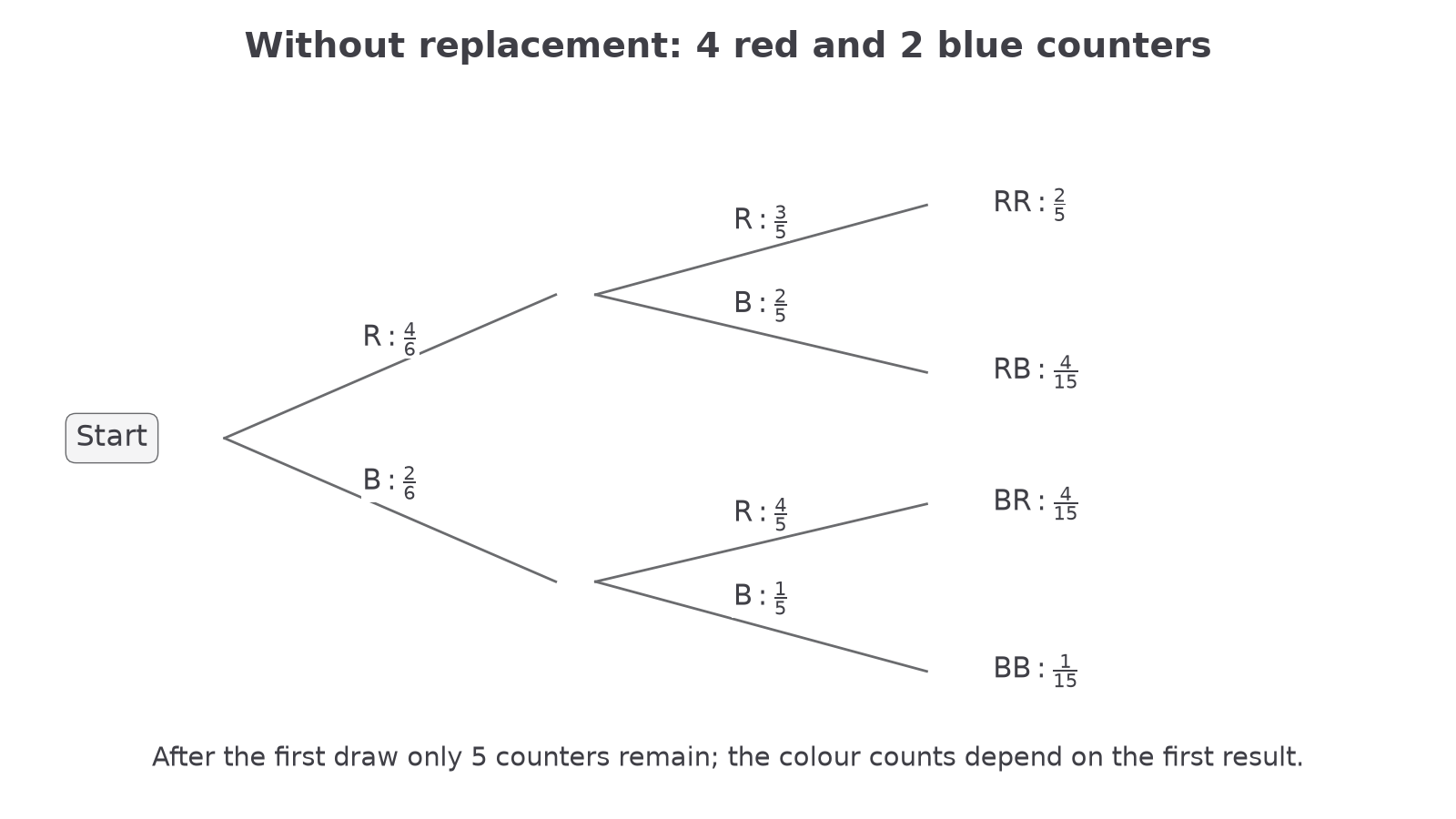
Take a bag of red and blue counters. After a red is removed, red and blue remain. After a blue is removed, red and blue remain. Both second-stage totals are , but their favourable counts differ.
[DIAGRAM: asset_name: Dependent draws without replacement; asset_slug: without-replacement-tree; caption: The first colour determines which second-stage count decreases.; description: A bag starts with four red and two blue counters. First probabilities are four sixths and two sixths. After red, second probabilities are three fifths red and two fifths blue. After blue, they are four fifths red and one fifth blue. Path probabilities are two fifths, four fifteenths, four fifteenths and one fifteenth.]
Worked example 3: two reds without replacement
Question. Two counters are drawn uniformly at random, without replacement, from red and blue counters. Find the probability of two reds.
Plan. After a first red, use the remaining reds among counters.
Answer. .
Check. Label the counters individually. There are equally likely ordered distinct pairs, and red-red pairs.
Continue this lesson.
You’re previewing NovaLearn without an account. Create a free account to read the rest.
Create free account