FG14, HG16 - Volumes of prisms and cylinders
Calculate how much space a solid occupies from its cross-section and length. FG14 and HG16 cover cuboids, other right prisms and cylinders. You will also reverse volume calculations to find a length and connect cubic units to litres and millilitres.
Constant cross-sections
Two solid bars have identical triangular ends, but one bar is twice as long. Does its volume double? Think of the bar as a stack of identical thin slices.
Volume measures three-dimensional space in cubic units. A cuboid wide, high and long has nine layers, each containing unit cubes. The volume is .
Constant cross-section
A cross-section is the flat shape made by a slice through a solid. In a right prism, slices parallel to its identical end faces have the same polygonal shape and area throughout. Its length is the perpendicular distance between those ends. A right circular cylinder has circular cross-sections and follows the same volume method.
[DIAGRAM: asset_name: Constant cross-sections of prisms; asset_slug: prism-cross-sections; caption: Find the end-face area, then multiply by the perpendicular length between identical ends.; description: Oblique projections of a 6 cm by 4 cm rectangular cross-section and a right-triangular cross-section of base 6 cm and perpendicular height 4 cm. Both right prisms have length 9 cm; end areas 24 square cm and 12 square cm are labelled.]
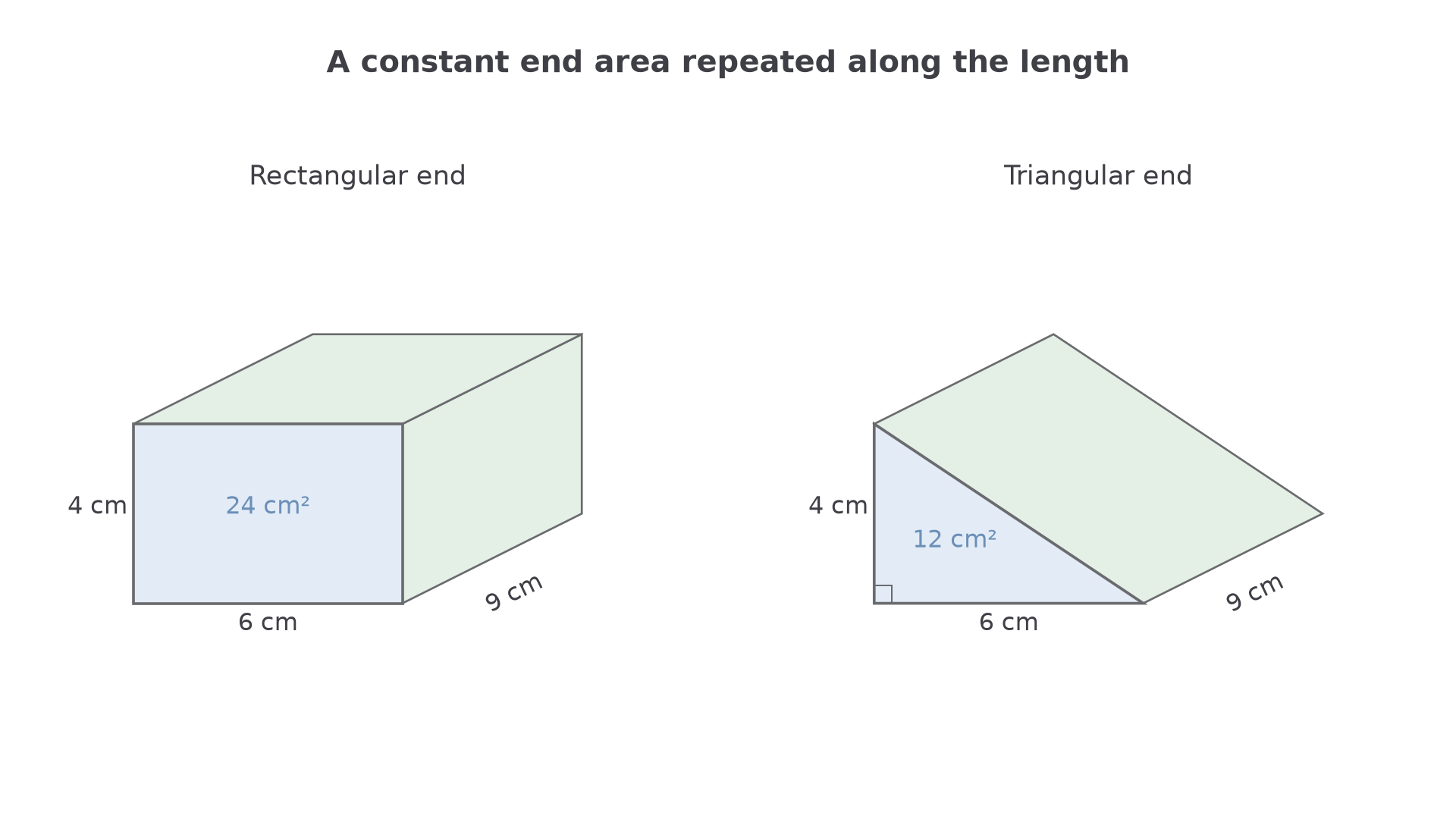
The slice argument works beyond whole centimetres: area times a small slice thickness gives a small volume; adding the slices gives area times the full perpendicular length.
Volume with a constant cross-section
Here is the cross-sectional area and is the perpendicular length between the end faces. The prism rule is supplied on the additional formulae sheet. If is in square centimetres and in centimetres, is in cubic centimetres.
The height used to calculate a triangular end's area is different from the prism's length.
Worked example 1: a rectangular cross-section
Question. A right prism has a rectangular end by and length . Find its volume.
Plan. Calculate the area of one end, then multiply by the length.
Answer. .
Check. Group the dimensions differently: . These are the same unit cubes grouped into different layers.
Keep the base, height and length, but replace the rectangular end by a triangle.
Worked example 2: a triangular cross-section
Question. A right triangular prism has end-face base , perpendicular end-face height and prism length . Find its volume.
Plan. Halve the end's base-height product before multiplying by the prism length.
Answer. .
Check. Two such prisms fit together to make the preceding cuboid: .
A pyramid narrows towards an apex, so its cross-section does not stay constant. Do not use directly for the whole pyramid.
Watch out
Multiplying a triangular end's three side lengths is not its area. Use with a perpendicular height, then multiply by the prism length.
Use a supplied cross-sectional area.
Prisms and cylinders
Choose the area formula for the cross-section before using the prism rule. A trapezium needs its parallel sides and perpendicular separation; a cylinder needs its circular radius.
For a right cylinder, every circular slice has area . Multiplying by its perpendicular height gives . This follows from the supplied circle-area and prism-volume rules. It is not the circumference times height: that product measures a surface area.
Worked example 3: a trapezium-ended prism
Question. A right prism has a trapezium cross-section with parallel sides and , separated by . Its length is . Find its volume.
Plan. Use the trapezium formula for one end, then multiply by .
Answer. .
Check. Two identical end trapezia make a parallelogram of area . Twice the volume is , so one volume is .
Continue this lesson.
You’re previewing NovaLearn without an account. Create a free account to read the rest.
Create free account