HA20 - Numerical solutions and iteration
How can you find a root accurately when an equation has no convenient factorisation? HA20 uses systematic trials, decimal searches, bisection and iterative rules to obtain numerical solutions. Keep enough precision, check the equation and distinguish evidence of convergence from a guarantee.
Trial and improvement
The equation has a root between one and two: the expression gives at one and at two. How can you decide its value to two decimal places?
Trial and improvement
Trial and improvement substitutes chosen inputs into an equation, compares the results with the target, and uses that evidence to choose closer trials. A root of an equation written with zero on one side makes the other side zero.
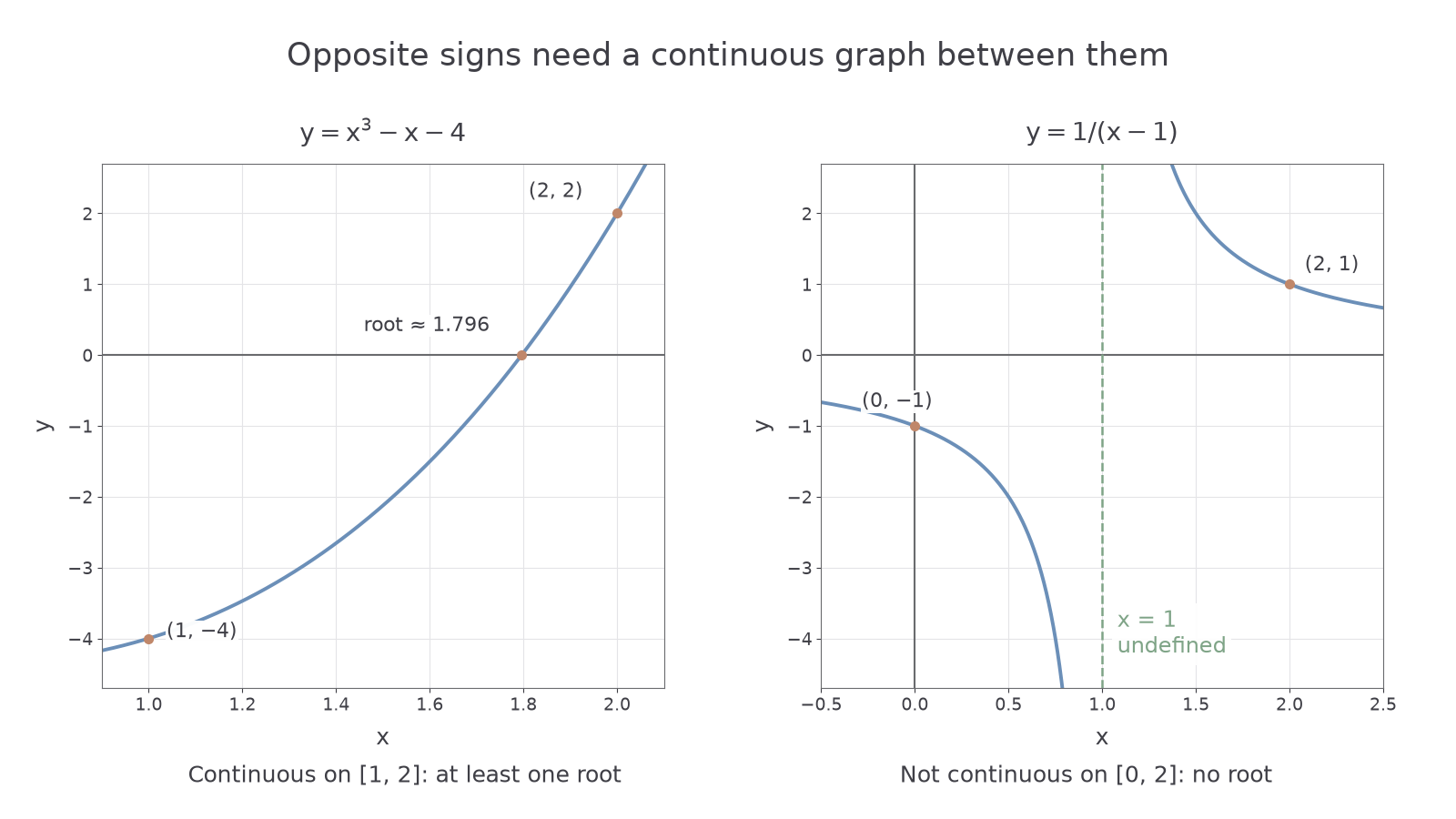
Record the input, calculated value and whether it is above or below zero. Use trials that narrow an interval, rather than guesses with no connection. For a continuous curve, a negative and positive value locate at least one crossing between them. Here the cubic is continuous; continuity is examined more closely in the next part.
Worked example 1: one decimal place
Question. Find the root of between one and two, correct to one decimal place.
Plan. Test tenths, then test the rounding boundary between the two possible answers.
| Comparison | ||
|---|---|---|
| below zero | ||
| above zero | ||
| below zero |
The crossing lies between and , so it lies above the halfway rounding boundary .
Answer. , correct to one decimal place.
Check. A later finer bracket places the root between and , which also rounds to . The small value at alone would not prove the rounding decision.
Requesting another decimal place changes the rounding boundary that must be checked.
Worked example 2: two decimal places
Question. Find the same root correct to two decimal places.
Plan. Test hundredths, then test the midpoint between and .
There is a crossing between and . Every value strictly inside that interval rounds to to two decimal places.
Answer. , correct to two decimal places.
Check. The midpoint evaluation is negative and the upper evaluation positive. The bracket supports the rounding; merely knowing would leave two possible rounded answers.
Keep the trailing zero when it communicates the requested accuracy.
Exam tip
Show the decisive trials, including the halfway value when needed. An unsupported calculator answer does not show that your trial-and-improvement method established the requested accuracy.
Use supplied trials to justify a new rounding decision.
Interval methods
A sign-change bracket is useful because continuity forces the graph to pass through zero on its way from a negative height to a positive one.
Continuity and a sign change
A graph is continuous on an interval when it has no break there. If a continuous expression has values of opposite signs at two endpoints, it has at least one root between them. This does not prove uniqueness. Without continuity, opposite signs need not imply a root.
For example, is negative at zero and positive at two, but it is undefined at one and never equals zero. Its sign changes across a gap, not across an x-axis intersection. Also, no sign change does not prove that there is no root: touches zero at two while staying non-negative on both sides.
[DIAGRAM: asset_name: Sign changes need continuity; asset_slug: continuity-and-root-brackets; caption: A continuous sign change forces a root; a jump across an undefined input does not.; description: Left scaled graph plots y equals x cubed minus x minus 4 between x equals 1 and 2, with endpoint values minus 4 and 2 and its root near 1.796. Right plots y equals 1 divided by x minus 1 on separate branches around x equals 1, with values minus 1 at zero and plus 1 at two, an asymptote at x equals 1 and no x-axis crossing.]
Bisection repeatedly tests the midpoint of a bracket and keeps the half with opposite endpoint signs. Each step halves the interval width. A decimal search tests tenths, then hundredths, then further decimal places around the crossing. Both depend on valid sign brackets.
Worked example 3: three bisection steps
Question. Starting with , perform three bisection steps to narrow a root of .
Plan. Evaluate each midpoint and keep the sign-changing half.
| Step | Midpoint | Expression value | New bracket |
|---|---|---|---|
| 1 | |||
| 2 | |||
| 3 |
Answer. A root lies strictly between and .
Check. The interval width is , one eighth of the original width, and its endpoint values have opposite signs.
Change to a decimal search on another continuous cubic, refining around the crossing rather than always halving.
Continue this lesson.
You’re previewing NovaLearn without an account. Create a free account to read the rest.
Create free account