FN5, HN5 - Listing possibilities
Find every possible outcome without missing one or counting one twice. You will organise lists, use tables and trees, and decide how restrictions and the order of choices affect the answer.
Organised lists
You choose two different ice-cream flavours from mango, lemon and vanilla. Does mango with lemon count as a different choice from lemon with mango? We will return to that question after learning how to organise possibilities.
Writing down whatever comes to mind can leave gaps. Instead, keep the first choice fixed while you work through every second choice. Then move to the next first choice and repeat in the same order.
Systematic list
A systematic list follows a fixed rule so that every allowed outcome appears. An exhaustive list includes all the possibilities. Each distinct outcome should appear once.
Before listing, identify what one complete outcome looks like. A two-digit number has a tens digit followed by a ones digit, so and are different outcomes.
Worked example 1: fixing the first digit
Question. Write down all the two-digit numbers that can be made using only the digits and . A digit may be used more than once.
Plan. Fix the tens digit, then put each allowed digit in the ones position.
The first row exhausts numbers beginning with . The second exhausts numbers beginning with . No other tens digit is allowed.
Answer. .
Check. Read the list by its last digit instead: end in , and end in . Every allowed ending occurs with each allowed beginning.
Now allow one additional digit. Keep the same ordering rule; every row must include the new option.
Worked example 2: a larger choice set
Question. Write down all the two-digit numbers that can be made using only . A digit may be used more than once.
Plan. Use rows beginning with , then , then , with the ones digits in that same order.
Answer. : nine numbers.
Check. Sorting by final digit gives ; ; . These are the same nine distinct numbers, with no gap in any group.
A list needs a stopping rule: finish every allowed first choice, and every allowed continuation for each one.
Watch out
The list is incomplete for the second example. Adding creates numbers such as and , not just . Rebuild each row when the choices change.
Use a fixed order for a fresh set of digits.
Tables and trees
A table or a tree makes the structure of a two-stage choice visible.
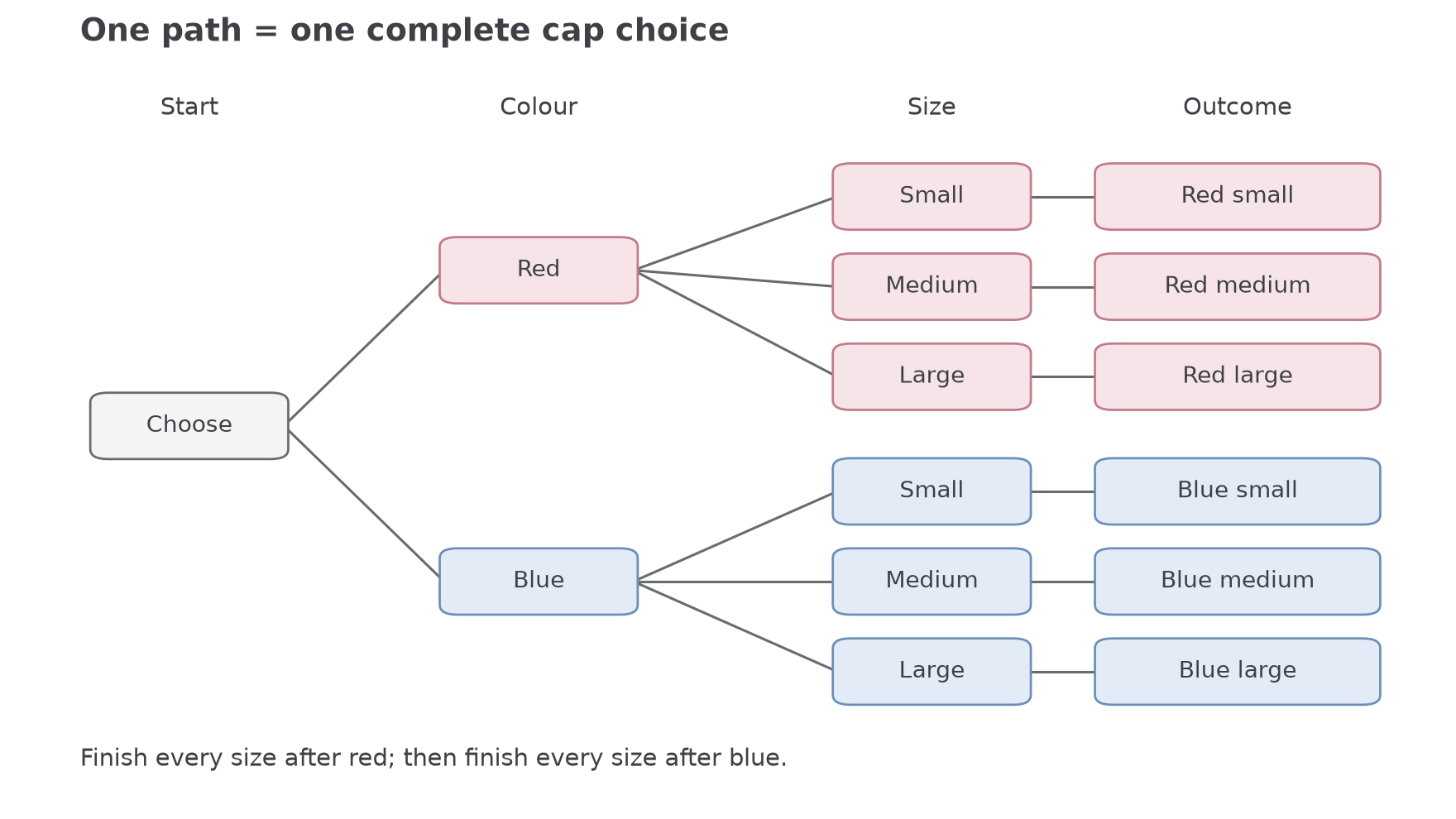
In a two-way table, the rows show the first choice and the columns show the second. Each cell represents one complete outcome. In a tree diagram, branches show the choices at each stage. One complete path from the start to an end represents one complete outcome.
Worked example 3: a table of choices
Question. A cap is available in red or blue, in small or medium. Write down all the colour-and-size choices.
Plan. Make one row for each colour and one column for each size.
| Colour | Small | Medium |
|---|---|---|
| Red | Red, small | Red, medium |
| Blue | Blue, small | Blue, medium |
Each row contains every size for that colour. Each cell gives both the colour and the size, so it describes a complete cap choice.
Answer. Red small, red medium, blue small and blue medium: four choices.
Check. Group by size instead: small has red and blue; medium has red and blue. This gives the same four choices.
Add large as a third size. A tree now needs three second-stage branches after each colour, because all three sizes are available in both colours.
[DIAGRAM: asset_name: Colour and size choices; asset_slug: cap-size-tree; caption: Each complete path gives one colour-and-size choice.; description: A two-stage tree starts with red and blue branches. Each colour then branches to small, medium and large, giving six labelled outcomes: red small, red medium, red large, blue small, blue medium and blue large.]
Worked example 4: checking a tree
Question. The red and blue caps are now available in small, medium or large. Write down all the choices.
Plan. Follow every complete path in the tree, finishing the red paths before the blue paths.
Answer. Red small, red medium, red large, blue small, blue medium and blue large: six choices.
Check. There are six end points on the tree and six cells in the table. Each of the listed choices appears once in each representation.
Count complete outcomes, rather than every branch segment or every label. The first branch “red” alone is unfinished: it does not yet tell you the size.
Watch out
A tree with three size branches after red but only two after blue has omitted blue large. Check the available options separately after every first-stage branch.
You can write a table, a tree or an organised list to answer the next question.
Listing with restrictions
Restrictions determine which outcomes are allowed; the meaning of an outcome determines whether its order matters.
For example, “use two different digits” excludes , but still allows both and as numbers. If a two-digit number uses digits without repetition, it can be or . A leading zero is excluded: is the number , which has only one digit.
When order matters
Order matters when swapping the choices changes the outcome. Choosing a captain and a deputy has ordered roles. Choosing two people for a team with equal roles does not: the same two people make the same team.
Apply restrictions as you build the list, or cross out forbidden outcomes from a complete unrestricted list. In either method, keep the remaining list organised.
Worked example 5: two different roles
Question. Ava, Ben, Cleo and Dan can be captain or deputy. One person cannot hold both roles. Write down every captain-and-deputy choice, using their initials with the captain first.
Plan. Fix the captain, then list each of the other three people as deputy.
The repeated-person choices are forbidden. However, and stay: they assign different captains.
Answer. The twelve choices in the table.
Check. Every person appears three times as captain and three times as deputy. There is no repeated-person choice.
Change only the roles: the two selected people will now have equal positions on a team. Swapping them no longer creates a new outcome.
Worked example 6: an unordered pair
Question. Two people from Ava, Ben, Cleo and Dan form a team with equal roles. Write down every possible team.
Plan. List pairs alphabetically, keeping the alphabetically earlier initial first so that each team appears once.
Do not write after : it is the same team.
Answer. Ava and Ben; Ava and Cleo; Ava and Dan; Ben and Cleo; Ben and Dan; Cleo and Dan. There are six teams.
Check. Pair each ordered choice in the previous example with its reverse: , , , , , . Each pair gives exactly one of these teams.
Extra restrictions remove outcomes rather than create new ones. If Ava and Ben cannot be on the same team, remove their single team . For the captain-and-deputy problem, remove both and .
Watch out
“No repeats” can mean no repeated person or digit within an outcome. It does not automatically mean that reversed outcomes are identical. Decide whether the roles or positions are different.
The opening ice-cream question has equal roles for the two flavours. Mango with lemon and lemon with mango describe the same choice. The exhaustive list is mango–lemon, mango–vanilla and lemon–vanilla: three choices.
Quick Recap
- Fix one choice and exhaust its continuations before moving on.
- Each cell of a table or complete path of a tree represents one outcome.
- Apply every restriction and check that none of the remaining outcomes is repeated.
- Swapping choices creates a new outcome only when the order changes its meaning.
For the opening ice-cream choice, reversing the two flavours does not create a new pair.