FN2, FN8, HN2, HN8 - Adding and subtracting fractions
Learn to add and subtract fractions by counting equal-sized parts of the same whole. You will calculate exactly with proper fractions, improper fractions and mixed numbers, then apply the same ideas to negative values. This develops the fraction arithmetic in FN2 and HN2 and the exact calculation in FN8 and HN8.
Common denominators
If you have of a metre of ribbon and add another of a metre, do you have of a metre? Adding ribbon cannot leave you with less than the amount you started with. The problem is that thirds and quarters are different-sized units.
You can add two thirds and one third immediately: together they make three thirds. The denominator stays because the pieces are still thirds. To combine thirds with quarters, first express both lengths using the same-sized pieces.
Common denominator
A common denominator is a denominator shared by equivalent forms of the fractions in a calculation. For thirds and quarters, twelfths work because both and divide .
Each third contains four twelfths, and each quarter contains three twelfths. Therefore and . The whole metre has not changed; only its subdivisions have changed.
[DIAGRAM: asset_name: Adding thirds and quarters; asset_slug: thirds-quarters-twelfths; caption: Two thirds and one quarter become eight twelfths and three twelfths.; description: Three equal-length bars show two thirds shaded blue, one quarter shaded sage, and their sum as eight blue twelfths followed by three sage twelfths. The combined bar has eleven of its twelve equal cells shaded.]
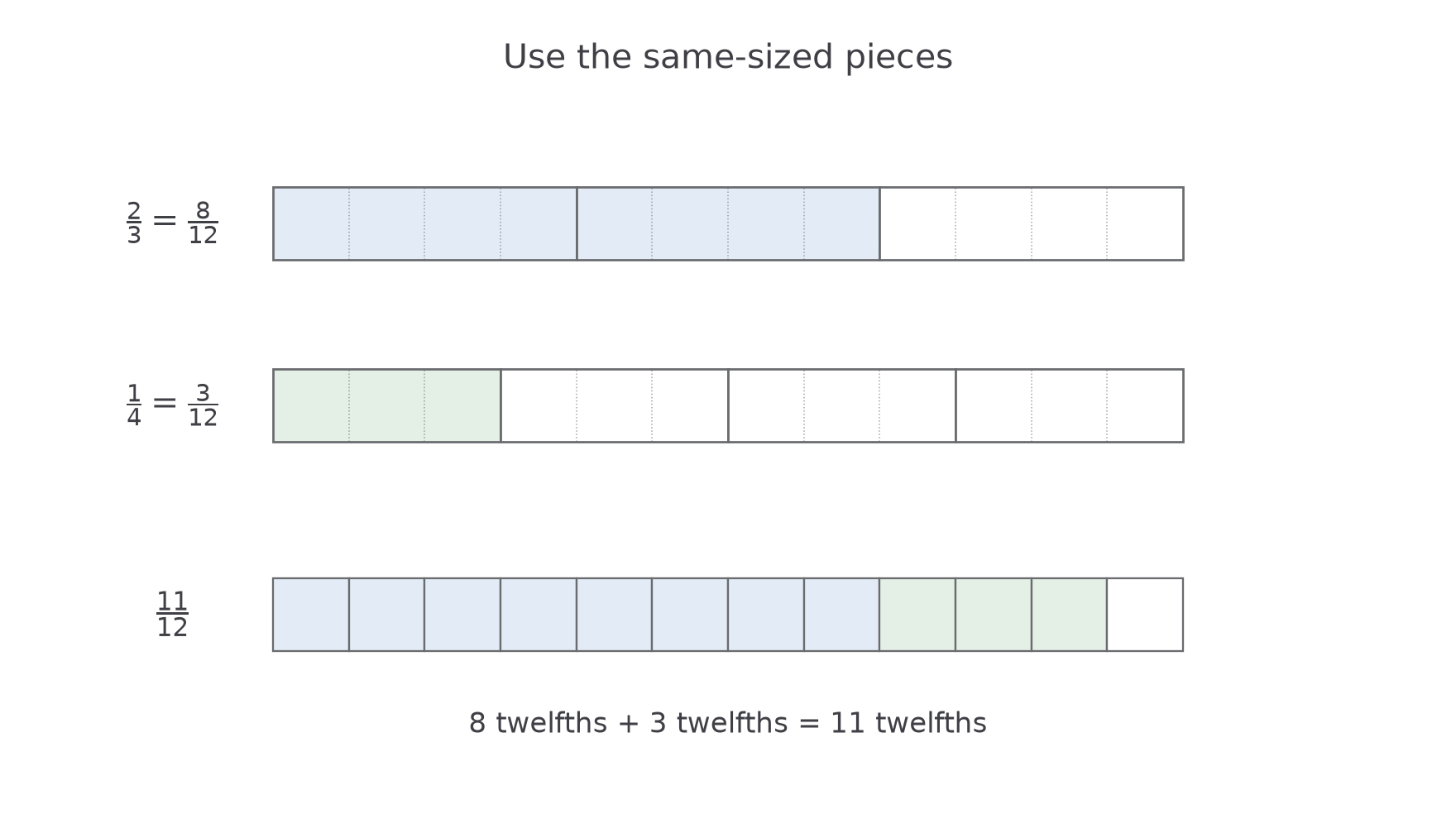
The lowest common multiple gives the lowest common denominator, which usually keeps the numbers small. Any common multiple works, provided you scale each numerator with its denominator. Once the units match, add or subtract the numerators and simplify the result.
Worked example 1: adding different units
Question. Work out . Give your answer in its simplest form.
Plan. Rewrite both fractions in twelfths, then count the twelfths.
Answer. .
Check. Two thirds needs another third to reach . Adding only a quarter must leave the total below , but above . Eleven twelfths fits both limits.
Change addition to subtraction. The equivalent fractions stay the same; the action on the numerators changes.
Worked example 2: subtracting the same units
Question. Work out . Give your answer in its simplest form.
Plan. Use twelfths again, then remove three of the eight twelfths.
Answer. .
Check. Add the removed amount back: .
The common denominator names the unit; it is not another quantity to add.
Watch out
. Adding the denominators changes the size of the pieces. Rewrite as , then add only the numerators.
Choose a common denominator for a new subtraction.
Mixed-number calculations
A mixed number combines whole units and a fraction of another unit. Converting it to an improper fraction lets you use the same method throughout a calculation.
For example, : the two wholes contain six thirds, with one third more. Keep the denominator when converting. To turn an improper answer back into a mixed number, divide the numerator by the denominator and use the remainder as the fractional numerator.
You already know
. Multiply the whole-number part by the denominator, then add the numerator. A fraction written in its simplest form has no common factor greater than in numerator and denominator.
With addition, a fractional total can cross a whole-number boundary. An improper fraction handles that crossing automatically.
Worked example 3: a total greater than a whole
Question. Work out . Give your answer as a mixed number in its simplest form.
Plan. Convert both mixed numbers to improper fractions, use twelfths, then convert the answer back.
Answer. .
Check. Add wholes and fractions separately: and . Together these give .
Now subtract the same mixed numbers. Here the fractional part of the first number is smaller, so subtracting the whole and fractional parts separately would require regrouping.
Worked example 4: subtracting across a whole
Question. Work out . Give your answer in its simplest form.
Plan. Use improper fractions so that no separate borrowing step is needed.
Answer. .
Check. Regroup as . Subtracting leaves , agreeing with the improper-fraction method.
An answer can be a proper fraction even when both starting numbers are mixed numbers. Always follow the requested answer form.
Watch out
Do not subtract the smaller fractional part from the larger just to avoid a negative result. In , the fraction calculation is , in that order. Use improper fractions or regroup one whole correctly.
Try another subtraction that crosses a whole-number boundary.
Signed fractions
Signs describe direction as well as size, so use the signed-number rules before combining fraction units.
Adding a negative number moves left on a number line. Subtracting a negative reverses that move, so it moves right. Thus means subtract a quarter, while means add a quarter. Brackets keep the operation separate from the number's sign.
A minus sign in front of a fraction applies to the whole fraction: . Keep denominators positive when rewriting. Similarly, means , not .
Worked example 5: adding a negative fraction
Question. Work out . Give your answer in its simplest form.
Plan. Treat adding a negative as subtraction, then combine the signed numerators over .
Answer. .
Check. The result must lie to the left of . Its distance from zero is , which is greater than , as required.
Change only the operation before the negative quarter. Subtracting it now moves right instead.
Worked example 6: subtracting a negative fraction
Question. Work out . Give your answer in its simplest form.
Plan. Replace subtraction of a negative by addition, then use twelfths.
Answer. .
Check. Reverse the subtraction: , the starting value.
Opposite fractions cancel exactly: . A zero numerator gives zero when the denominator is nonzero. For a nonzero answer, simplify its magnitude and retain its sign.
Watch out
does not become . Only the subtraction of the second negative changes to addition; the first fraction stays negative.
The ribbon question is now settled: equal-sized twelfths give of a metre. Negative values use the same common units; their signs tell you which way to combine them.
Quick Recap
- Add or subtract equal-sized fraction units by using a common denominator.
- Convert mixed numbers to improper fractions, or regroup wholes carefully.
- Apply signed-number rules without changing unrelated signs.
- Simplify the exact answer and check its direction and size.