FG19, HG21 - Exact trigonometric values
Calculate with special angles without replacing their ratios by rounded decimals. FG19 and HG21 require exact sine and cosine values at , and exact tangent values at . You will derive the acute-angle values from simple triangles and use them in exact calculations.
Special triangles
A right triangle has hypotenuse and angle . Can you find the opposite side exactly without a calculator? A special triangle shows that the side is always half the hypotenuse.
Two simple constructions generate the acute-angle values: a right isosceles triangle, and half an equilateral triangle. The ratios do not change when the triangles are enlarged.
Here is the positive number whose square is , and is the positive number whose square is . A fraction such as means divided by ; a length such as means . In particular, and .
[DIAGRAM: asset_name: Special right triangles; asset_slug: exact-special-triangles; caption: Unit isosceles legs give the 45-degree values; half an equilateral triangle gives 30 and 60 degrees.; description: Exact right isosceles triangle with legs 1, 1, hypotenuse square root 2 and two 45-degree angles; beside it an equilateral triangle of side 2 split by its perpendicular altitude into right triangles with sides 1, square root 3, 2 and angles 30, 60, 90 degrees.]
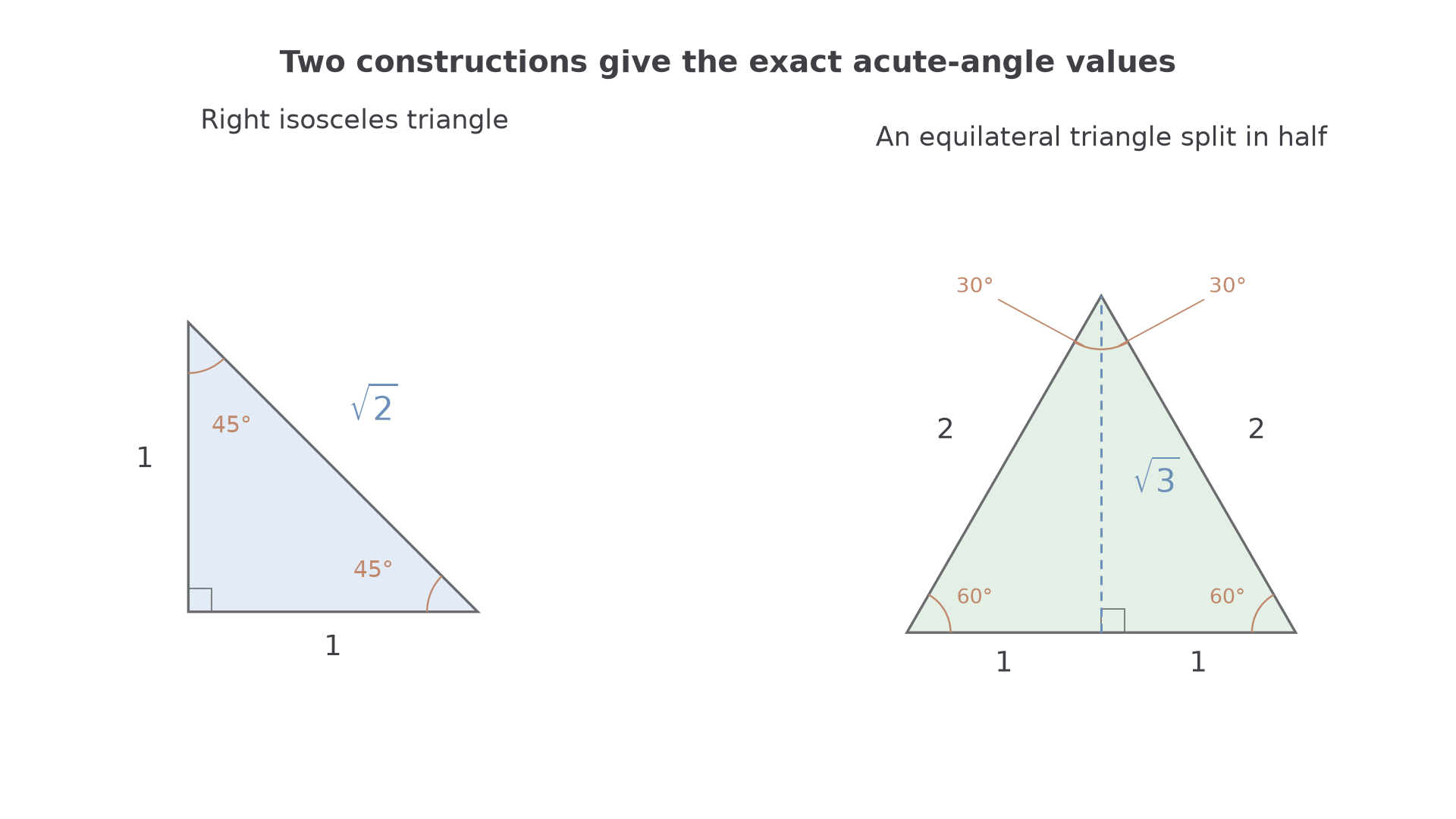
Worked example 1: deriving the 45-degree values
Question. A right isosceles triangle has both shorter sides . Find its hypotenuse and derive the exact sine, cosine and tangent of .
Plan. Use Pythagoras for the hypotenuse, then form the side ratios.
The two acute angles are equal and sum to , so each is .
Answer. Sine and cosine are ; tangent is .
Check. The fraction times hypotenuse gives , recovering either shorter side. This also verifies that and are equal.
Both and mean the number which becomes when multiplied by . Likewise, , since multiplying either form by gives . These two equalities explain the alternative fraction forms used below.
Change to an equilateral triangle of side . Its perpendicular altitude splits the base into two lengths of and the top angle into two angles.
The two right triangles have equal hypotenuses and a shared height. They are congruent by RHS, so their base halves and top angles are equal.
Worked example 2: deriving 30 and 60 degrees
Question. Use half an equilateral triangle of side to find the exact trigonometric ratios at and .
Plan. Find the altitude, then choose opposite and adjacent relative to each acute angle.
At the top angle, opposite is , adjacent , hypotenuse . At the bottom angle, the shorter-side roles swap.
Answer. The ratios are those shown above.
Check. The three side lengths satisfy . Also , confirming the alternative exact form of .
The sine and cosine columns swap between and , since the opposite and adjacent sides swap.
Exact acute-angle values
| Angle | |||
|---|---|---|---|
These exact values are not supplied on the formula lists: learn them, or reconstruct them from the special triangles. Equivalent forms and are also exact.
Keep the root symbols when an exact answer is requested.
Watch out
, while . First identify the chosen angle and its opposite/adjacent sides; do not choose a table entry by familiarity alone.
Use the half-valued ratios in new calculations.
Axis angles
At and , an ordinary right triangle collapses onto an axis. A radius of length gives a geometric way to extend the sine and cosine values to these endpoints.
Measure the angle anticlockwise from the positive horizontal axis. For a radius of length in the first quadrant, sine is the endpoint's vertical coordinate and cosine its horizontal coordinate: the ratio denominator is . At , the endpoint is ; at , it is .
Continue this lesson.
You’re previewing NovaLearn without an account. Create a free account to read the rest.
Create free account