FG2, HG2 - Loci and regions
Where could a point be if it must stay near one place and equally far from two others? FG2 and HG2 use compass constructions to describe all positions satisfying a distance rule. Learn to distinguish a boundary from a region and combine several conditions accurately.
Fixed distance
A sprinkler reaches exactly from its centre in every direction. The outer edge is a circle, but the watered area includes positions closer to the centre too. The wording changes the answer from a line to a region.
Locus
A locus is the set of all points satisfying a stated condition. Its plural is loci. A locus can be a curve, a line, a few points or a region; it is not a single example position unless only one point satisfies the rule.
All points exactly distance from a fixed point form a circle with centre and radius . Construct it by setting the compass to . “Less than ” means inside the circle, excluding its circumference; “at most ” includes the circumference. “At least ” means on or outside it.
[DIAGRAM: asset_name: Fixed-distance loci; asset_slug: fixed-distance-loci; caption: Distance from a point gives a circle; distance from a line gives parallels; a finite segment needs rounded ends.; description: Three panels show a circle of radius r about A, two parallel lines at perpendicular distance d on opposite sides of line l, and the locus exactly distance d from a finite segment AB, consisting of two parallel segments joined by semicircles centred at its endpoints.]
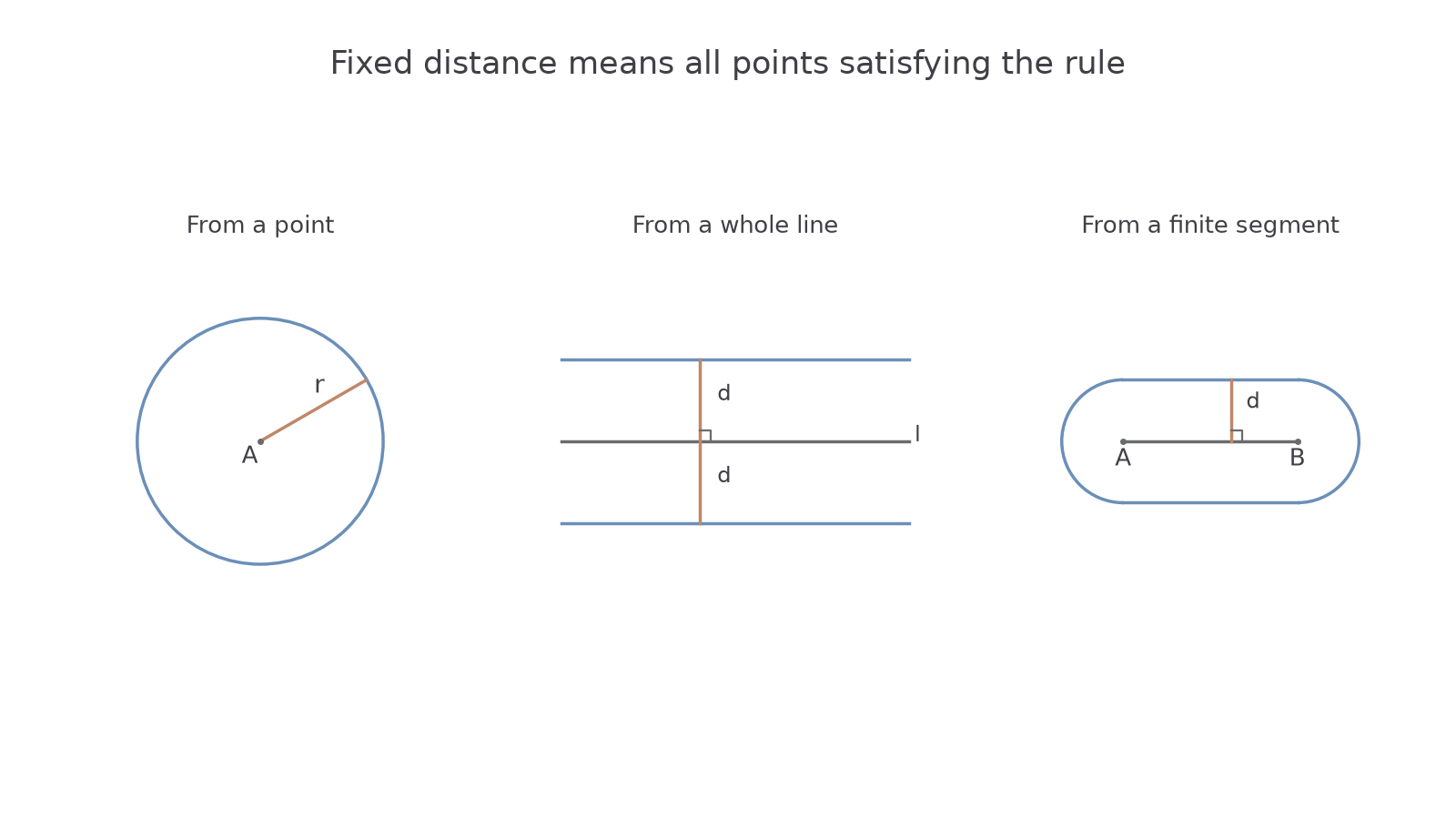
The distance from a point to a straight line is measured perpendicularly. It is the shortest route to that line: a circle expanding from the point first touches the line directly below it, along the perpendicular. A sloping route reaches another point on the line and is longer. You do not need to calculate that sloping length to identify the shortest route.
For a whole straight line, points exactly distance away lie on two parallel lines, one on each side. Construct a perpendicular, mark on both sides, then construct parallels through the marks by making lines perpendicular to that perpendicular. For distance from a finite segment, include semicircular ends: beyond an endpoint, the nearest point of the segment is that endpoint. Two infinite parallels alone would wrongly include points far beyond the segment.
Worked example 1: a fixed point
Question. Describe and construct the locus of points exactly from a point . Does a point from belong to it?
Plan. Turn the fixed distance into a compass radius.
Set the compass to , place its point at , and draw the full circle. Every point on it is from .
Answer. The circumference of a circle, centre , radius . The point away is inside it and does not belong to this exact-distance locus.
Check. A point on the circle above, below, left or right of has the same radius. Filling in the interior would add distances not requested.
Change the fixed object from a point to a line; the distance is now perpendicular separation.
Worked example 2: a fixed straight line
Question. Describe the locus exactly from a straight line . A point has perpendicular distance from ; a sloping segment from to is . Does lie on the locus?
Plan. Use the shortest, perpendicular distance, not an arbitrary connection to the line.
Draw a perpendicular to , mark on each side, and construct the parallel through each mark. These two parallels contain all points at the required distance.
For , the distance to the line is , so
Answer. Two lines parallel to , each from it. is not on either line.
Check. The sloping route is longer than the perpendicular and cannot define the distance to .
A region within distance of a whole line is the strip between those parallels, including its boundaries if the wording is “at most”.
Watch out
Distance from a line means perpendicular distance. Drawing one circle of radius around an arbitrary point on the line describes distance from that point, not from the whole line.
Distinguish two closely related locus rules.
Equidistant points
Equal distances from two points produce a different locus from a fixed distance from one point.
For fixed points and , their perpendicular bisector is the locus equally distant from both. Construct equal arcs from and , using a radius greater than half , then join the two intersections. The whole resulting line is the locus, extending beyond the short piece on your drawing.
Why is it complete? If is the midpoint and lies on the perpendicular bisector, right triangles and have equal legs and , so . Conversely, if , the triangles match by their three sides. Their angles at are equal and fill a straight angle, so each is . Thus any such lies on the perpendicular bisector, including the midpoint itself.
[DIAGRAM: asset_name: Equal-distance bisector loci; asset_slug: equidistant-bisectors; caption: The perpendicular bisector compares distances to points; an angle bisector compares perpendicular distances to lines.; description: Left panel shows points A and B, their midpoint M, a perpendicular bisector and a point P on it with equal segments PA and PB. Right panel shows two intersecting lines forming a chosen angle, its internal angle bisector, and a point Q with equal perpendicular distances to the two lines.]
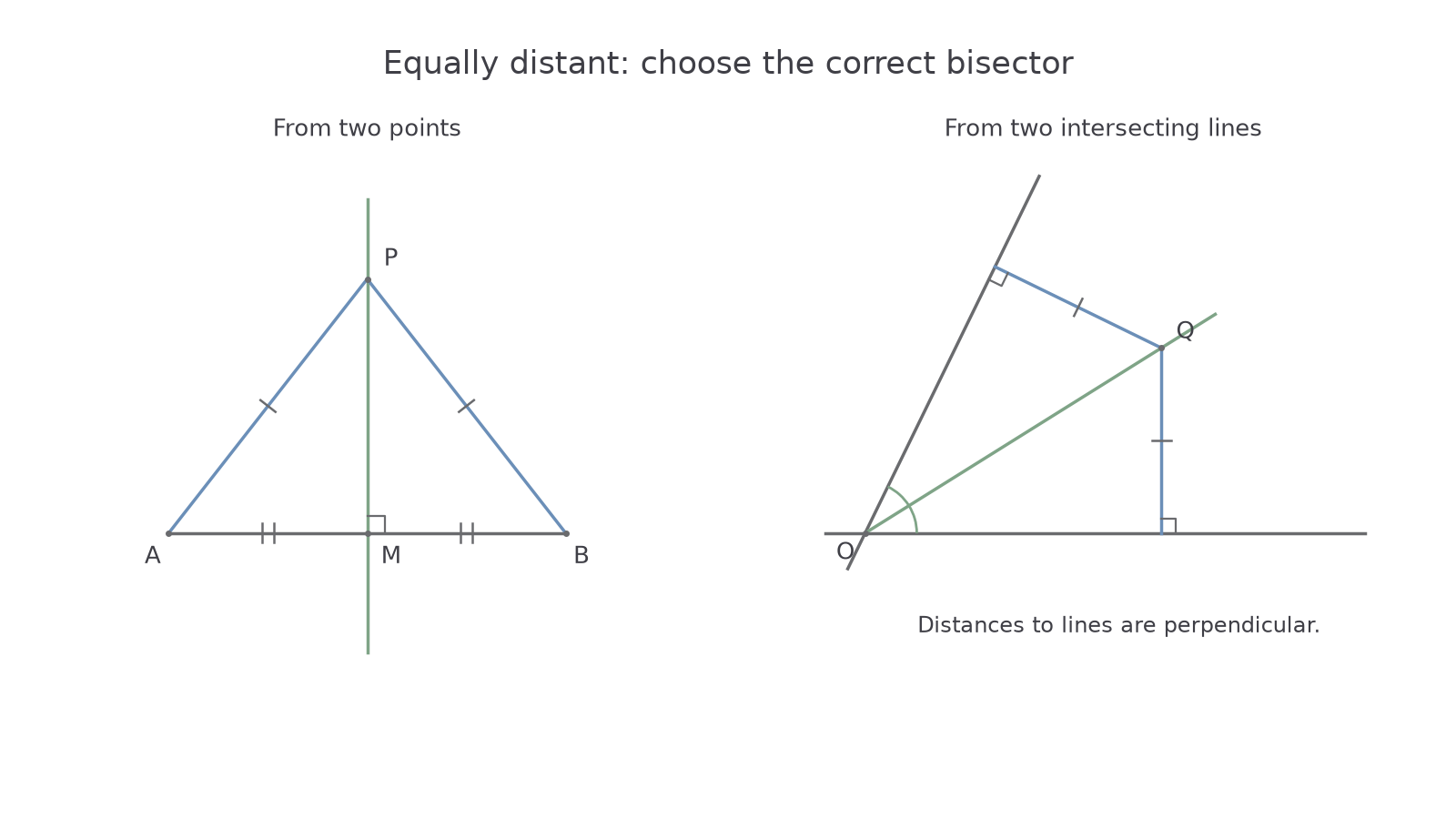
The locus nearer to than is the half-plane on 's side of this bisector; the bisector itself is excluded because distances there are equal. Check the correct side by testing : its distance from itself is zero.
Worked example 3: equally distant from two points
Question. Points and are apart. Describe their equal-distance locus. A point on it is from ; how far is it from ?
Plan. Construct the perpendicular bisector, then use the distance equality it represents.
Mark the two intersections of equal-radius arcs centred at and , then join them. This line crosses at , where .
Answer. The perpendicular bisector of ; .
Check. need not be the midpoint. Every point on the whole bisector has equal distances, although those distances vary along it.
Continue this lesson.
You’re previewing NovaLearn without an account. Create a free account to read the rest.
Create free account