FG10–FG11, HG12–HG13 - Three-dimensional shapes and views
A drawing can show a solid's front while hiding what lies behind it. Use FG10 and HG12 to identify solids from their faces, surfaces, edges and vertices, then use FG11 and HG13 to construct and interpret views from above, in front and from the side. Nets and cube arrangements help you decide what a flat drawing does, and does not, tell you about a solid.
Solids
Could two different stacks of cubes have exactly the same plan, front elevation and side elevation? First learn what makes a solid different from the flat picture used to represent it.
A three-dimensional solid has length, width and height. Its outside can include flat faces and curved surfaces. In a drawing, a dashed line often represents an edge hidden behind a face; it is still part of the solid.
Faces, surfaces, edges and vertices
A face is a flat part of a solid's surface. An edge is where faces or surfaces meet; edges can be straight or curved. A vertex is a corner or apex. The plural of vertex is vertices. A curved surface bends rather than lying in a single plane.
Count all of a solid, including the parts hidden in a drawing. Use “flat faces” and “curved surfaces” separately so the descriptions of cylinders, cones and spheres are unambiguous. A circle drawn on a sphere to show its roundness is not an edge: no surfaces join there.
[DIAGRAM: asset_name: Named solids and their structure; asset_slug: named-solids; caption: Hidden edges still count. Curved surfaces are different from flat faces.; description: Eight labelled solids are shown: cube, cuboid, triangular prism, square-based pyramid, triangular-based pyramid, cylinder, cone and sphere. Polyhedra have visible solid edges and hidden dashed edges. The cylinder has two circular flat ends and a curved side, the cone has a circular base and apex, and the sphere has no edge.]
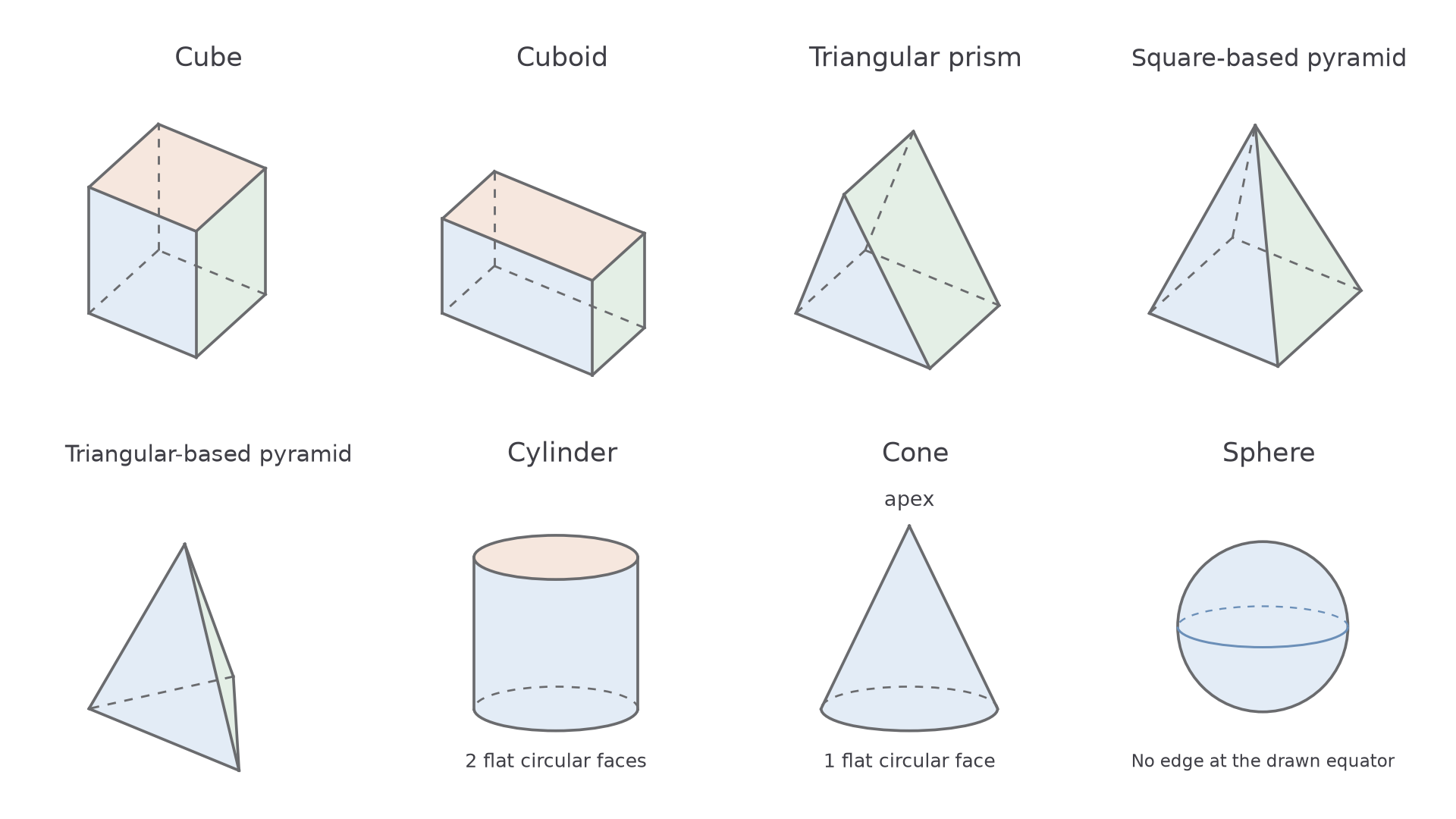
A prism has two congruent, parallel polygonal end faces and the same cross-section all along the direction between them. Congruent means the same shape and size. Its other faces are parallelograms; for a right prism they are rectangles. Name a prism after its end shape, not after whichever face is easiest to see. A triangular prism has two triangular ends, not just one triangle somewhere on its surface.
A pyramid has a polygonal base and triangular side faces that meet at one apex. A square-based pyramid has one square face and four triangular faces. A triangular-based pyramid has four triangular faces in total; it is also called a tetrahedron. Its base is not an extra fifth face.
| Solid | Flat faces | Curved surfaces | Edges | Vertices |
|---|---|---|---|---|
| Cube | squares | straight | ||
| Cuboid | rectangles | straight | ||
| Triangular prism | triangles and side faces | straight | ||
| Square-based pyramid | square and triangles | straight | ||
| Triangular-based pyramid | triangles | straight | ||
| Cylinder | circles | circular rims | ||
| Cone | circle | circular rim | apex | |
| Sphere |
A cube is a special cuboid: square faces are also rectangles. Changing a cuboid's lengths changes its shape, but not its face, edge or vertex counts. Changing the number of sides in a prism's end does change those counts.
Worked example 1: counting a prism systematically
Question. Work out the numbers of faces, edges and vertices of a triangular prism.
Plan. Count each end, then count what joins the ends.
- Faces: two triangular ends and three side faces give .
- Edges: each end has three edges, and three further edges join corresponding vertices: .
- Vertices: three on each end give .
Answer. faces, edges and vertices.
Check. Each of the five faces has been included once. In particular, the hidden triangular end is counted as well as the visible one.
Keep the same structure, but replace each triangular end by a hexagon.
Worked example 2: a different prism end
Question. Work out the numbers of faces, edges and vertices of a hexagonal prism.
Plan. Repeat the end-and-joining-parts count with six sides per end.
- Faces: two hexagonal ends and six side faces give .
- Edges: six on each end and six joining edges give .
- Vertices: six on each end give .
Answer. faces, edges and vertices.
Check. Each vertex belongs to one of the two hexagonal ends. There are twelve such vertices, with one joining edge for each of the six corresponding pairs.
The counting method extends to other prisms without memorising another row of numbers.
Watch out
“A triangular prism has three faces because it is triangular” confuses the end shape with the whole solid. It has two triangular ends plus three side faces. A pyramid instead has one base and side triangles meeting at an apex.
Use the same count with a new polygonal end.
Plans and elevations
A plan or elevation shows a solid as seen looking straight towards it, without perspective shrinking the parts farther away.
Plan and elevation
A plan is the view vertically from above. An elevation is a view horizontally from a specified direction. A front elevation looks straight at the front; a side elevation looks straight at the stated side. These are flat, two-dimensional views.
Three perpendicular directions separate the dimensions:
| View | Dimensions that remain | Dimension hidden along the viewing direction |
|---|---|---|
| Plan | Width and depth | Height |
| Front elevation | Width and height | Depth |
| Right-side elevation | Depth and height | Width |
For a cuboid wide, deep and high, the plan is a by rectangle, the front is a by rectangle, and the side is a by rectangle. The front and plan must agree on width; the front and side must agree on height. A sloping edge in a perspective sketch does not mean that the elevation should be sloping.
The same idea identifies other solids. An upright cylinder has a circular plan and rectangular front elevation. An upright cone also has a circular plan, but its front elevation is triangular. A square-based pyramid with its apex above the base centre has a square plan, with lines from the corners to the projected apex at the centre, and triangular elevations. A triangular elevation alone does not prove that a solid is a triangular-based pyramid.
[DIAGRAM: asset_name: Views of a cube arrangement; asset_slug: cube-views; caption: An elevation shows the tallest stack along each line of sight, rather than the sum of the stacks.; description: An exact unit-cube arrangement has three stacks across each row. From left to right its front row heights are 1, 3, 2 and its back row heights are 2, 1, 0. Arrows specify the front and right-side directions. Aligned flat views show five occupied plan cells, front heights 2, 3, 2 and right-side heights 3, 2 from front to back.]
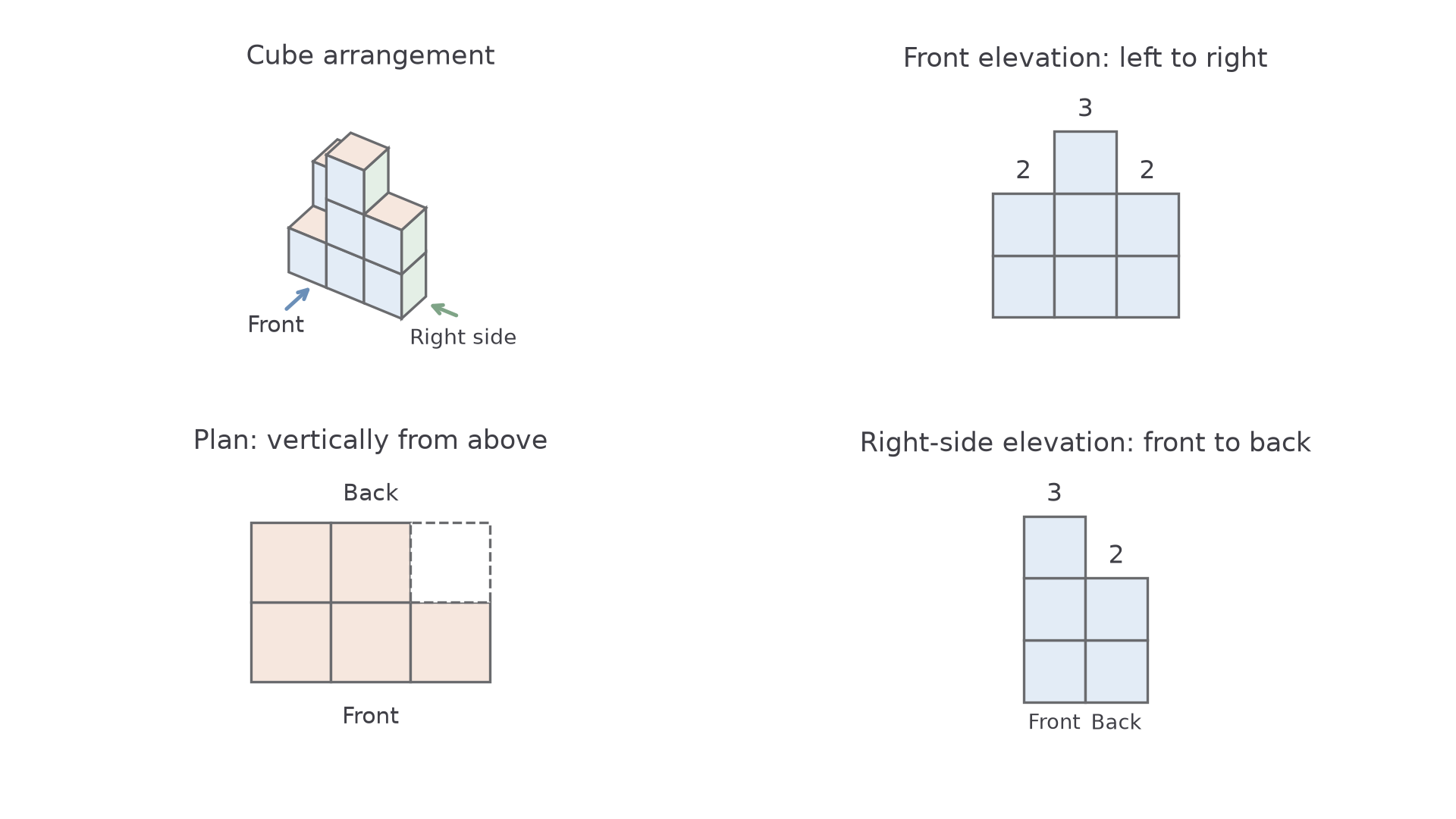
For stacks of unit cubes standing on a table, a height plan records the number of cubes in each vertical stack. A zero means an empty position. The drawing above is described by this table; the front row is the row nearest the observer looking from the front.
| Row | Left | Middle | Right |
|---|---|---|---|
| Back | |||
| Front |
To draw the plan on squared paper, shade one square for each occupied position: omit only the zero positions. For the front elevation, look through the depth in each left-to-right position. Draw a column as high as the largest stack on that line of sight. For a side elevation, look across the width and repeat for each front-to-back position. Keep a consistent square scale, use a ruler for the outlines and label the view. These cube arrangements have no gaps below the top cube of a stack.
Worked example 3: constructing the three views
Question. For the height table above, describe the plan and give the front-elevation heights from left to right and the right-side-elevation heights from front to back.
Plan. Mark occupied cells for the plan, then use the greatest height along each viewing line.
The plan has all three front positions and the left two back positions: five unit squares.
For the front view, compare the front and back stacks at each position:
From the right, the greatest front-row height is ; the greatest back-row height is .
Answer. Plan: five occupied cells, with the back-right cell missing. Front: . Right side, front to back: .
Check. The tallest stack is three cubes, so both elevations must reach height . Neither can reach height by adding stacks behind one another.
Continue this lesson.
You’re previewing NovaLearn without an account. Create a free account to read the rest.
Create free account