FN13, FR1, FG12, HN13, HR1, HG14 - Units and conversions
Convert everyday measures while keeping the quantity unchanged, calculate time across clock boundaries, and explain why area and volume need different conversion factors from length. FN13, HN13, FG12 and HG14 cover the standard measures; FR1 and HR1 connect their units, including squared and cubed units.
Metric measures
If , does as well? We will return to that question after finding what a unit conversion actually counts.
Units tell you the size of the pieces you are counting. One metre contains centimetres, so the same length needs a number times as large when you count centimetres. The length has not grown: the unit is smaller.
Conversion factor
A conversion factor links equivalent amounts in two units. For example, , so multiply a number of kilograms by to get grams, and divide grams by to get kilograms.
Choose the factor from the units, rather than move the decimal point by a guessed number of places.
| Measure | Equivalent standard amounts |
|---|---|
| Length | , , |
| Mass | , , tonne |
| Capacity | litre millilitres, written |
| Money | £ pence |
Smaller units give a larger numerical value; larger units give a smaller numerical value. This is a sense check, not a substitute for knowing the factor. For instance, converting kilometres to metres and kilograms to grams uses ; converting metres to centimetres uses .
Worked example 1: metres to centimetres
Question. Convert to centimetres.
Plan. Count centimetres for each metre.
Answer. .
Check. is , and is . Together they give .
Keep the same numerical value, but change the units. This time the factor is , not .
Worked example 2: kilograms to grams
Question. Convert to grams.
Plan. Use the mass relationship .
Answer. .
Check. Reverse the conversion: , recovering the original number of kilograms.
In the reverse direction, divide by the factor. Thus , because . Money works the same way: pence is £, because ; £ is pence. The zero in a money amount keeps the pence in the correct place.
Convert to a common unit before combining measures. A ribbon of and a ribbon of have total length , not of an unspecified unit.
Watch out
uses the metres-to-centimetres factor by mistake. Name the units and write a known equivalent pair before choosing to multiply or divide.
Use the factor and keep all lengths in one unit.
Time
Time conversions use groups of , rather than the groups of , and used in metric measures.
Elapsed time
Elapsed time is the duration between a start time and a finish time. A clock time names a moment; a duration tells you how long something lasts.
Use seconds minute, minutes hour and hours day. There are days in a week, but months do not all have the same number of days.
The 24-hour clock runs from 00:00 at midnight through 12:00 at noon to 23:59 just before the next midnight. For example, 16:20 means 4:20 pm. On a 12-hour clock, 12 am means midnight and 12 pm means noon. A time such as 18:45 has hours and minutes, not hours.
For elapsed time, count forwards through convenient hour boundaries. Specify the next day when the finish time is after midnight.
Worked example 3: crossing an hour
Question. A journey starts at 21:48 and finishes at 23:13 on the same evening. How many minutes does it take?
Plan. Count to the next hour, then whole hours, then the remaining minutes.
Answer. minutes, or hour minutes.
Check. Adding one hour to 21:48 gives 22:48. Adding another minutes gives 23:13.
Now move the same length of journey across midnight. The clock restarts at 00:00, but elapsed time keeps increasing.
Worked example 4: crossing midnight
Question. A journey starts at 23:48 and finishes at 01:13 the next day. How many minutes does it take?
Plan. Count forwards to midnight and then through the following morning.
Answer. minutes, or hour minutes.
Check. hours minutes plus hour minutes is hours minutes from the first day's midnight. Subtracting hours gives 01:13 the next day.
Decimal hours need a conversion too. In hours, the decimal part means of an hour:
So hours means hour minutes, not hour minutes. In the reverse direction, hours minutes is hours. To change minutes to seconds, calculate seconds.
Watch out
Subtracting clock displays as decimals ignores that an hour contains minutes. Count forwards or convert both times to minutes from a common starting point, allowing for the next day when needed.
Handle the day boundary and a decimal duration separately.
Area and volume units
An area counts unit squares; a volume counts unit cubes. A length conversion therefore acts in two directions for area and three directions for volume.
Square and cubic units
One square centimetre, , is the area of a square with sides . One cubic centimetre, , is the volume of a cube with edges .
Because , a square centimetre contains rows of square millimetres: . A cubic centimetre contains layers, each with cubic millimetres: .
[DIAGRAM: asset_name: Squared and cubed unit factors; asset_slug: squared-and-cubed-units; caption: Ten smaller units on each edge give one hundred squares or one thousand cubes.; description: A square with sides one centimetre is divided into ten rows of ten one-millimetre squares, showing one square centimetre equals one hundred square millimetres. A cube with edges one centimetre has ten unit lengths on each of its three edges, giving ten layers of one hundred one-millimetre cubes and one thousand cubic millimetres.]
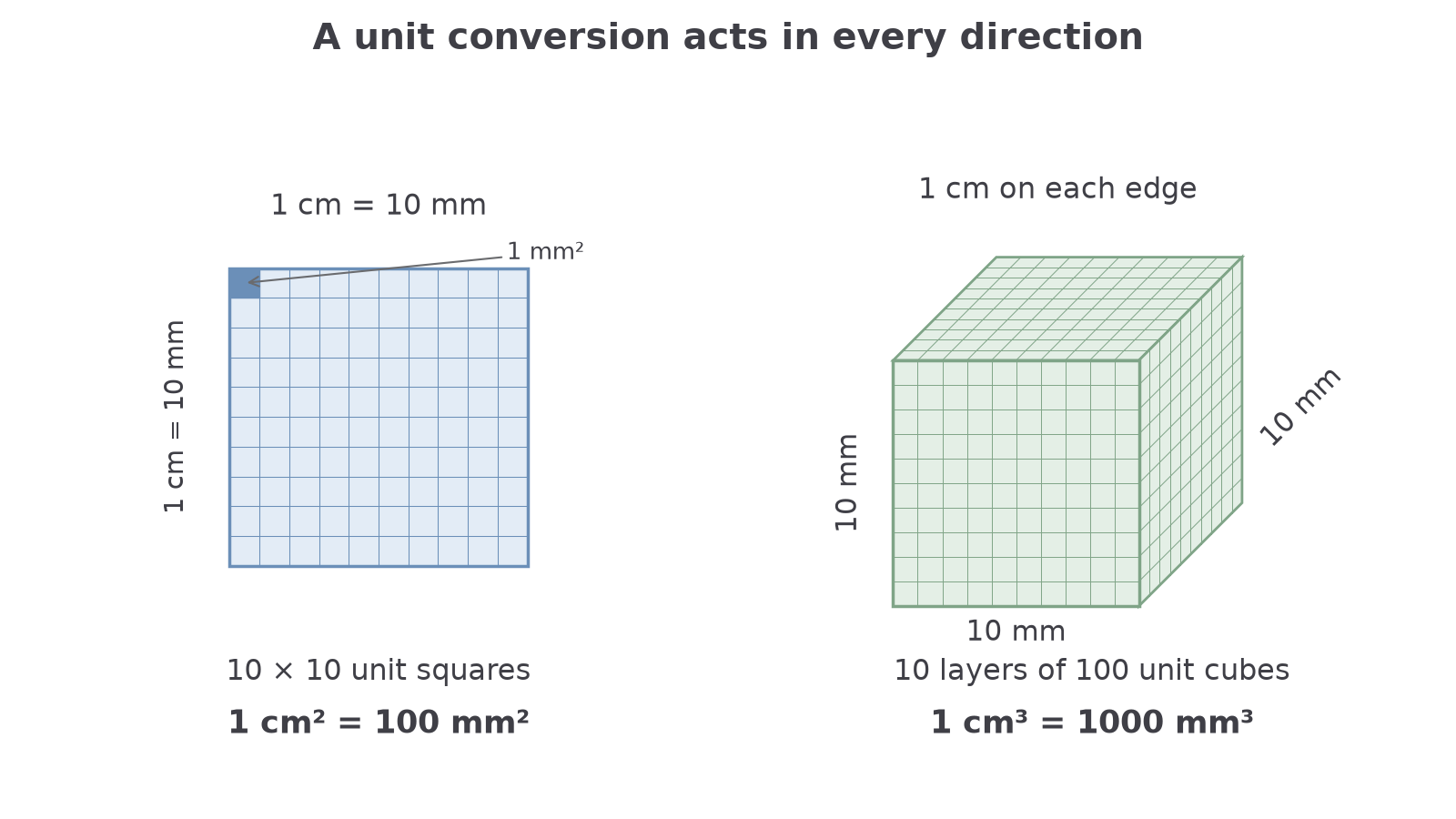
The same reasoning applies to metres and centimetres. The length factor is , so the area factor is , and the volume factor is .
| Converting metres to centimetres | Factor for the numerical value |
|---|---|
| Length: to | |
| Area: to | |
| Volume: to |
In general, square the length factor for area and cube it for volume. Divide by the corresponding factor when converting in the reverse direction.
Worked example 5: converting an area
Question. Convert to square centimetres.
Plan. Use the factor in both length directions, so multiply the area by .
Answer. .
Check. A rectangle by has this area. In centimetres its sides are and , so it contains square centimetres.
Change the dimension from area to volume while keeping the same starting numerical value. A third direction adds another factor of .
Worked example 6: converting a volume
Question. Convert to cubic centimetres.
Plan. Use the length factor in three directions, so multiply by .
Answer. .
Check. A cuboid by by has sides , and . Their product is cubic centimetres.
Volume and capacity are linked by and . Therefore . For example, is . Do not confuse a cubic metre with a litre.
This answers the opening question: is , but is . The numerical conversion factor depends on what the units measure.
Watch out
Converting by multiplying by uses a length factor once. Volume needs that factor three times. Read the exponent on the unit before calculating.
Convert a fresh volume using two different unit relationships.
Quick Recap
- A conversion changes the numerical value and unit together while preserving the quantity.
- Convert to a common unit before combining measures.
- Time uses minutes per hour. Count forwards across hour and midnight boundaries.
- Square a length conversion factor for area and cube it for volume.
The opening area needs a factor of , even though the corresponding length conversion needs only .