FG7, FG9, FG20, HG7, HG11, HG24 - Reflections, rotations and translations
Learn to reflect, rotate and translate shapes, and give the information that makes each transformation precise. FG7, FG9, HG7 and HG11 develop these movements on coordinates; FG20 and HG24 describe translations with two-dimensional vectors.
Reflections
A triangle can move without stretching, but “move it to the other side” is not a complete instruction. What must we specify to locate its image exactly? For a reflection, we need a mirror line.
Reflection
A reflection places each point on the opposite side of a mirror line at the same perpendicular distance. The mirror line is the perpendicular bisector of the segment joining a point to its image. Points on the line stay fixed.
To construct a reflection on squared paper, take one vertex at a time. Draw or count along a perpendicular to the mirror, then continue equally far beyond it. Label its image with a prime, such as , and join image vertices in the original order. The image is congruent to the original: side lengths and angles are unchanged, although its orientation is reversed.
Worked example 1: reflection in the vertical axis
Question. Triangle has vertices , , . Reflect it in the -axis and give its image coordinates.
Plan. Keep each height and reverse its signed horizontal distance from .
Answer. .
Check. Each corresponding pair has equal height and opposite horizontal coordinates, so its joining segment is horizontal with midpoint on the -axis. The mirror is its perpendicular bisector.
Keep the triangle but change the mirror to the diagonal . A horizontal count alone is no longer a perpendicular distance to the mirror.
Worked example 2: a diagonal mirror
Question. Reflect the same triangle in .
Plan. Swap each point's horizontal and vertical coordinates; this exchanges its position across the diagonal.
Answer. . Point is on the mirror, so it stays fixed.
Check. The midpoint of is , on ; crosses the diagonal at a right angle. The same holds for .
The diagrams show the two different mirror lines, with the same original triangle.
[DIAGRAM: asset_name: Reflecting a triangle in two mirror lines; asset_slug: reflection-pair; caption: Mirror lines bisect the perpendicular joins between corresponding points.; description: Two exact coordinate panels reflect A(1,1), B(4,1), C(2,3) in the y-axis and in y=x. Originals are pale blue, images pale sage, mirror lines dashed grey, and selected corresponding joins are perpendicular to the mirrors. A is fixed in the second panel.]
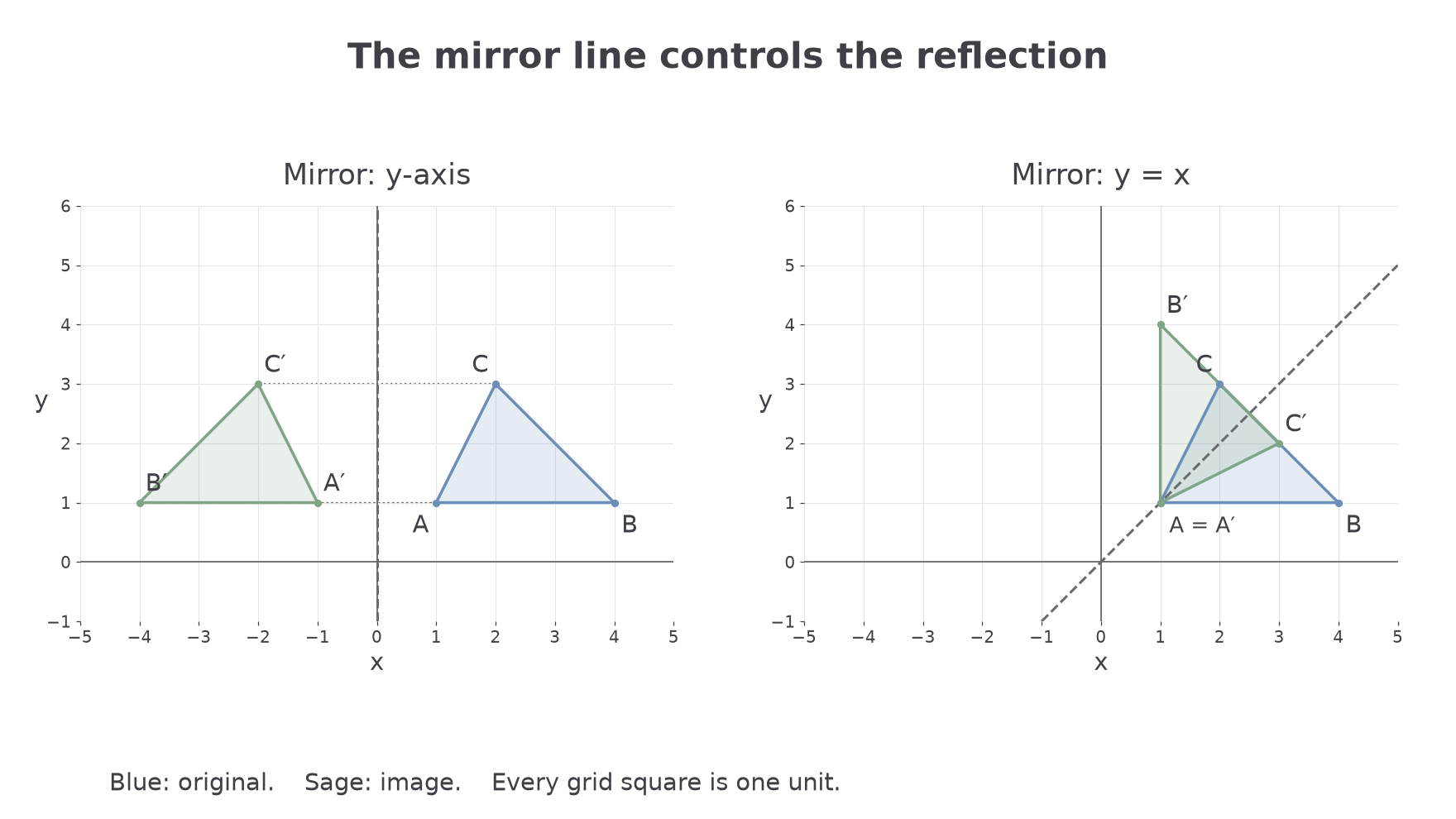
For the -axis, keep and reverse the sign of . For , swap the coordinates and reverse both signs. A mirror away from the axes needs distances from that mirror: reflecting in gives , since both are units from the line. Similarly, reflected in gives .
Watch out
Reflecting in the -axis changes the horizontal coordinate, not the vertical one. Name the line, then check equal perpendicular distances instead of changing a sign by memory alone.
Use a fresh triangle with the diagonal mirror.
Rotations
A rotation turns every point through the same angle about a fixed centre. Each point stays the same distance from that centre.
Rotation
A rotation is specified by its centre, angle and clockwise or anticlockwise direction. A half-turn is , for which either direction gives the same image. The centre stays fixed; lengths and angles are preserved.
On paper, a tracing sheet pinned at the centre helps turn the whole shape accurately. On coordinates, first describe each vertex's horizontal and vertical displacement from the centre. Turn that displacement, then start it from the same centre again.
| Turn about the origin | Displacement rule |
|---|---|
| anticlockwise | |
| clockwise | |
A clockwise turn has the same image as anticlockwise. These coordinate rules apply directly only when the centre is the origin; another centre requires relative displacements.
Worked example 3: a quarter-turn about the origin
Question. Rotate , , through anticlockwise about .
Plan. Turn each displacement using .
Answer. .
Check. Turning each image clockwise reverses the operation: for example, returns .
Keep the shape, angle and direction, but move the centre to . The absolute-coordinate rule must now be applied to displacements from that point.
Continue this lesson.
You’re previewing NovaLearn without an account. Create a free account to read the rest.
Create free account