FN1–FN2, HN1–HN2 - Place value and number order
A number's digits tell you its value only when you know where they sit. Learn to read decimal place values, compare positive and negative numbers, and write comparisons with mathematical symbols. This begins FN1 and HN1 on number order, and FN2 and HN2 on place value; comparing fractions and performing calculations come later.
Digit values
Which is larger: or ? The second has more digits, but that alone cannot tell us which number is larger. Start by finding what each digit is worth.
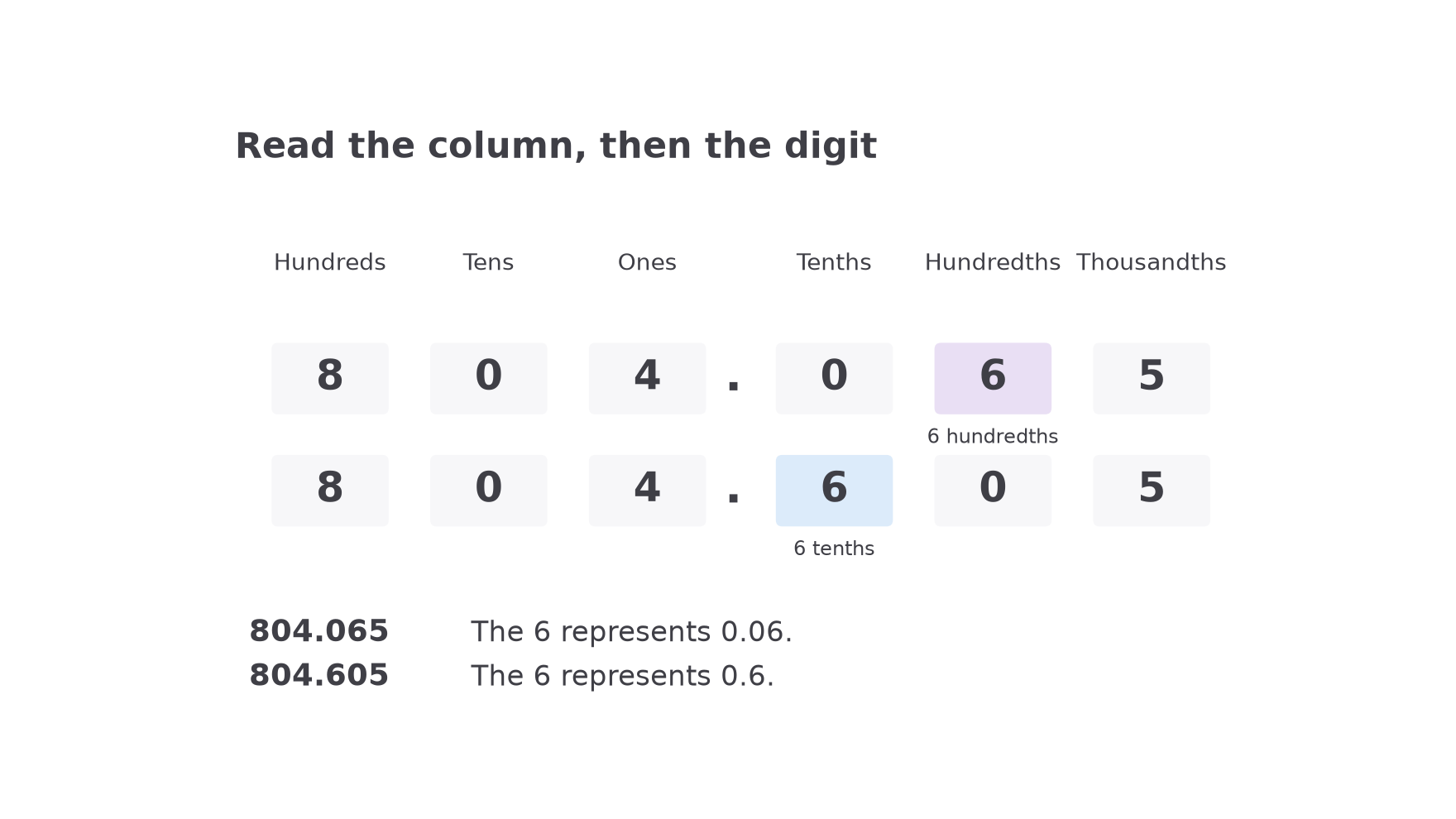
In , the means eight hundreds, the means four ones, and the means six hundredths. Each place is worth one tenth of the place immediately to its left. The decimal point separates the ones from the tenths.
Place value
A digit's place value tells you the size of the units it counts. The digit has value in , but value in .
A zero can hold a place even though it contributes no value. The zero in the tenths column of keeps the in the hundredths column.
[DIAGRAM: asset_name: Reading decimal places; asset_slug: decimal-place-value; caption: The same digits have different values when their positions change.; description: Place-value table comparing 804.065 and 804.605,with columns hundreds,tens,ones,tenths,hundredths,thousandths; six hundredths highlighted in the first row and six tenths in the second.]
Worked example 1: reading a digit's value
Question. Write down the value of the in .
Plan. Name the column containing the .
Moving right from the decimal point gives tenths, then hundredths. The is in the hundredths column, so it represents six hundredths.
Answer. .
Check. The number partitions as , so the value fits its position.
Now move the same digit one place left. Its value becomes ten times as large.
Worked example 2: a different position
Question. Write down the value of the in .
Plan. Find its column rather than count the digits in the whole number.
The is immediately after the decimal point: it represents six tenths.
Answer. .
Check. . Replacing by would give a different number.
The digit stayed the same; its position changed its value.
Watch out
The value of the in is , not . Give the amount it represents, rather than simply repeat the digit.
Use the column names to read a new number.
Comparing decimals
Compare decimals by the first place where their digits differ, working from left to right.
Writing as does not change its value: the added zero contributes zero thousandths. This makes the opening comparison easier to see:
Both numbers have four tenths. The first has five hundredths; the second has none. So is larger, despite having fewer decimal digits.
Equal decimal values
Zeros added at the end of a decimal do not change its value: . A zero inserted between existing digits can change their positions: .
Align the decimal points, then compare whole-number places, tenths, hundredths and so on. Once a place differs, smaller places cannot reverse the decision.
Worked example 3: unequal lengths
Question. Which is larger, or ?
Plan. Write both to the same number of decimal places and compare left to right.
Answer. is larger.
Check. lies between and ; it has not reached .
The next pair has matching tenths, so compare one place further to the right.
Worked example 4: matching tenths
Question. Write and in increasing order.
Plan. Align the decimals and find the first different column.
The tenths match. In the hundredths column, has , while has .
Answer. .
Check. Both are between and , but is only six thousandths above ; is six hundredths above it.
The decimal point is not a separator between two independent whole numbers.
Watch out
“, so ” compares the wrong units. Compare with : thousandths with thousandths.
Try a comparison in which a zero's position matters.
Ordering negative numbers
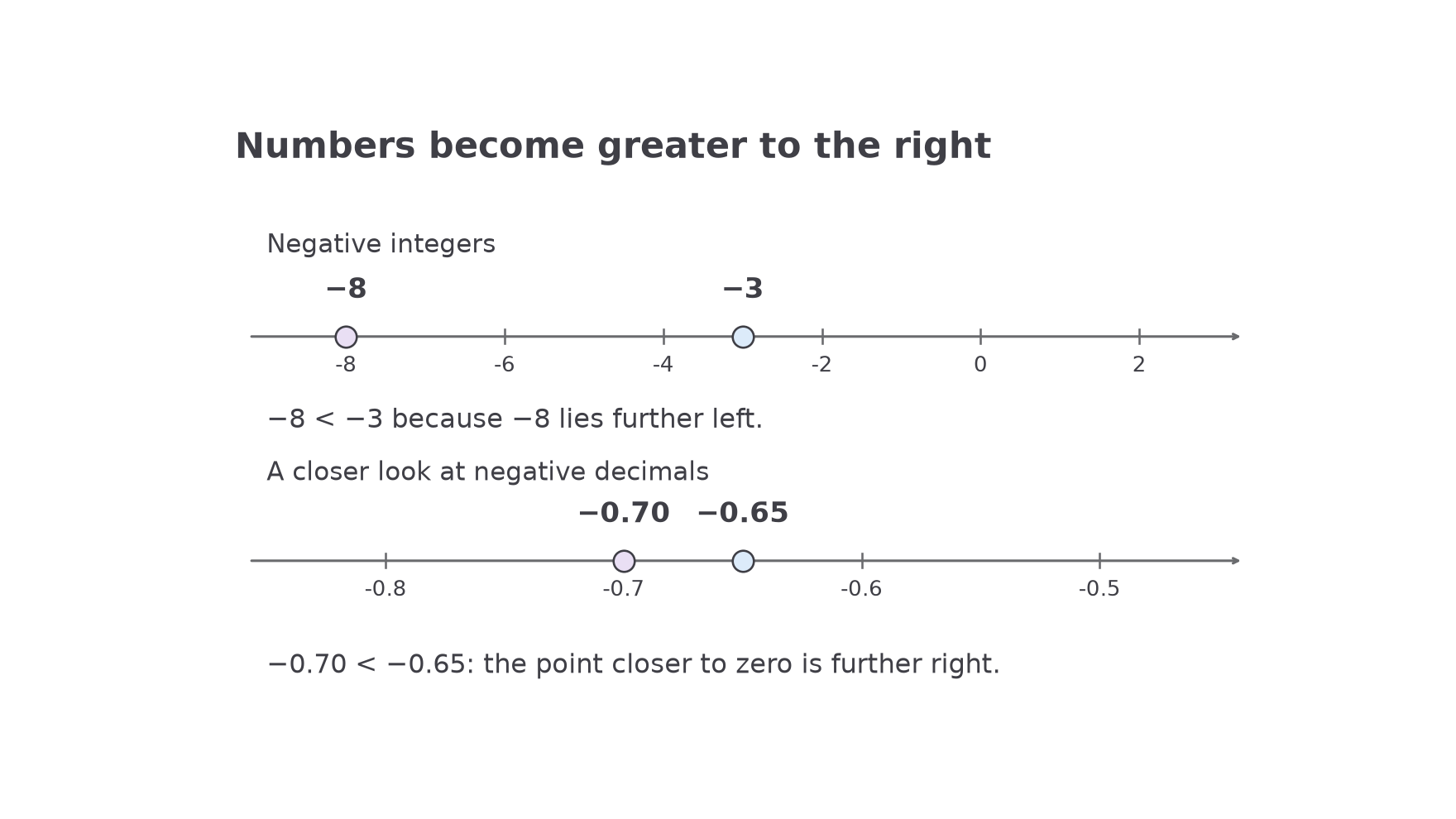
A number further right on a number line is greater. This rule works on both sides of zero.
For example, is greater than : is closer to zero, and lies further right. A colder temperature can have a larger digit after its minus sign, so comparing only the digits gives the wrong result.
Positive, negative and integer
A positive number is greater than zero; a negative number is less than zero. Zero is neither positive nor negative. Integers are the whole numbers and their negatives, including zero: .
For two negative numbers, the one closer to zero is greater. Thus , even though .
[DIAGRAM: asset_name: Ordering signed numbers; asset_slug: signed-number-lines; caption: Values increase to the right, including on the negative side of zero.; description: Two exact number lines show integer points minus 8 and minus 3 around zero,and a magnified decimal line showing minus 0.70 and minus 0.65,with the rightward direction labelled greater.]
Worked example 5: negative integers
Question. Write in increasing order.
Plan. Place the negatives to the left of zero and read from left to right.
Among the negatives, lies further left than . Zero comes next, followed by the positive number.
Answer. .
Check. Reading backwards gives decreasing values: .
The same rule applies when the negative numbers are decimals.
Worked example 6: negative decimals
Question. Which is greater, or ?
Plan. Write , then compare their positions relative to zero.
The distance from to zero is . The distance from to zero is smaller, , so lies further right.
Answer. is greater.
Check. A temperature of is warmer than , agreeing with the number line.
“Closer to zero means greater” applies when both numbers are negative. A positive number is greater than any negative number, regardless of their distances from zero.
Key idea
Read a number line from left to right for increasing order. Keep each minus sign attached to its number.
Order a mixture of negative decimals, zero and a positive number.
Writing inequalities
Comparison symbols turn a decision about order into a short mathematical statement.
| Symbol | Meaning | True example |
|---|---|---|
| is equal to | ||
| is not equal to | ||
| is less than | ||
| is greater than | ||
| is less than or equal to | ||
| is greater than or equal to |
The narrow end of or points to the smaller value. The extra line in or allows equality as well. If a parcel must have mass at most , a mass of exactly is allowed.
Worked example 7: choosing a symbol
Question. Complete using , or .
Plan. Compare the signed values before choosing the symbol.
is closer to zero than , so it is greater.
Answer. .
Check. The smaller number, , is at the narrow end of . Read the statement aloud: “negative one point zero eight is greater than negative one point eight”.
You can join two comparisons to show the order of three numbers. Both comparisons must be true.
Worked example 8: an inequality chain
Question. Write in increasing order, using .
Plan. Order the values first, then join each neighbouring pair with .
Write . Then lies just to its left, while lies to its right.
Answer.
Check. and are each true, so the whole chain is true.
Equality also belongs in number comparisons: and name the same point on a number line. That is why the opening question has answer , rather than a decision based on how many digits each has.
Exam tip
When asked for increasing order, start with the least value. If asked for a symbol, write the symbol between the given numbers without swapping their positions.
Use equality and order in two separate statements.
Quick Recap
- A digit's value comes from its column.
- Align decimal places to compare values; trailing zeros preserve a decimal's value.
- Numbers increase to the right on a number line, including below zero.
- Use to state exactly which comparison you mean.