HA9, HA16 - Perpendicular lines and circle tangents
Use perpendicular gradients to connect straight lines with origin-centred circles. HA9 supplies the line methods; HA16 uses a circle equation and the radius-tangent right angle to find tangent equations.
Perpendicular gradients
A radius points from a circle's centre to a contact point. How can its direction determine a tangent's equation? First translate a right angle into a relationship between gradients.
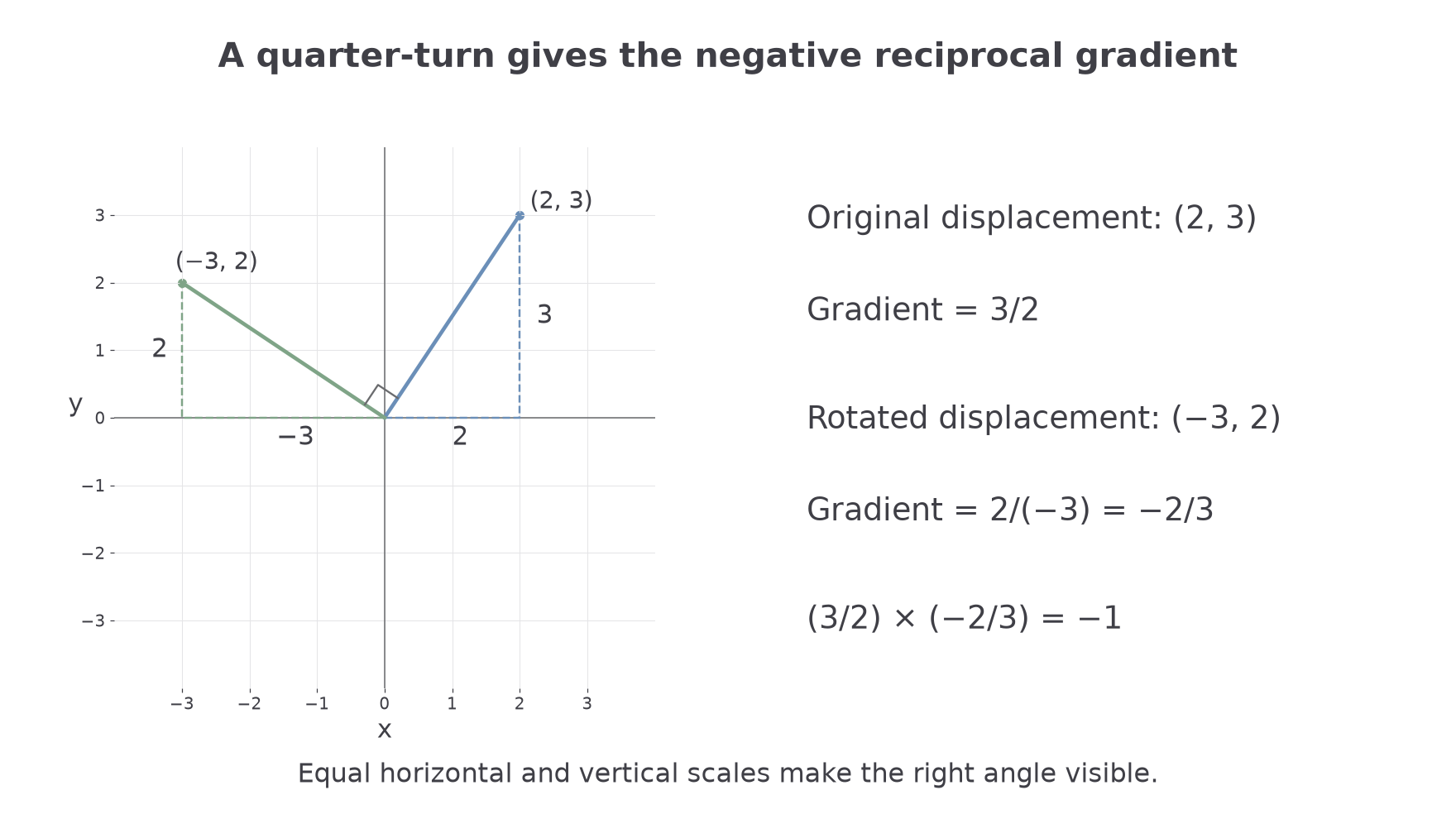
Perpendicular lines meet at . Suppose a line has horizontal and vertical steps , with . Its gradient is . Turning the step anticlockwise gives , whose gradient is . The two gradients therefore multiply to .
Negative reciprocal gradients
For two perpendicular lines with finite, non-zero gradients,
Change the sign and take the reciprocal. A horizontal line has gradient zero and is perpendicular to a vertical line, whose gradient is undefined; that pair must be treated separately.
The step rotation explains the reciprocal as well as the sign change.
[DIAGRAM: asset_name: A right angle changes the gradient; asset_slug: perpendicular-steps; caption: Turning a displacement(a,b) through90degrees gives(-b,a), so the gradients are negative reciprocals.; description: Exact equal-scale coordinate diagram shows origin-based perpendicular displacements(2,3) and(-3,2), their horizontal/vertical step triangles and a right-angle marker. The gradients are3/2 and minus2/3.]
Worked example 1: perpendicular to a positive gradient
Question. Find the line through perpendicular to .
Plan. Find the negative reciprocal gradient, then substitute the given point into .
Answer. , or .
Check. At , . Its gradient times the given gradient is , as a right angle requires.
Change the original gradient to its own negative reciprocal. The perpendicular gradient becomes the earlier positive gradient.
Worked example 2: perpendicular to a negative gradient
Question. Find the line through the same point , perpendicular to .
Plan. Take the negative reciprocal of , then use the point.
Answer. .
Check. The point satisfies , and the gradient product is . Applying the negative-reciprocal operation twice returns the original gradient.
If a line is not already written as , rearrange it before reading its gradient. For example, has gradient , not .
Watch out
Changing only the sign gives a negative gradient but usually not a perpendicular line. For gradient , the perpendicular gradient is , not . For horizontal/vertical lines, use their directions instead of trying to divide by zero.
Find a new perpendicular line from an equation in another form.
Origin-centred circles
For a point on a circle of radius centred at , the horizontal and vertical displacements form the shorter sides of a right triangle. Pythagoras gives
This works in every quadrant: the actual leg lengths are , whose squares are . Points on the axes satisfy the same equation directly.
Equation of an origin-centred circle
describes all points at distance from the origin, with . Take the positive square root of the constant to find the radius. To find a missing coordinate, solve its square equation and retain both signs unless the point's position restricts it.
For example, has radius , not . Constant zero gives only the origin, not a positive-radius circle; a negative constant gives no real points because squares cannot sum to a negative number.
Worked example 3: the two possible heights
Question. A circle is centred at the origin with radius . Write its equation and find both circle points whose -coordinate is .
Plan. Square the radius, substitute the known coordinate and solve for .
Answer. The equation is ; the points are .
Check. Both give . They are reflections across the horizontal axis, as the origin-centred circle requires.
Keep the circle and reverse the sign of the known horizontal coordinate. Squaring removes that sign, while the points move to the other half of the circle.
Worked example 4: a negative known coordinate
Question. Find both points on whose -coordinate is .
Plan. Substitute with brackets, then solve the same square equation.
Answer. .
Check. Each point is distance from the origin, since . Reflecting the earlier two points across the vertical axis gives these two points.
If , the same circle gives only , since and coincide. If , the equation would require , so there is no real point. These boundaries agree with the circle's horizontal extent.
Continue this lesson.
You’re previewing NovaLearn without an account. Create a free account to read the rest.
Create free account