FG3–FG4, HG3–HG4 - Angles in triangles and polygons
Why does adding a side to a polygon add to its interior angle total? Derive triangle and polygon angle sums using FG3 and HG3, then use the special-triangle properties in FG4 and HG4 to find missing angles. Connect the angles of regular polygons to one full turn.
Triangle sum
Could three angles of , and belong to a triangle? Their total, rather than the appearance of a sketch, decides.
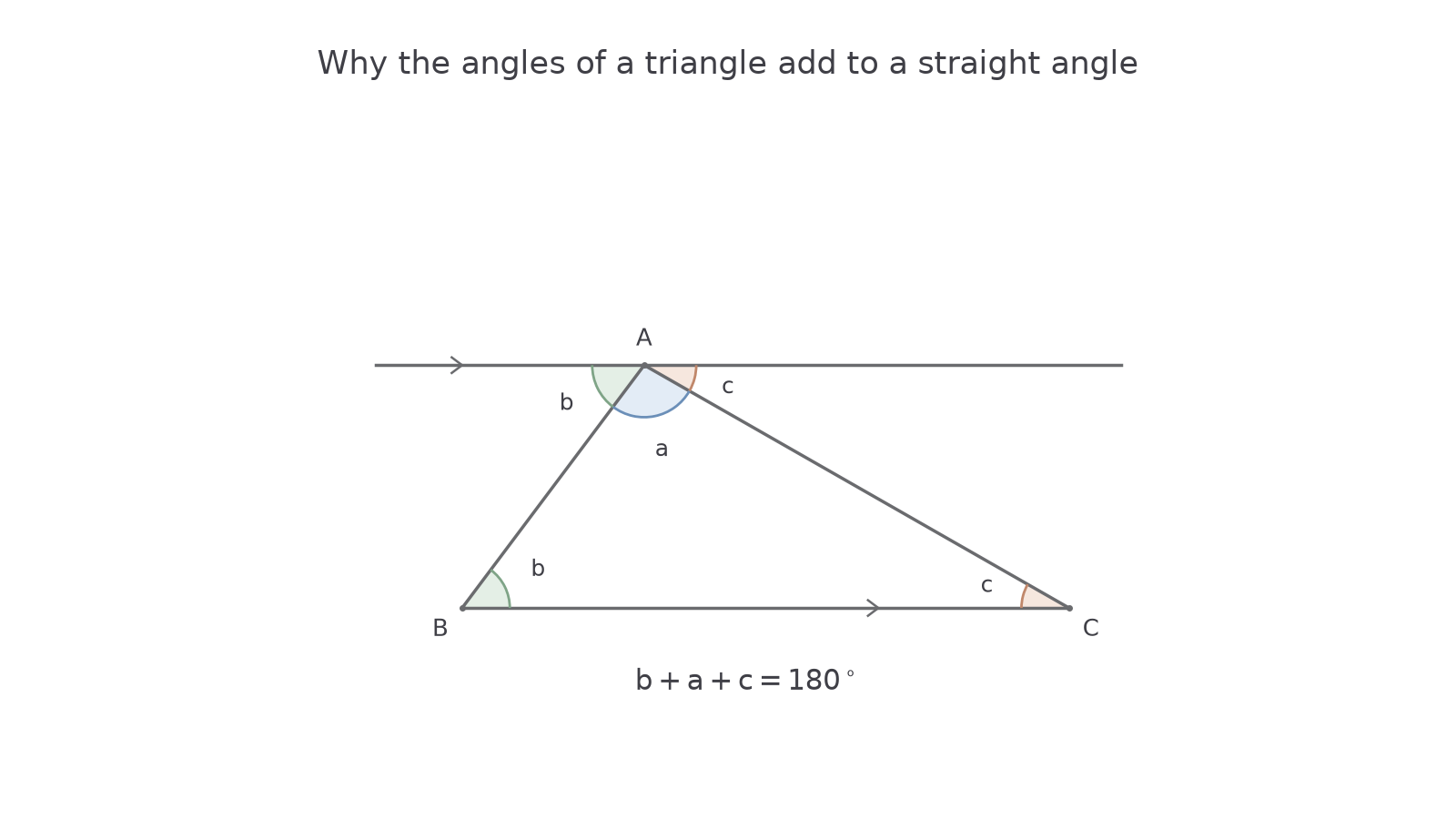
Draw a line through vertex of triangle , parallel to . The angles between that line and , and between that line and , equal the angles at and by alternate angles. Together with the angle at , they fill a straight angle.
[DIAGRAM: asset_name: Deriving the triangle angle sum; asset_slug: triangle-angle-derivation; caption: A line parallel to the base brings the three triangle angles together on a straight line.; description: A scalene triangle ABC has a horizontal base BC and a horizontal line through A marked parallel to BC. Angles at B and C are labelled b and c, the angle at A is a, and the corresponding alternate sectors at A are labelled b and c.]
Triangle angle sum
The three interior angles of a triangle add to :
This applies to every triangle in a flat plane. Not in the formula booklet: learn it.
An isosceles triangle has two equal sides and equal angles opposite them. An equilateral triangle has all three sides equal, so all three angles are equal: . In a right-angled triangle, the other two angles sum to . Equal sides need not be drawn upright; find the angle opposite each marked side.
Worked example 1: an isosceles triangle
Question. In triangle , and angle . Work out the two base angles.
Plan. Subtract the vertex angle, then share the remaining total equally.
Answer. Both base angles are .
Check. , and the angles opposite the equal sides match.
Change which angle is known: the equal pair is now the starting information.
Worked example 2: a known base angle
Question. In triangle , and angle . Work out angle . The side is then extended past to ; find angle .
Plan. Identify the equal base angles, use the triangle sum, then a straight line.
Answer. , .
Check. The exterior angle equals the two remote interior angles . In any triangle this follows by subtracting its third angle from .
Use the equality markings before deciding which angle to double.
Watch out
An isosceles triangle does not have three equal angles unless it is equilateral. If the vertex angle is , dividing into three equal pieces discards the given information.
Find a vertex angle and its adjacent exterior angle.
Polygon sums
Split a polygon into triangles to turn a many-sided problem into a familiar one.
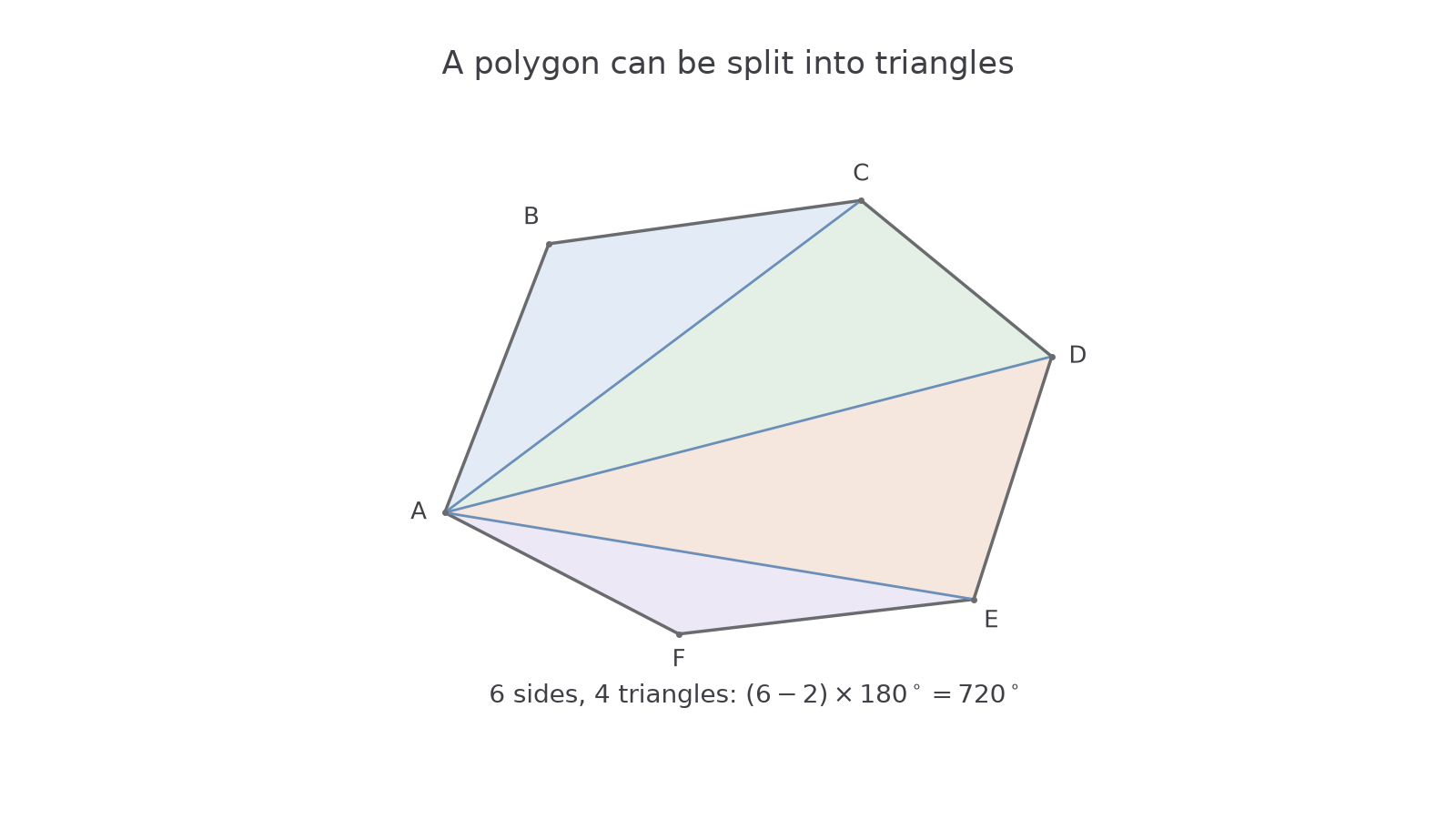
A quadrilateral splits into two triangles along a diagonal, giving . A pentagon splits into three triangles, giving . Each extra vertex adds one more triangle.
[DIAGRAM: asset_name: Triangulating a polygon; asset_slug: polygon-triangulation; caption: A six-sided polygon splits into four triangles without adding an interior vertex.; description: An irregular convex hexagon ABCDEF has diagonals from A to C, D and E, creating four lightly shaded triangles. All six vertices are labelled, and text states six sides, four triangles.]
Interior angle total
For a simple polygon with sides,
There are triangles. The formula also holds for a concave polygon, including any reflex interior angles, if it is split into triangles without overlap. Not in the formula booklet: learn it.
Continue this lesson.
You’re previewing NovaLearn without an account. Create a free account to read the rest.
Create free account