FR6, FR8–FR9, HR6, HR8–HR9 - Sharing and solving ratio problems
Use equal parts to share totals, reconstruct missing amounts and scale mixtures. Then connect linked ratios and use a common multiplier to form equations. FR6 and HR6 supply the sharing contexts; FR8–FR9 and HR8–HR9 connect equivalent proportions, fractions and linear relationships.
Sharing and recovering totals
Does a ratio tell you how much money each person receives? It fixes the relative sizes, but you need one amount to set the value of an equal part.
For example, sharing £ in the ratio means sharing equal parts. One part is £ £, so the shares are £ and £. Dividing by or would confuse one person's parts with all the parts.
Common part value
In a ratio share, every part has the same value. Divide a known amount by the number of parts it represents, then multiply that part value by the required number of parts.
With more than two recipients, add every ratio entry when the known amount is the total.
Worked example 1: three shares from a total
Question. A, B and C share £ in the ratio . Work out each share.
Plan. Find the value of one of the equal parts.
Answer. A receives £, B £ and C £.
Check. , and dividing the three shares by gives .
Keep the same ratio, but now only one share is known. Divide by that share's parts, not by the total parts.
Worked example 2: recovering the total
Question. A, B and C share money in the ratio . B receives £. Work out the total amount.
Plan. B's £ represents parts; recover one part, then all .
Answer. £.
Check. B receives of £, which is £, as required.
The bars show why the same part value works for every recipient.
[DIAGRAM: asset_name: Equal parts in three shares; asset_slug: sharing-equal-parts; caption: All twelve parts have value twelve pounds each.; description: Three bars represent A to B to C in the ratio 3 to 5 to 4. Each segment is labelled twelve pounds, giving shares thirty-six, sixty and forty-eight pounds, with total one hundred and forty-four pounds.]
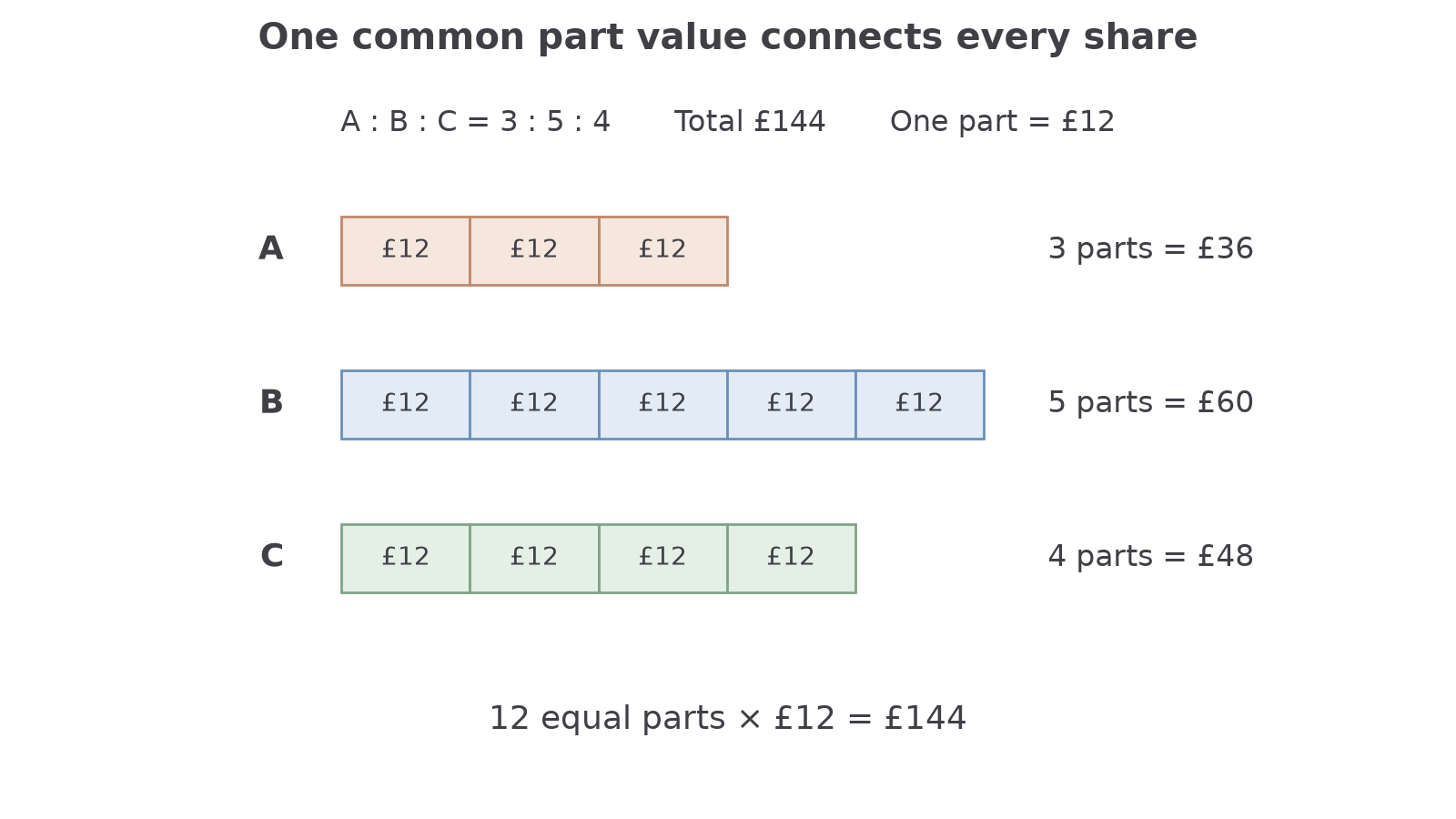
For indivisible objects, the resulting shares must be whole numbers. If counters must be shared in the ratio , there are parts and counters per part. A total of counters could not be shared exactly in that ratio without breaking counters or leaving some over.
Watch out
Ask “What does the known amount represent?” A total of £ and B's share of £ lead to different part values.
Recover a total from a different named share.
Ratios, fractions and mixtures
Scaling a mixture preserves its composition when every ingredient is multiplied by the same factor. The amount changes; each ingredient's fraction of the whole stays fixed.
Proportion
Two quantities are in the same proportion when their ratios are equal. For example, , or : both ingredients have been multiplied by .
For concentrate to water , concentrate is of the whole drink, because there are parts altogether. Concentrate to whole drink is , not . If given that part-to-whole ratio, subtract from to find the water parts.
Assume the component volumes add when using the drink mixtures below.
Worked example 3: a mixture from its total
Question. Concentrate and water are mixed in the ratio . Work out the amounts needed for of drink, giving both in millilitres.
Plan. Convert the total to millilitres, then share its parts.
Answer. concentrate and water.
Check. The amounts total , and . The concentrate fraction is .
Now the concentrate is known instead of the total. The composition is unchanged.
Worked example 4: scaling from an ingredient
Question. Concentrate and water are mixed in the ratio . All of concentrate is used. Find the water needed and the total drink volume.
Plan. The concentrate is parts, so divide by before scaling to water and total.
Answer. Add water to make of drink.
Check. , confirming the concentrate-to-water proportion.
The same method works for concentration by mass. A mixture of colouring and water has colouring fraction . A mixture with the same colouring but only water has colouring fraction , so it is more concentrated.
Watch out
Adding the same amount of each ingredient does not normally preserve a mixture. Starting from , adding one part of each gives , a different composition.
Continue this lesson.
You’re previewing NovaLearn without an account. Create a free account to read the rest.
Create free account