FG3, HG3 - Angle facts and parallel lines
Find missing angles without measuring the drawing. FG3 and HG3 supply the facts about turns, intersecting lines and parallel lines; use those facts to build equations and explain each step.
Basic angle facts
Two straight roads cross. One angle is : can you find the other three without a protractor? A drawing gives the arrangement, while angle facts give exact answers.
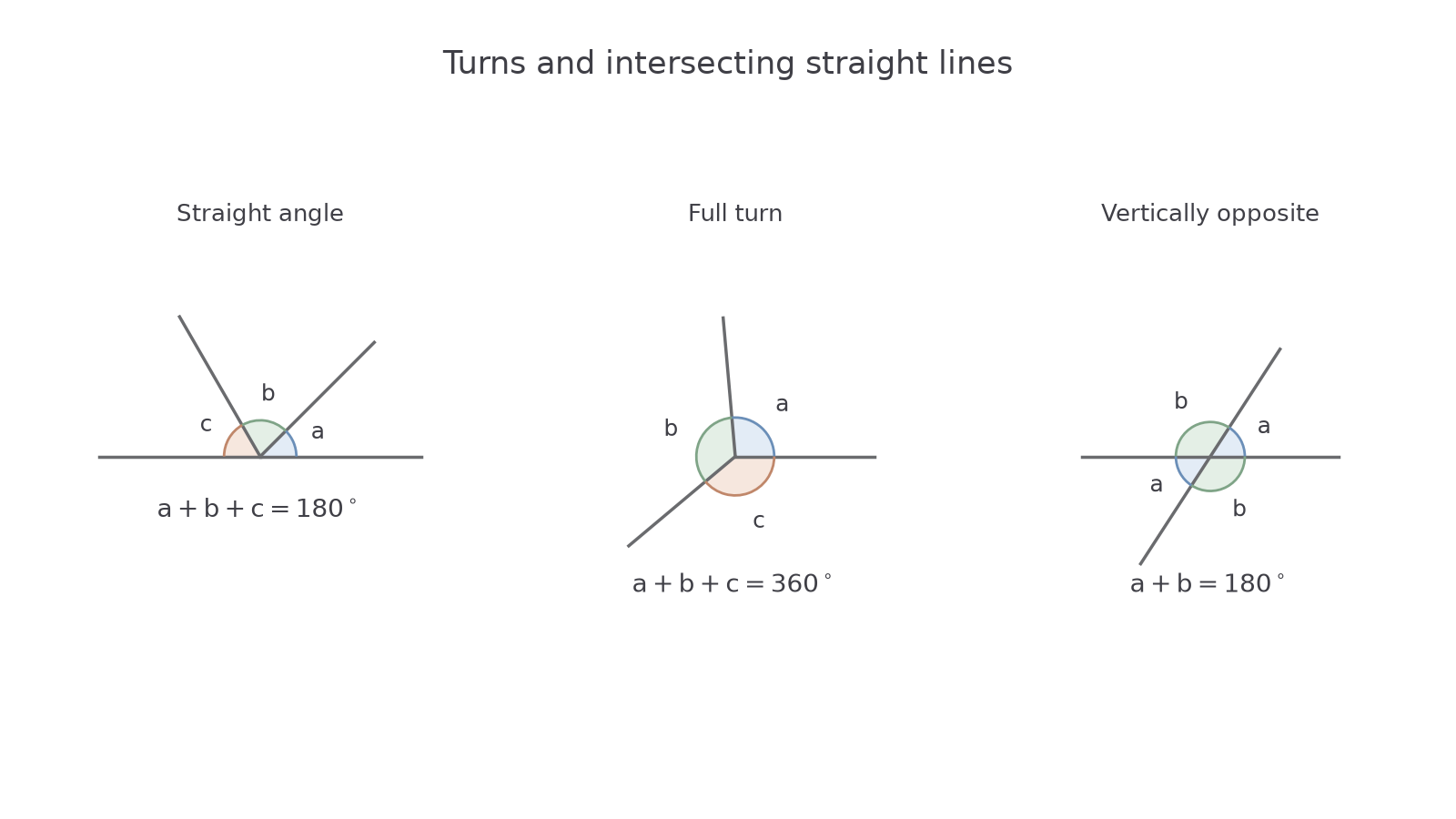
An angle measures a turn. One full turn is , half a turn is , and a quarter turn is . Angles around a point add to when they fill the whole turn with no gap or overlap. Angles on a straight line add to when they fill one side of that line.
Vertically opposite angles
When two straight lines cross, the pair of angles opposite one another are vertically opposite angles. They are equal. The word “vertically” does not mean that the lines must be upright.
Here is why they are equal. If neighbouring angles are and , then . If the angle opposite is , then . Subtracting the same gives .
[DIAGRAM: asset_name: Turns and intersecting lines; asset_slug: angle-basics; caption: A straight angle is half a full turn; opposite angles at a crossing are equal.; description: Three panels show three sectors completing a straight angle, three sectors around a point completing a full turn, and two crossing straight lines with equal opposite sectors labelled a and equal opposite sectors labelled b.]
Worked example 1: a straight line
Question. Three adjacent angles on one side of a straight line are , and . Work out .
Plan. Subtract the two known angles from a half turn.
Answer. , so the angle is .
Check. , as required.
The next example changes the available turn: the angles now surround the point completely.
Worked example 2: a full turn and a crossing
Question. Three angles around a point are , and . Separately, two straight lines cross with one angle . Find and the other three crossing angles.
Plan. Use a full turn for ; use opposite angles and straight lines at the crossing.
The two neighbours are also a vertically opposite pair.
Answer. ; the other crossing angles are in order around the point.
Check. and .
Name the complete turn before subtracting.
Watch out
“Angles touching each other add to ” is incomplete. They must fill a straight angle. Angles filling the whole turn add to .
Apply the crossing facts to new values.
Parallel lines
A line crossing two other lines is called a transversal. When the two lines are parallel, the transversal creates equal angles at different intersections.
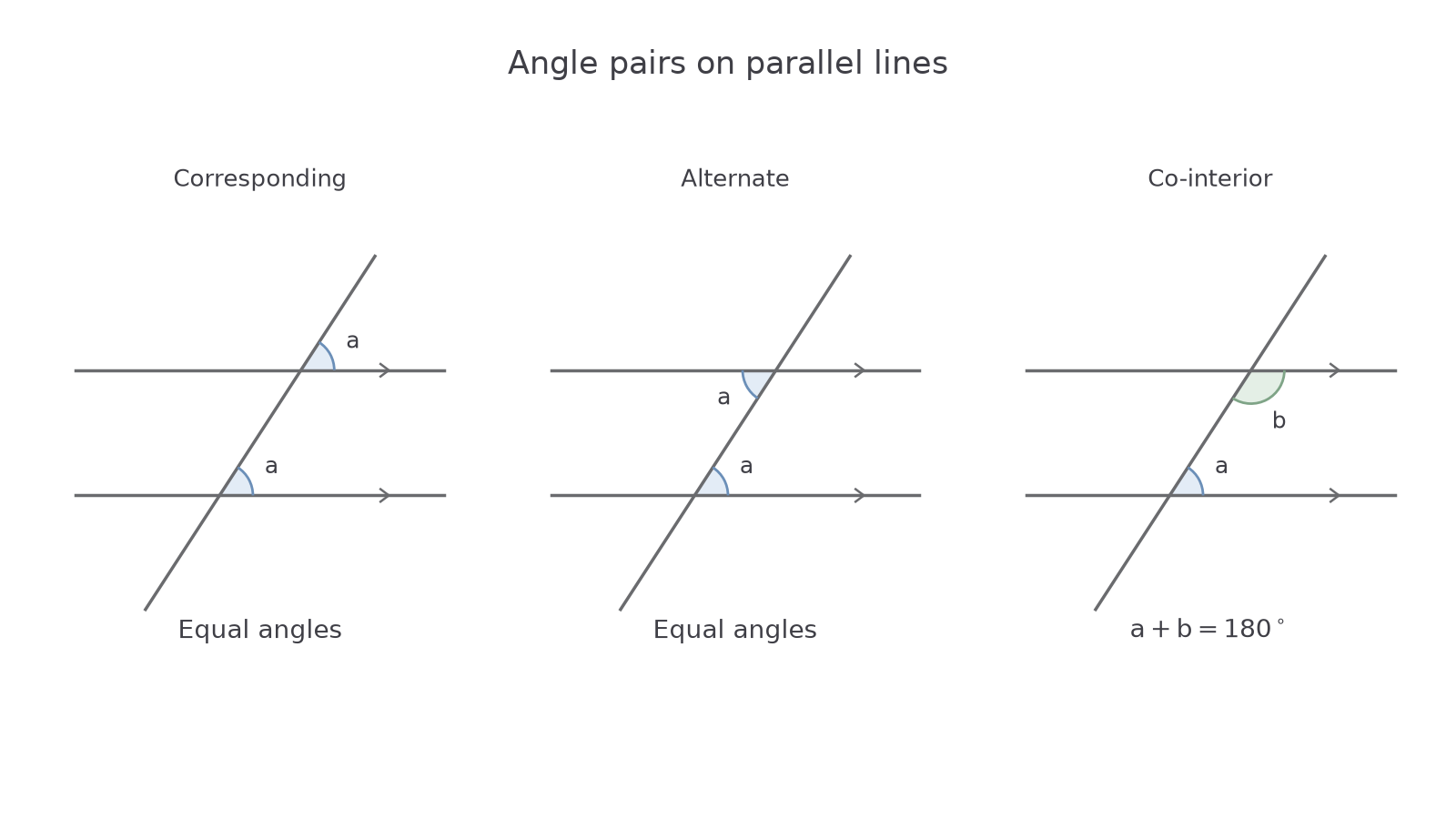
Follow the same side of the transversal at each crossing. Angles in the same relative position are corresponding angles. Inside the parallel lines, on opposite sides of the transversal, the angles form an alternate pair.
Parallel-line angle facts
For parallel lines cut by a transversal, corresponding angles are equal and alternate angles are equal. Interior angles on the same side of the transversal, also called co-interior angles, add to .
Co-interior angles add to because one equals an alternate angle adjacent to the other on a straight line. Do not decide from an apparent letter shape alone: identify the lines, the transversal and the angle positions. Parallel arrow marks or a stated fact establish that the lines are parallel.
[DIAGRAM: asset_name: Angle pairs on parallel lines; asset_slug: parallel-angle-pairs; caption: Corresponding and alternate pairs are equal; co-interior angles add to a straight angle.; description: Three panels show two horizontal parallel lines cut by an oblique transversal. Corresponding angles occupy matching positions, alternate angles lie inside on opposite sides, and co-interior angles lie inside on the same side.]
Continue this lesson.
You’re previewing NovaLearn without an account. Create a free account to read the rest.
Create free account