6.3 - Venn probabilities and mutually exclusive events
Learn to read probabilities from Venn regions, reconstruct missing counts and decide when event probabilities can be added. You will distinguish a whole circle from its “only” region and count each person once. This lesson applies at Foundation and Higher; its addition rule is for mutually exclusive events.
Reading Venn regions as events
In a group of learners, attend music and attend sport. Does that mean attend at least one club? What if attend both? The overlap is the key to this question.
You already know
An event selects outcomes from the universal set . For a person chosen uniformly at random, probability is the selected count divided by the total population.
A Venn diagram gives each person one place. Someone in both clubs goes in the overlap, rather than being drawn twice. The circles show membership; their areas do not measure the probabilities.
Venn events
The intersection means both and . The union means , or both. The complement means outside , but still inside . “ only” excludes the overlap.
Read “or” inclusively unless the question says “exactly one”. In this diagram the four separate regions contain , , and learners, totalling .
[DIAGRAM: asset_slug: m094_venn_example; caption: Clubs of forty learners, with twelve music only, eight both, ten sport only and ten neither; description: Universal set E contains 40 learners. Music-only region 12, intersection 8, sport-only 10, outside both 10. Circles are schematic and their areas do not represent frequency; file: m094_venn_example.png; recommended_method: matplotlib]
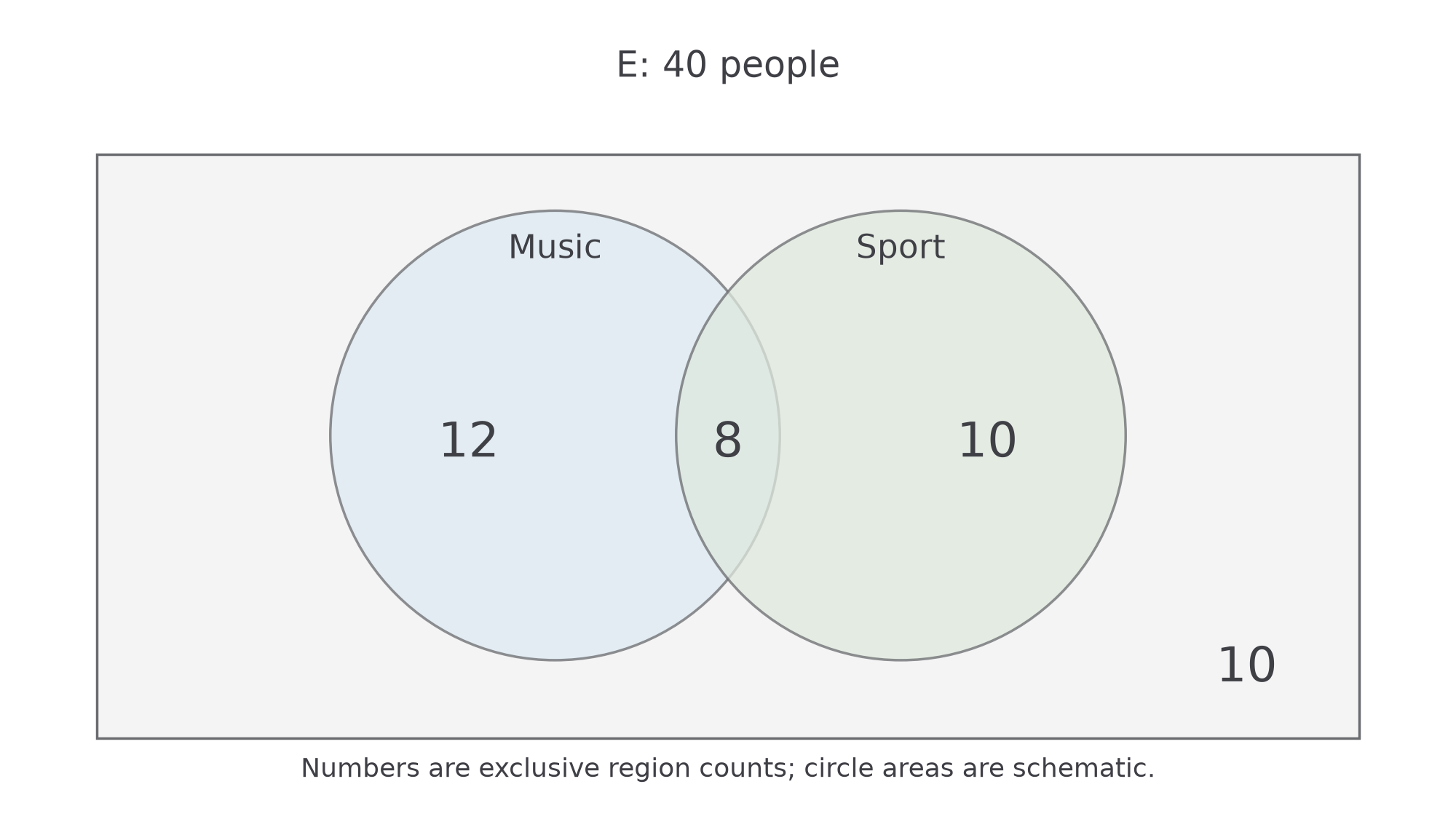
The overlap contributes to either whole-circle total. To find the union, count that overlap once. The counting probability rule is absent from both tier formulae sheets.
Worked example 1: selecting Venn regions
Question. Of learners, attend music only, both clubs, sport only and neither. One learner is chosen at random. Find the probabilities of music, both, neither, and music or sport.
Plan. Select the separate regions for each event and divide by .
Why include in music? Those learners belong to music even though they also belong to sport.
Answer. Respectively , , and .
Check. The union and neither are complements: .
Change only the first target from music to sport. Keep the population and the other requested events unchanged.
Worked example 2: selecting the other circle
Question. Of learners, attend music only, both, sport only and neither. One is chosen at random. Find the probabilities of sport, both, neither, and music or sport.
Plan. Include the overlap in the sport circle and reuse the unchanged regions for the other events.
Why do three answers stay fixed? Changing which circle you ask about does not change the data.
Answer. , , and .
Check. Sport has members and its complement has ; .
The opening puzzle gives a useful surprise: club memberships belong to only people. The people in both clubs each appear in both membership totals.
Watch out
answers “music only”. For music, include the overlap: .
Use the same region choices with fresh counts in the next check. Every required count is supplied here.
Reconstructing region counts
A statement that people belong to normally gives the whole-circle total. It includes people who also belong to . The notation means the number of members of .
Start with the overlap, the most restricted region. Subtract it from each circle total to find the only regions. Add the three inside regions, then subtract their total from the universal total to find neither. Each subtraction removes people already placed elsewhere.
Worked example 3: reconstructing the four regions
Question. Of people, belong to , to , and to both. Find all four region counts and the probability of exactly one membership for a randomly chosen person.
Plan. Place both first, find each only count, then find neither.
Why start with both? It belongs to both circle totals, so it must be removed from each to find the only regions.
Answer. in only, both, in only, neither; probability .
Check. , , and all four regions total .
Continue this lesson.
You’re previewing NovaLearn without an account. Create a free account to read the rest.
Create free account