1.10 - Time, money and currency conversions
Read clock intervals, convert durations to decimal hours and calculate payments. Use a stated exchange rate in either direction, keeping track of the currency and the order of any fees.
Clock times and intervals
A job runs from to at per hour. After a exchange fee, how many euros would the worker receive at euros per ? First we need the duration; then we can follow the money.
You already know
Multiplying an amount per unit by the number of units gives a total. Minutes are parts of an hour, but their denominator is , not .
A clock time identifies a moment. A duration tells you how long an interval lasts. A clock reading such as is not the decimal number .
Time units
Not in the formulae sheet: learn it. These conversions are absent from the Foundation and Higher sheets.
The -hour clock removes the need for a.m. and p.m. For example, p.m. becomes . Noon is , and midnight is . In afternoon and evening times add to the hour, except at noon; a.m. is midnight. Always read the date if the interval crosses midnight.
Worked example 1: within one day
Question. A journey starts at and ends at on the same day. Find the duration.
Plan. Count forwards through the next whole hour.
Why count forwards? It respects the -minute hour without treating clock digits as decimals.
Answer. minutes.
Check. Adding minutes and then minutes to the departure reaches .
Now change the arrival so that the journey crosses midnight. The next day's date adds a whole day to its clock reading.
Worked example 2: across midnight
Question. A journey starts at and ends at the next day. Find its duration in hours and minutes.
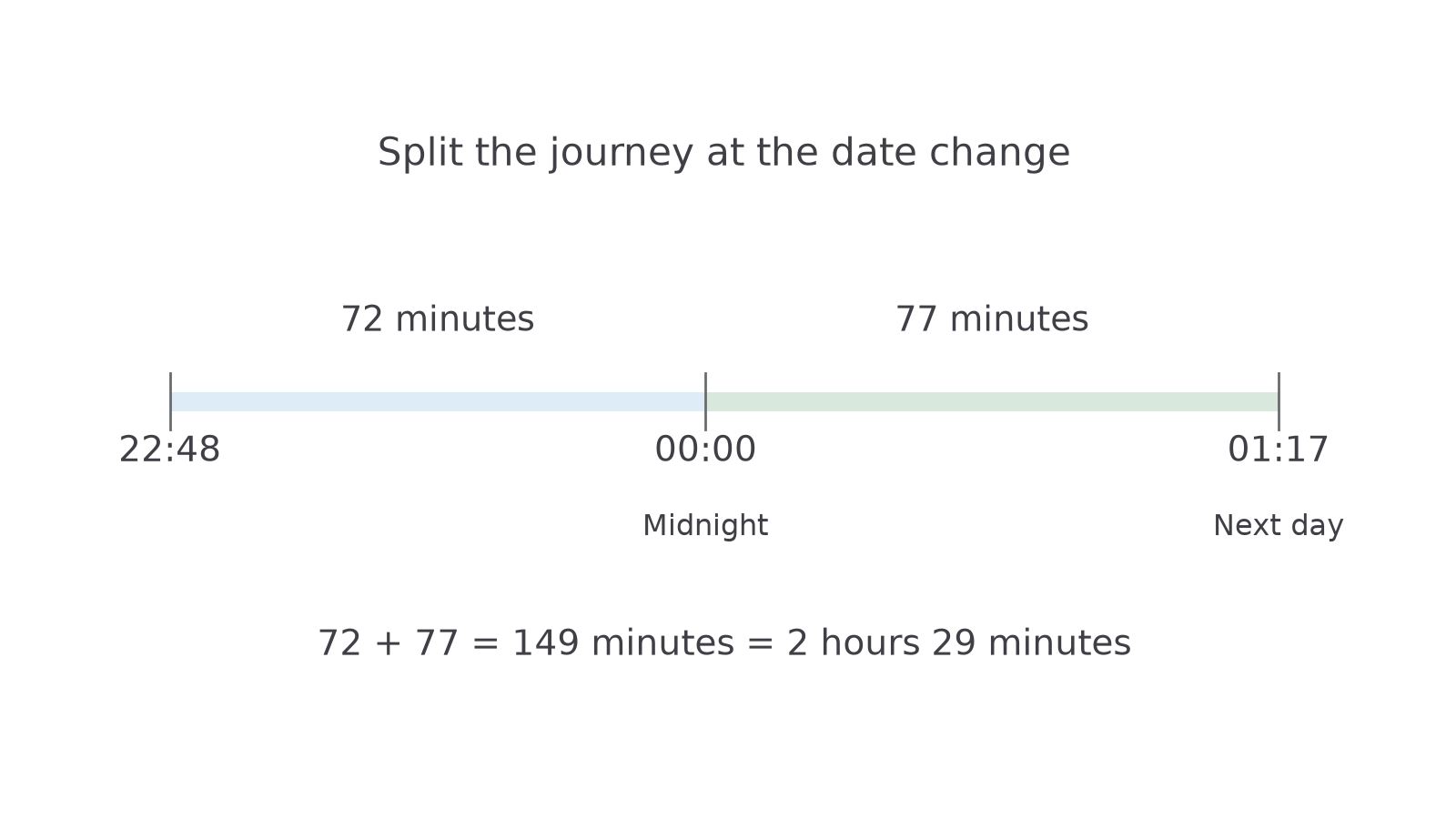
Plan. Split the interval at midnight, then combine the durations.
Why not subtract the clock readings directly? The arrival's smaller hour belongs to the following day.
Answer. hours minutes.
Check. plus hours reaches ; another minutes reaches .
A timeline keeps the date change visible. Each labelled interval is a duration, not a decimal clock reading.
[DIAGRAM: asset_name: Journey across midnight; asset_slug: m021_midnight_timeline; caption: Split a journey at midnight and add its two durations.; description: Timeline from 22:48 to 01:17 the next day, with midnight between. The first segment is labelled 72 minutes, the second 77 minutes and the total 149 minutes or 2 hours 29 minutes.]
Watch out
The line “ hours minutes is hours” is wrong. The minutes are out of . Keep hours and minutes separate until you deliberately convert them.
Use the same midnight split with a new journey.
Decimal hours
An hourly pay rate needs a duration measured in hours, including the fractional hour.
Decimal duration
A decimal duration writes the whole and fractional parts in the same unit. In hours, the is a fraction of an hour; it is not minutes.
Since an hour contains minutes, minutes is of an hour. This is why decimal hours are useful when multiplying by an hourly rate.
Converting decimal hours
Not in the formulae sheet: learn it. Neither tier sheet supplies these conversions.
Use the first relationship to convert into decimal hours; reverse it to get hours and minutes.
Worked example 3: into decimal hours
Question. Express hours minutes in decimal hours.
Plan. Convert only the minutes to a fraction of an hour.
Why divide by ? That is the number of minutes in one whole hour.
Answer. hours.
Check. minutes, and .
Change only the direction of conversion. Work on the fractional part, leaving the whole hours intact.
Worked example 4: back to hours and minutes
Question. Express hours in hours and minutes.
Plan. Multiply the fractional hour by .
Why use , not ? The already counts whole hours.
Answer. hours minutes.
Check. hours.
A useful surprise: hour is minutes, not . Ten such intervals make minutes exactly. Similarly, convert seconds to decimal minutes by dividing by ; keep exact fractions or calculator precision when the decimal repeats.
Watch out
The line “ hour minutes is hours” treats minutes as hundredths. Use hours. In fact, hour is only minutes.
Try a decimal fraction that is not a quarter.
Money and payments
Identify each component of a bill or payment before choosing the operations.
For pounds, pence make ; for euros, cents make euro. Use one currency and unit throughout a sum. A unit price or hourly rate tells you the cost or pay per one item or hour. Multiply by the quantity, add separate components and subtract from the amount paid to find change. These relationships are not in either tier's formulae sheet.
For example, four items at , plus one at , cost . Change from is . Keep the two decimal places in a final monetary amount.
Worked example 5: finding overtime from total pay
Question. A worker earns per hour for normal hours and per overtime hour. Total pay is . Find the overtime hours.
Plan. Remove normal pay, then divide only the overtime payment by its rate.
Why remove normal pay first? The overtime rate applies only to the remaining payment.
Answer. overtime hours, or hours minutes.
Check. , recovering total pay.
Change only the total pay. The two rates and the normal hours remain fixed.
Worked example 6: a different total payment
Question. The same worker receives , with the same normal hours and rates. Find the overtime hours.
Plan. Subtract the unchanged normal pay, then divide the remainder.
Why keep ? None of the information determining normal pay has changed.
Answer. overtime hours, or hours minutes.
Check. The extra compared with the previous total pays for exactly one extra overtime hour.
In the opening job, to is hours minutes, or hours. Pay at per hour is therefore . We can now convert it.
Watch out
The line does not give the overtime hours. It wrongly charges every hour at the overtime rate. First subtract normal pay: .
When a question asks for a payment, retain full precision through any time conversion and round the final amount to the required currency precision.
Currency conversion
An exchange rate is a relationship between two currencies; its direction tells you whether to multiply or divide.
Exchange rate
An exchange rate states how much of one currency corresponds to a stated amount of another. At euros per , each pound buys euros, before fees.
To turn pounds into euros at that rate, multiply by . To turn euros into pounds, divide by . For example, euros corresponds to , since . These proportional calculations are not in either tier's formulae sheet. Use the rate supplied in the question; the rates here are examples rather than current market rates.
Worked example 7: conversion without a fee
Question. A service gives euros for each , with no fee. How many euros does buy?
Plan. Multiply the pounds by the euros received per pound.
Why multiply? We receive the stated euro amount once for each pound exchanged.
Answer. euros.
Check. , recovering the original pounds.
Change only the presence of a fee. It is charged in pounds before conversion, so fewer pounds are exchanged.
Worked example 8: a fee before conversion
Question. The same service deducts a fee from , then converts the remainder at euros per . Find the euros received.
Plan. Deduct the pound fee before multiplying by the exchange rate.
Why subtract first? The fee is in pounds, so it must be taken from the pound amount.
Answer. euros.
Check. . The fee reduced the euros by euros.
A fee charged in euros after exchange would instead be subtracted from the euro total. For a fee of euros on the fee-free exchange above, the result would be euros. Both the order and the currency matter.
Watch out
The line euros is wrong for a fee taken before conversion. It treats the fee as euros. Use euros.
Return to the opening job: pay is , so the worker receives euros. One chain has linked clock time, decimal hours, pay and exchange.
Quick Recap
- Clock times identify moments; durations measure intervals. Account for the date at midnight.
- Divide minutes by to get fractional hours; multiply fractional hours by to get minutes.
- Separate payment components before calculating a missing quantity.
- Follow the stated exchange rate, and apply each fee in its own currency and correct order.
- Round final money amounts as requested, keeping intermediate precision.
The opening worker earns for hours and receives euros after the stated fee and conversion.