4.2 - Polygons and quadrilaterals
You will recognise polygons from their properties and calculate their angles. You will see why the angle sums work and use an exterior angle to find the number of sides. A name such as “hexagon” counts sides; it does not promise that the shape is regular.
Polygon names and quadrilateral properties
A robot follows the edge of a regular garden bed, turning through at every corner. How many corners will return it to its starting direction? We will answer this after sorting out the shapes it might follow.
You already know
A triangle's angles total . Allied angles between parallel lines total , and you can solve a linear equation by doing the same operation to both sides.
A triangle, a tilted rectangle and an irregular five-sided outline all count as polygons. A circle does not, because its boundary is curved.
Polygon
A polygon is a closed two-dimensional shape bounded by straight sides. A quadrilateral has four sides. A pentagon has five, a hexagon six, and an octagon eight. A diagonal joins two nonadjacent vertices.
Side counts do not tell you whether sides or angles are equal. Look for the stated properties or the marks shown on the shape.
| Shape | Defining properties | Useful further properties |
|---|---|---|
| Parallelogram | Both pairs of opposite sides parallel | Opposite sides and angles equal; diagonals bisect each other |
| Rectangle | Four right angles | Opposite sides equal and parallel; equal diagonals bisect each other |
| Square | Four equal sides and four right angles | Equal diagonals bisect at right angles and bisect the vertex angles |
| Rhombus | Four equal sides | Opposite sides parallel and opposite angles equal; diagonals bisect at right angles and bisect opposite angles |
| Trapezium | One pair of opposite sides parallel | A general trapezium need not have equal sides or equal angles |
| Kite | Two pairs of equal adjacent sides | The diagonal through the vertices where equal sides meet bisects the other diagonal at right angles; the other pair of opposite angles is equal |
[DIAGRAM: asset_slug: quadrilateral_properties; caption: Six quadrilaterals with equal-side, parallel and right-angle marks; description: A parallelogram, rectangle, square, rhombus, trapezium and kite. Equal-side ticks and parallel arrows identify the given relationships. Shapes are property examples, not a measuring exercise; file: quadrilateral_properties.png; recommended_method: matplotlib]
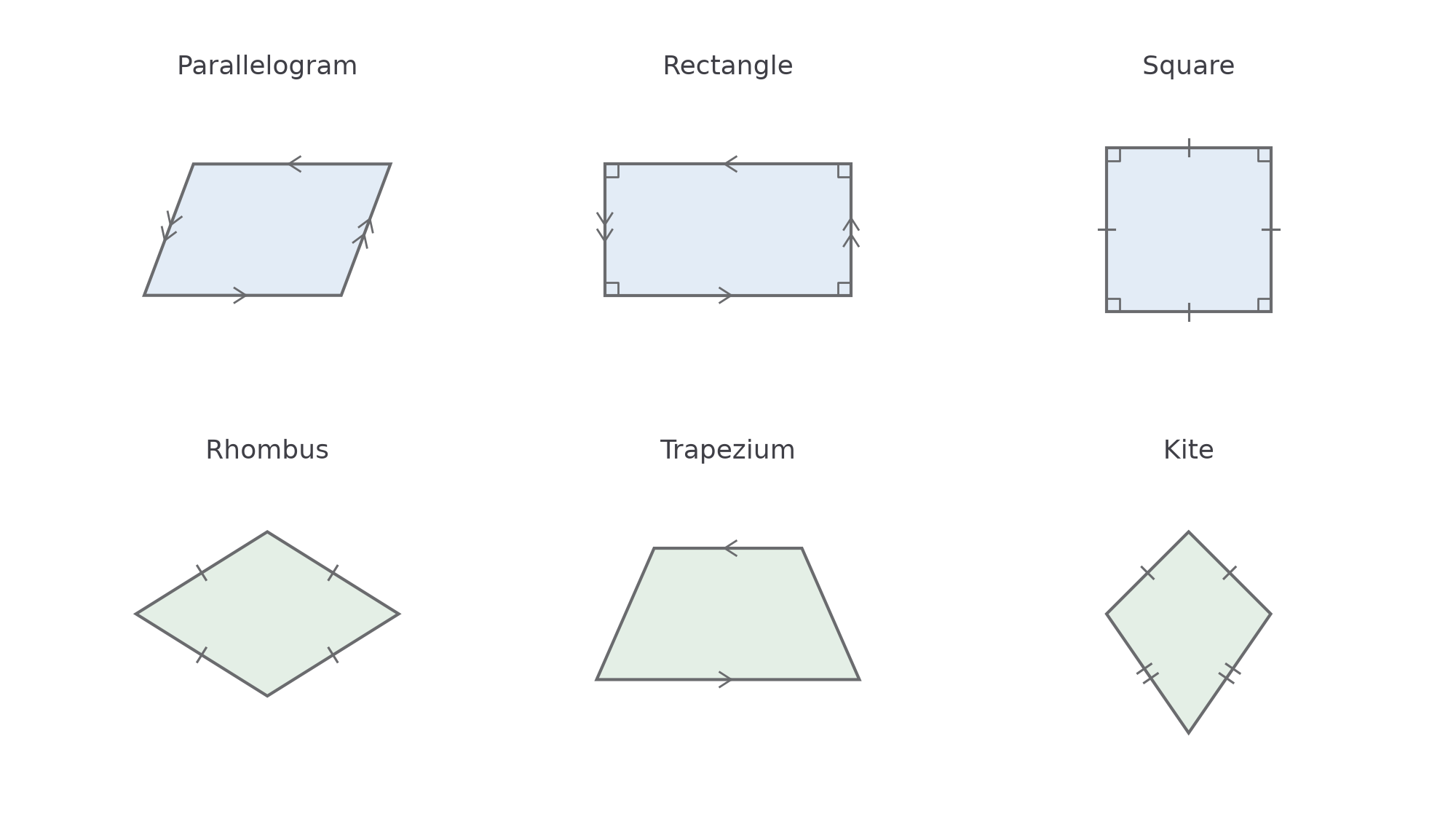
To bisect means to divide into two equal parts. In a parallelogram both diagonals do this to each other. In a general kite only the diagonal along its symmetry axis bisects the other: do not reverse that statement.
A square belongs to several classes at once: it is also a rectangle, a rhombus and a parallelogram. Four equal sides alone establish a rhombus, not a square; right-angle information is needed for the more specific name. Equal diagonals alone do not establish a square either: a nonsquare rectangle is a counterexample. These properties are absent from both the Foundation and Higher formulae sheets: learn them.
Key idea
Name the most specific shape justified by the information. A drawing's tilt does not change its properties.
Use the definitions, rather than whether a shape looks like a familiar picture, for these two names.
Interior angles of quadrilaterals
Draw a diagonal across a convex quadrilateral. It divides the interior into two triangles, so the four corners together contain two triangle totals.
Quadrilateral angle sum
This also holds for a simple concave quadrilateral, including its reflex interior angle. For Foundation and Higher: Not in the formulae sheet: learn it.
For example, angles , and leave . Adding all four gives . When several angles contain an unknown, add the complete expressions before solving.
[DIAGRAM: asset_slug: quadrilateral_angles; caption: Quadrilateral angles given as numbers and expressions; description: Four panels show the numerical 87 93 110 degree example, then quadrilaterals with angles 90, x plus 15, x plus 25 and x plus k degrees. k is 35 for example 1, 20 for example 2 and 5 for the check. Figures are labelled not to scale; file: quadrilateral_angles.png; recommended_method: matplotlib]
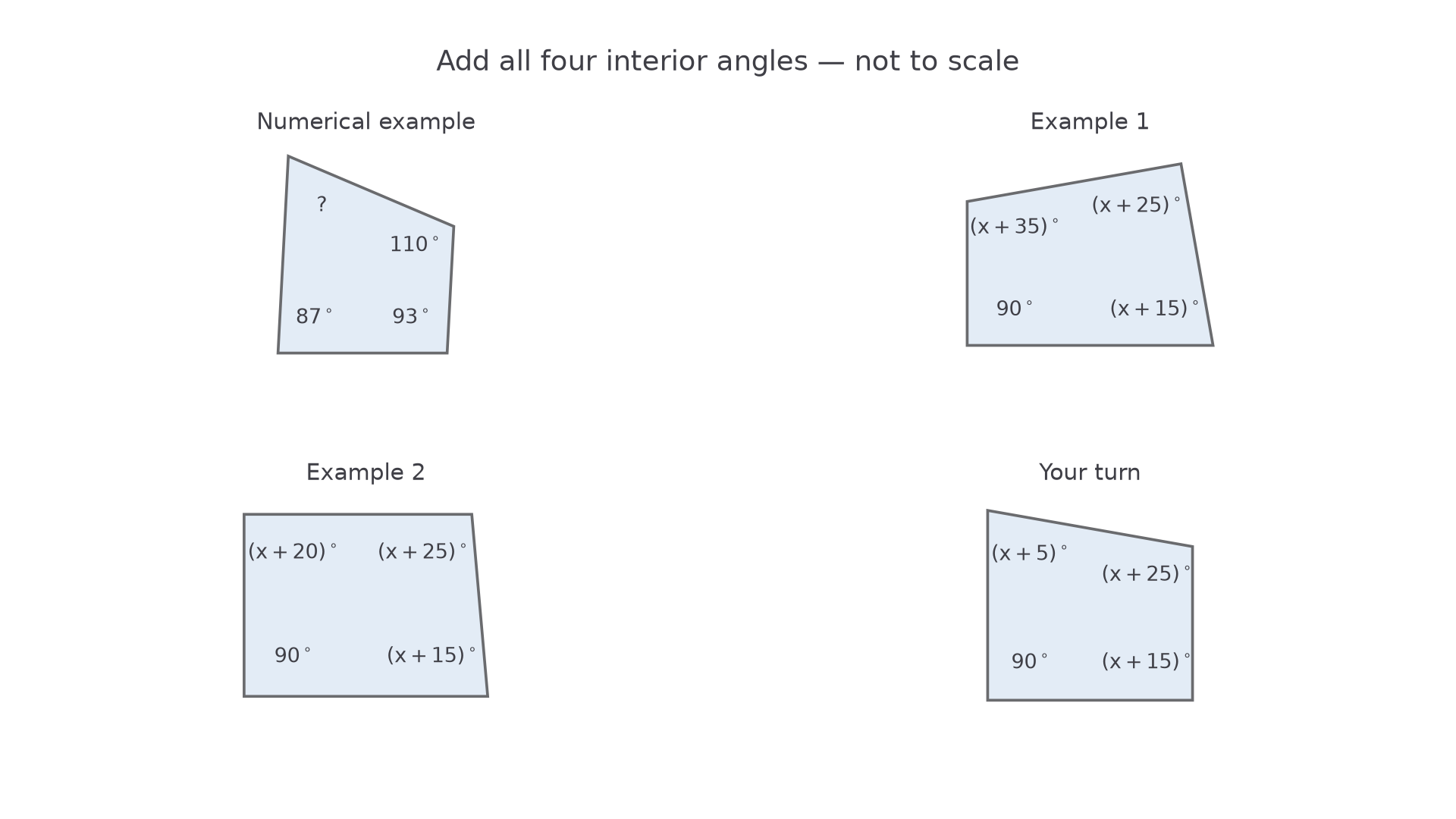
The second panel turns the same angle-total idea into an equation.
Worked example 1: add angle expressions
Question. A quadrilateral has angles , , and . Find .
Plan. Add the four angles and set the total equal to .
Why three copies of ? Three angle expressions contain it; the fixed does not.
Answer. .
Check. The angles are , , , , totalling .
Change only the last angle from to . Keep the other three expressions.
Worked example 2: one angle expression changes
Question. A quadrilateral has angles , , and . Find .
Plan. Build a new total from all four expressions.
Why rebuild the total? The changed constant affects , so the previous value cannot simply be reused.
Answer. .
Check. .
Special properties can shorten a calculation. In a parallelogram, opposite angles are equal and adjacent angles total , from allied angles between its parallel sides. Thus an angle of has neighbours of . Only rectangles and squares guarantee four right angles.
Watch out
The line misses the fixed angle. With the included, the correct line is .
For the last panel, the final angle changes again. Show the equation so your method is clear.
The interior-angle sum of a polygon
A hexagon can be split into four triangles from one corner. Count the triangles, not the six corners: their angle totals fill the whole interior.
Continue this lesson.
You’re previewing NovaLearn without an account. Create a free account to read the rest.
Create free account