1.6 - Percentages and percentage change
A percentage compares an amount with a chosen whole using parts per hundred. You will change between percentage, fraction and decimal forms, compare amounts fairly, and calculate percentage parts and changes. Choosing the right whole is the key to every method here.
Percentage, fraction and decimal forms
A shop takes off an bag. Should you multiply by or by to find the price you pay? By the end, you will know what each calculation finds.
You already know
Equivalent fractions and decimals name the same value: . Divide the numerator by the denominator to change a fraction to a decimal; cancel common factors to simplify a fraction.
Imagine a whole split into equal parts. Taking of those parts means taking per hundred, regardless of the whole's actual size.
Percentage
Percentage means “number of parts per hundred”. Thus means of a whole. The percent sign matters: , whereas is twelve whole units.
Dividing the percentage number by gives its decimal form. For the fraction form, simplify the fraction after dividing by .
Percentage forms
To express a decimal or fraction as a percentage, multiply its value by and attach the percent sign. Foundation and Higher: not supplied. Not in the formulae sheet: learn it.
Start with a percentage below one whole. Its decimal must be below .
Worked example 1: twelve parts per hundred
Question. Write as a fraction in simplest form and as a decimal.
Plan. Write the percentage over , simplify, and divide to find the decimal.
Why is the denominator ? That is what the percent sign means; it is not the number of items in a particular group.
Answer. and .
Check. , so converting back gives .
Now change the percentage to one above . The conversion rule stays the same; the answer now exceeds one whole.
Worked example 2: more than a whole
Question. Write as a fraction in simplest form and as a decimal.
Plan. Use the same denominator, then simplify and divide.
Why can the decimal exceed ? is one and a half times the whole, not a part smaller than it.
Answer. and .
Check. is one whole plus half a whole, agreeing with .
Percentages can also be smaller than or have decimal parts. Keep the same divide-by- rule.
Watch out
The line is wrong: means . Divide by , not : .
Try a different decimal percentage and give both requested forms.
Expressing one amount as a percentage of another
A count alone can hide the comparison. Getting questions right means something different on a test of questions and on a test of . The total is the whole you compare with.
Comparison base
The base is the amount that represents . To express as a percentage of , the base is . The phrase “as a percentage of” tells you which quantity goes underneath.
Divide to find the proportion of the whole, then express that proportion per hundred. Both amounts must use the same units; for example, convert metres to centimetres before comparing them. The base must be nonzero.
One amount as a percentage of another
Foundation and Higher: not supplied. Not in the formulae sheet: learn it.
The denominator is a decision about meaning, so identify it before using the calculator.
Worked example 3: choose the test total
Question. A learner answers of questions correctly. Work out the percentage answered correctly.
Plan. Use the total number of questions as the base.
Why divide by ? All questions represent , while is the part achieved.
Answer. .
Check. of is ; .
Change only the test total to . The number correct stays , but it is now a smaller share of the whole.
Worked example 4: the same count, a different base
Question. A learner answers of questions correctly. Work out the percentage answered correctly.
Plan. Divide the unchanged correct count by the new total.
Why has the percentage fallen? The same correct count now belongs to a larger test.
Answer. .
Check. of is , so is .
Equal percentages can also come from different counts: correct out of is , matching out of . Percentages let you compare different-sized groups fairly.
Watch out
The line reverses the comparison in Worked example . It asks what percentage is of . Use for the stated question.
Keep the meaning of the denominator clear with new amounts.
Finding a percentage of an amount
Now the percentage is given and you want the amount. Multiplying by the decimal percentage scales the original quantity to the required part.
Percentage of an amount
The result has the same units as . Foundation and Higher: not supplied. Not in the formulae sheet: learn it.
A multiplier is a number you multiply by. Here the multiplier finds the percentage part, rather than a new total after an increase or discount.
Worked example 5: find a percentage part
Question. Work out of .
Plan. Convert the percentage to a decimal and multiply the amount by it.
Why multiply by ? You want parts out of every parts of the whole amount.
Answer. .
Check. , and of are , and . Their sum is .
Change only the percentage to . Keep the whole amount , and expect a smaller result.
Worked example 6: a small percentage
Question. Work out of .
Plan. Use its decimal multiplier; retain the zero after the decimal point.
Why is the zero important? would find , ten times the required proportion.
Answer. .
Check. is a quarter of , and .
Here is a surprising shortcut: of equals of . Both are . This works because : the same factors are multiplied in a different order. Swapping the numbers can make a mental calculation easier.
Watch out
Writing ignores the percent sign. It finds two and a half times the whole. The correction is .
Keep the percentage fixed and change the whole amount for your turn. If you use a mental method, show enough to make the chosen percentage clear.
Increases, decreases and rates of change
A percentage part and a changed total are different amounts. An increase keeps the original and adds the increase. A decrease keeps only the percentage that remains.
Multipliers for a new amount
Here is the percentage change. For an ordinary nonnegative price, a discount is between and . Foundation and Higher: not supplied. Not in the formulae sheet: learn it.
For example, increasing by gives . Decreasing it by gives . The percentage parts alone are and ; they are not the new prices.
If you know the old and new amounts instead, find their difference and compare it with the original amount. That original amount is the base before anything changes.
Percentage change from two amounts
For a positive original amount,
Use the formula matching the direction of change. Foundation and Higher: not supplied. Not in the formulae sheet: learn it.
The same method applies to price, attendance or mass: keep the units consistent, find the change, and choose the original base.
Worked example 7: find and apply an increase rate
Question. A ticket price rises from to . Work out the percentage increase. A different ticket costs before the same percentage increase. Find its new price.
Plan. Compare the rise with the original , then form an increase multiplier for the other ticket.
Why divide by ? The question measures the increase relative to the price before the rise.
Answer. The increase is ; the other ticket's new price is .
Check. . Also, a quarter of is , so the other price rises to .
Now reverse only the direction of the first price change: it goes from to . The difference is still , but the original base changes, so the percentage will change too.
Worked example 8: reverse the direction
Question. A ticket price falls from to . Work out the percentage decrease. A different ticket costs before the same percentage decrease. Find its new price.
Plan. Compare the fall with the original , then use the percentage retained for the other ticket.
Why use , rather than , for the new price? You pay the remaining after the is removed.
Answer. The decrease is ; the other ticket's new price is .
Check. . On the other ticket, the discount is , and .
This also answers the opening shop question. Multiplying by finds the discount; multiplying by finds the price you pay. Keep full calculator precision until a final monetary answer needs rounding.
[DIAGRAM: asset_slug: percentage_discount_bar; caption: A twenty-percent discount leaves eighty percent of the price to pay; description: A bar represents the original eighty-pound price as one hundred percent. Its first eighty percent is shaded sage and labelled sixty-four pounds, the price paid. The remaining twenty percent is shaded clay and labelled sixteen pounds, the discount. The widths are in the ratio eighty to twenty.; file: percentage_discount_bar.png; recommended_method: matplotlib]
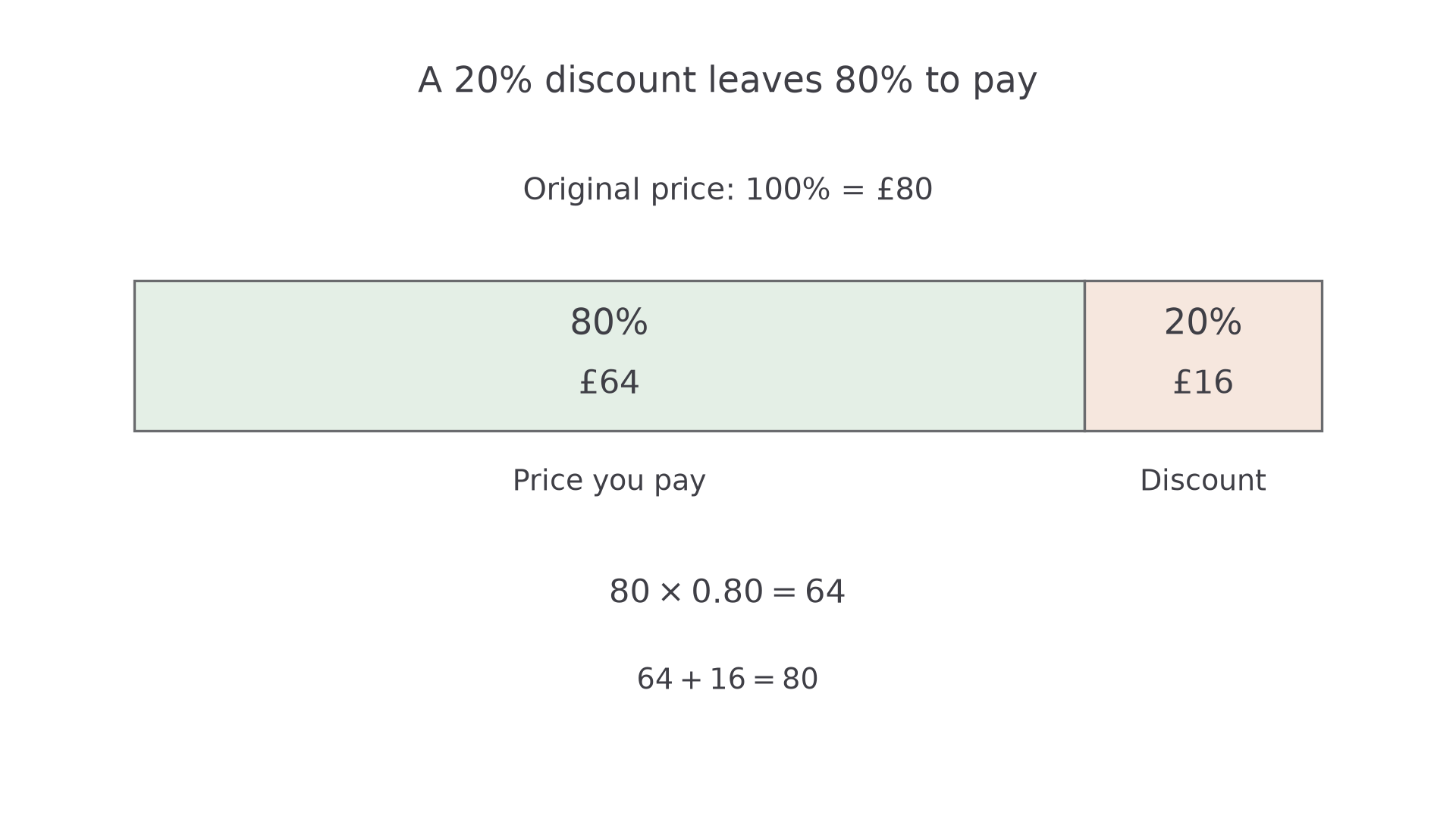
The two parts of the bar add back to the original price. This is a quick way to check that you have found the retained amount rather than the removed amount.
Watch out
For a rise from to , the line uses the new price as its base. The required percentage increase is . The denominator must be the original amount.
Pearson questions can hide the base inside a context: percentage profit compares profit with cost, so find the total cost before forming the fraction.
Exam tip
Label your change and original amount in a percentage-change calculation. If a question asks for the new amount, finish with that amount rather than only the increase or discount.
Try the decrease method with new prices. The second item uses the rate you find, so keep that connection clear.
Quick Recap
- A percentage means parts per hundred: divide by for its decimal form.
- To express one amount as a percentage of another, divide by the stated base and multiply by .
- To find a percentage part, multiply by the decimal percentage.
- A new total uses for an increase or for a decrease.
- Percentage change compares the change with the original amount.
For the opening bag, is the discount. You pay .