1.2 - Equivalent fractions and ordering
Fractions let you describe equal parts, compare shares and calculate part of a quantity. You will simplify fractions, change between mixed and improper forms, put fractions in order and express one quantity as a fraction of another.
Equivalent fractions and cancelling
One team completes of a route and another completes of the same route. Which team has gone farther? The numerators alone cannot tell us: the pieces they count are different sizes.
You already know
A factor divides a number exactly. A common factor divides both numbers, while a common multiple is in both multiple lists. We will use both ideas to make fractions easier to handle.
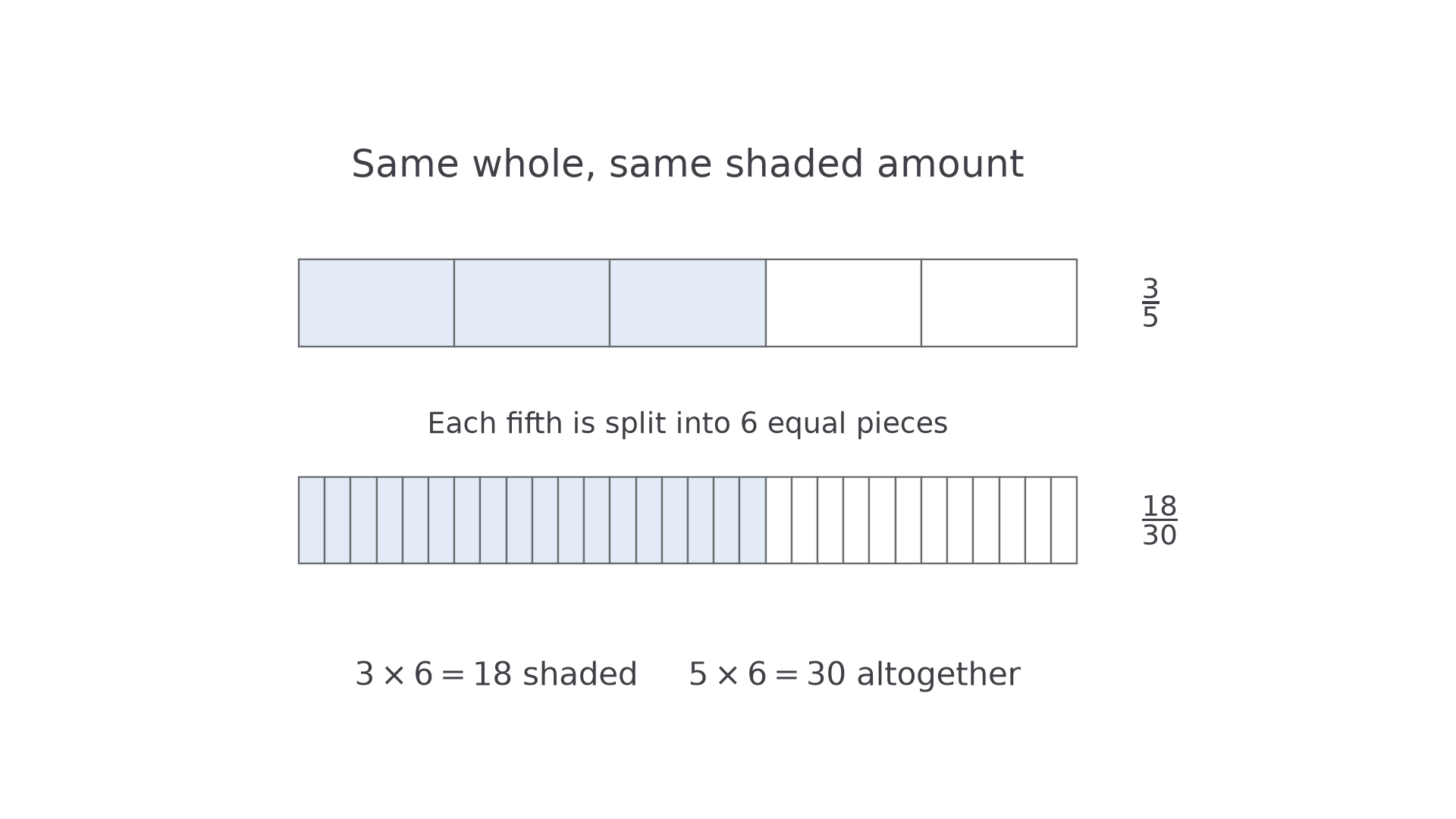
For of a bar, split one whole bar into five equal pieces and take three. Splitting each fifth into six smaller equal pieces gives eighteen shaded pieces out of thirty. The shaded amount has not changed.
[DIAGRAM: asset_name: Equivalent fraction bars; asset_slug: m003_equivalent_fraction_bars; caption: Three fifths and eighteen thirtieths shade the same amount of the same whole; description: Two equal-length bars have the same left three fifths shaded blue. The upper bar is divided into five equal pieces, with three shaded. The lower bar is divided into thirty equal pieces, with eighteen shaded. A note explains that each fifth has been split into six equal pieces.]
Numerator, denominator and equivalent fractions
In , the denominator gives the number of equal parts in one whole, and the numerator counts those parts. The fraction also means , so . Equivalent fractions have the same value: for example, , whereas .
Multiplying the top and bottom by the same nonzero number scales the count and the number of parts together. Dividing both by a common factor undoes that splitting. This is cancelling. In lowest terms, numerator and denominator have no common positive factor greater than one.
Keeping a fraction equivalent
Here and . For integer fractions, cancel common factors until there are none left.
Foundation and Higher: Not in the formulae sheet: learn it.
You can cancel in several stages, but using the greatest common factor makes the arithmetic shorter.
Worked example 1: simplifying and choosing a denominator
Question. Simplify . Then write an equivalent fraction with denominator .
Plan. Cancel the common factor , then scale the simplified denominator to .
Why this step? The denominator needs a factor of , so the numerator must get the same factor.
Answer. in lowest terms; with the requested denominator.
Check. , confirming the equivalent fractions.
Change only the starting numerator, from to . The same common factor and denominator multiplier still work.
Worked example 2: a different numerator
Question. Simplify . Then write an equivalent fraction with denominator .
Plan. Cancel , then multiply the top and bottom by .
Why this step? Changing only the numerator changes the value, but it does not change how we preserve that value during simplification.
Answer. in lowest terms; with denominator .
Check. .
Each cancellation must divide the whole numerator and the whole denominator.
Watch out
Wrong: . Subtracting the same number does not preserve the fraction. Right: divide both by to get . The incorrect is , a different value.
Now change the starting numerator to .
Mixed numbers and improper fractions
A fraction can count more pieces than make one whole.
If you have three whole bars and two fifths of another, you have bars. Each whole contains five fifths, so three wholes contain fifteen fifths. Add the remaining two fifths to count seventeen altogether.
Proper, improper and mixed forms
For nonnegative fractions with a positive denominator, a proper fraction has numerator smaller than denominator, such as . An improper fraction has numerator at least as large as denominator, such as or . A mixed number combines a whole number and a proper fraction, such as . “Vulgar fraction” means ordinary numerator-over-denominator notation, rather than decimal notation.
The whole number and fraction in a mixed number are added: , not . To convert back from an improper fraction, divide the numerator by the denominator. The quotient counts complete wholes; the remainder counts the leftover pieces.
Converting a positive mixed number
Here is a nonnegative whole number and , with .
Foundation and Higher: Not in the formulae sheet: learn it.
The denominator stays the same because the pieces stay fifths throughout the conversion.
Worked example 3: counting all the fifths
Question. Write as an improper fraction.
Plan. Count the fifths in three wholes, then add the remaining fifths.
Why this step? Multiplying the whole number by the denominator counts pieces of the correct size.
Answer. .
Check. , so the fraction is between and , as the mixed number is.
The next example keeps the same amount and changes only the conversion direction. This shows how the two forms undo each other.
Worked example 4: finding complete wholes
Question. Write as a mixed number.
Plan. Divide by , retaining the remainder.
Why this step? A remainder of means two fifths remain after making the complete wholes.
Answer. .
Check. , returning the original numerator.
The same reasoning gives , so . The remainder is smaller than , which makes the fractional part proper.
Watch out
Wrong: . This counts the three wholes as only three fifths. Right: .
Change just the numerator of the improper fraction for your turn.
Ordering fractions with common denominators
Fractions are easiest to compare when they count equal-sized pieces of the same whole.
For example, and . Sixteen twenty-fourths exceeds fifteen twenty-fourths, so . Comparing the original numerators and would give the wrong answer.
Common denominator
A common denominator is a shared denominator used to write equivalent fractions. It is a common multiple of the original denominators. For and , works; also works, but gives larger numbers to calculate with.
To compare several fractions, choose a common denominator, scale every numerator by the same factor as its denominator, then order the numerators. Any common multiple works; a small convenient one keeps the working short. This method is absent from both tier formulae sheets.
Worked example 5: comparing three shares
Question. Write in order of size, starting with the smallest.
Plan. Use denominator , which is a multiple of , and .
Why this step? Once every part is a thirty-sixth of the same whole, a larger numerator means a larger amount.
Answer. .
Check. For adjacent pairs, and .
Change only the numerator of the ninths, from to . It changes position in the order.
Worked example 6: changing one share
Question. Write in order of size, starting with the smallest.
Plan. Keep denominator and change only the ninths calculation.
Why this step? The denominator is unchanged, so the larger numerator makes the ninths share larger than before.
Answer. .
Check. , and .
Those product checks are a shortcut for comparing two fractions exactly. With positive denominators, comparing and means comparing and , because the equivalent fractions have denominator . This comparison rule is absent from both tier formulae sheets.
Watch out
Wrong: because “”. The conclusion happens to be correct, but the reason ignores different piece sizes. Right: compare with , so the conclusion follows from equal-sized pieces.
The opening route puzzle is settled: , so the second team has gone farther. The surprise is how small the difference is: one thirty-sixth of the route, because and . Different-looking fractions can be very close.
Exam tip
Keep an exact comparison visible. Rounding fractions to short decimals can hide a small difference; Pearson fraction questions may explicitly require a fraction in its simplest form.
For your turn, change the ninths numerator once more.
Fractions of quantities and part-to-whole ratios
Identify the whole before finding a share or writing a fraction.
To find of , find one eighth first: . Three eighths is then . “Of” here means multiplication: .
Finding a share and expressing a fraction
Use a nonzero reference quantity and the same units in numerator and denominator.
Foundation and Higher: Not in the formulae sheet: learn it.
For example, as a fraction of is . The reference quantity need not be larger: as a fraction of is . But a part of a whole cannot exceed that whole.
If a distance is out of , first write . The fraction is , not .
Worked example 7: finding those who remain
Question. There are pupils in a class. travel by bus and the rest walk. Find the number who walk and the fraction of the class who walk, in simplest form.
Plan. Find the bus group, subtract it from the whole class, then put the walking group over the whole class.
Why this step? The fraction of the class uses all pupils as its denominator, including those travelling by bus.
Answer. pupils walk; they are of the class.
Check. , and : the groups make the whole class.
Change only the class size, from to . The number of walkers changes, but their fraction stays the same.
Worked example 8: a larger whole
Question. There are pupils in a class. travel by bus and the rest walk. Find the number who walk and the fraction of the class who walk, in simplest form.
Plan. Apply the same share to the new whole.
Why this step? Each class has three eighths on the bus and five eighths walking, even though its number of pupils is different.
Answer. pupils walk; they are of the class.
Check. , and .
When counting people or objects, check that the proposed count is a whole number. A fractional count may show that the stated share cannot describe that group exactly.
Watch out
Wrong: the walking fraction in the first class is . This compares walkers with bus users. Right: the requested fraction of the class is , because the denominator must be the whole class.
You can also find the remaining share directly: removing three of the eight equal parts leaves five of them, so the remaining fraction is . The opening route comparison used the same principle of identifying a common whole: both teams travelled on the same route.
Quick Recap
- Equivalent fractions scale numerator and denominator together; cancel common factors to reach lowest terms.
- A mixed number counts wholes and a proper fraction; convert by counting all the pieces.
- Use a common denominator to compare equal-sized pieces.
- To find a fraction of a quantity, divide by the denominator and multiply by the numerator.
- To express one quantity as a fraction of another, identify the reference quantity and match units first.
The second team goes farther: . Its lead is one thirty-sixth of the route.