1.1 - Integers and the order of operations
Read whole numbers accurately, compare numbers below zero and calculate changes such as temperature rises. You will also use signed multiplication and division, then decide which operation to do first when a calculation has several steps.
Integers and place value
A freezer is at . It warms by , then cools by . Does it finish above zero? Keep that question in mind as we build the tools to answer it.
You already know
Ten ones make one ten, and ten tens make one hundred. Addition and subtraction describe increases and decreases.
The sign of a number tells you which side of zero it lies on. Its distance from zero does not, by itself, tell you which number is greater.
Integer
An integer is a positive or negative whole number, or zero. Examples are , and . The number is not an integer. Zero is neither positive nor negative.
Place value is the value a digit has because of its position. Each column is worth ten times the column on its right. For example,
The is worth , not . The zeros keep the thousands and tens places empty: deleting them would change the number to . Read as “fifty thousand, eight hundred and four”. To make the smallest positive integer from given digits, use every digit as instructed and put the smallest nonzero digit first; a leading zero does not make a new place.
The column pattern continues after a decimal point: tenths, hundredths, then thousandths. In , the is worth seven hundredths, . That is different from seven hundreds, . We will calculate with decimals in a later lesson.
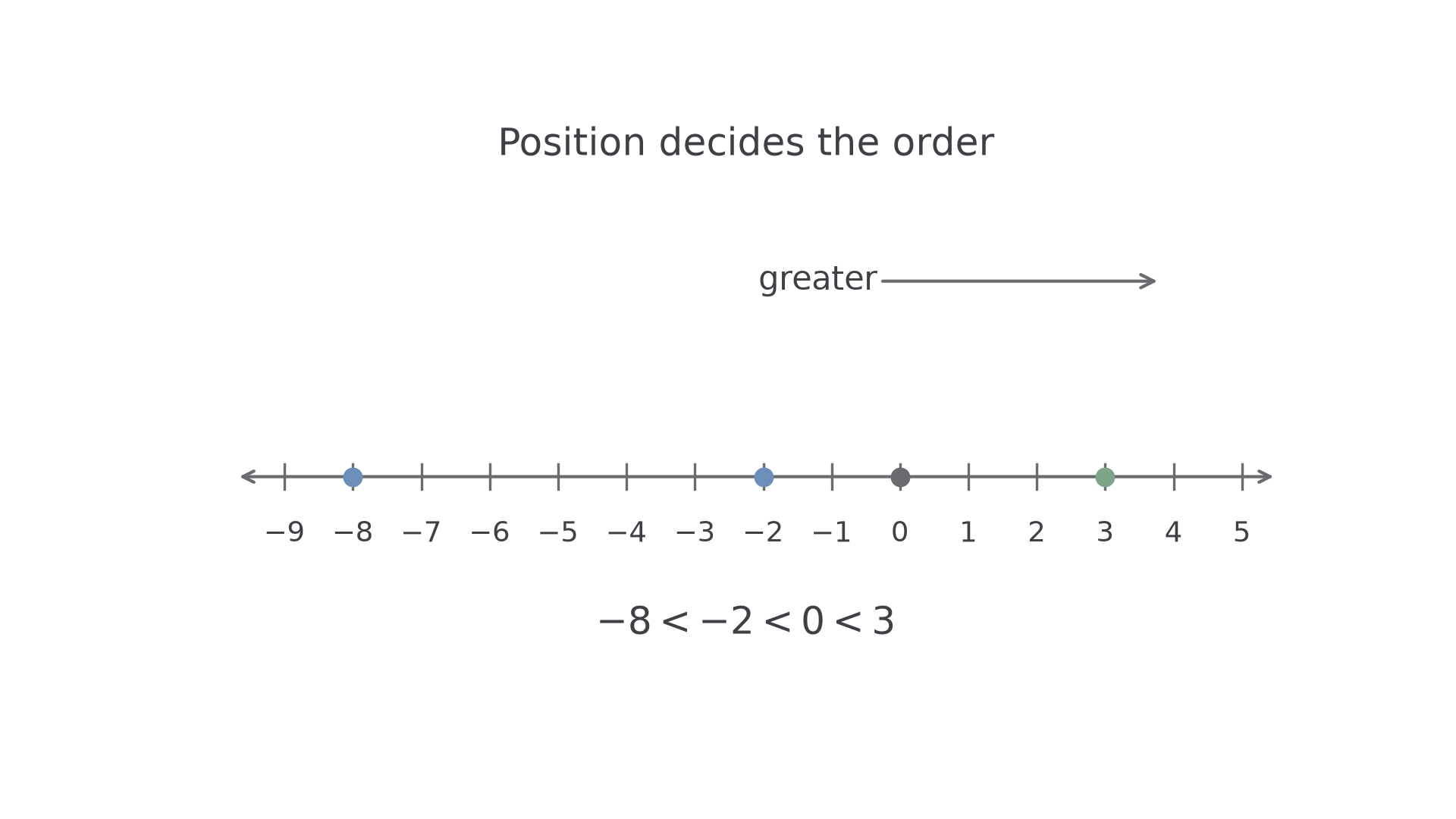
A number line puts these values in order. Moving right makes a number greater. The symbols and mean “less than” and “greater than”; the open side faces the greater number.
[DIAGRAM: asset_name: Integers on a number line; asset_slug: m001_integer_number_line; caption: Negative integers farther left are smaller, even when their distance from zero is greater; description: A horizontal number line from negative nine to positive five with equally spaced integer ticks. Negative eight and negative two are marked in blue, zero in grey and positive three in sage. A right-pointing arrow labelled greater sits above the line.]
Worked example 1: ordering signed integers
Question. Write in order of size, starting with the smallest.
Plan. Put the numbers in their left-to-right order on a number line.
Why this step? Both negative numbers are smaller than zero, and is farther left than .
Answer. .
Check. Reading along the line to the right gives exactly this order.
The next example changes only the sign of . It now belongs among the negative numbers.
Worked example 2: changing one sign
Question. Write in order of size, starting with the smallest.
Plan. Compare the three negative positions before placing zero.
Why this step? Among negative numbers, a greater distance from zero means a smaller value.
Answer. .
Check. Each move to the next number goes right, and every listed number appears once.
Compare positions, rather than ignoring the signs.
Watch out
Wrong: because . The minus signs place both numbers left of zero. Right: , because is farther left.
Here you change the negative to a negative , then check a separate place-value fact.
Changes with directed numbers
A signed change tells you how far to move and in which direction.
A directed number has a positive or negative sign relative to a chosen zero. A floor number is a position; “up eight floors” is a change. Choose the positive direction first. On a number line, adding a positive number moves right and adding a negative number moves left.
Subtracting undoes an addition. Since adding moves four places left, subtracting must undo that move and take you four places right.
Subtracting a negative and finding a change
A rise is positive when increasing values are the positive direction.
Foundation and Higher: Not in the formulae sheet: learn it.
Separate the value you reach from the amount you change by. For the freezer in the opening question,
It finishes at , above zero. The overall change is , since , and checks the final temperature.
Worked example 3: a rise across zero
Question. A temperature rises from to . Work out the rise.
Plan. Subtract the initial temperature from the final temperature.
Why this step? The journey goes four degrees to zero, then three more degrees above it.
Answer. A rise of .
Check. : adding the rise gives the final temperature.
Now reverse only the journey. The distance is unchanged, but the change must have the opposite sign.
Worked example 4: a fall across zero
Question. A temperature falls from to . Work out the signed change.
Plan. Use final minus initial again.
Why this step? The same rule handles rises and falls; the result's sign gives the direction.
Answer. The change is , a fall of .
Check. , the final temperature.
A temperature and a temperature change answer different questions.
Watch out
Wrong: the rise from to is . That is the final value. Right: , so the rise is .
The next journey changes the final temperature only.
Signed multiplication and division
For multiplication and division, decide the sign separately from the size of the answer.
Three changes of give . To understand two negative factors, use a pattern: , and . Decreasing the first factor by one increases the product by two, so the next product is .
Signs in multiplication and division
Same signs give a positive answer; different signs give a negative answer.
Here and are positive. Division uses the same sign rule because it reverses multiplication. Never divide by zero.
Foundation and Higher: Not in the formulae sheet: learn it.
For instance, , but is undefined: no number multiplied by zero gives six.
Worked example 5: two negative factors
Question. Work out .
Plan. Work from left to right, finding the sign of each result.
Why this step? The first two factors are both negative, so their product is positive before the division.
Answer. .
Check. , and , undoing both operations.
Change only the sign of the divisor. The first product remains positive, but the quotient changes sign.
Worked example 6: a negative divisor
Question. Work out .
Plan. Keep the first product, then apply the division sign rule.
Why this step? A positive number divided by a negative number is negative: .
Answer. .
Check. Multiplying the answer by returns the product .
Addition has its own meaning; it does not use the multiplication sign rule.
Watch out
Wrong: because “two negatives make a positive”. That rule is for a product or quotient. Right: , because both movements go left.
Change just the first factor for your calculation.
Brackets and the order of operations
An agreed order of operations gives everyone the same meaning for an expression.
Calculate brackets first, then powers and roots, then multiplication and division, then addition and subtraction. Multiplication and division have equal priority: work from left to right. Addition and subtraction also share a priority and run from left to right. A square means multiplying a number by itself; for example, .
There is a surprising consequence: the same three numbers and two operation signs can give different answers when you insert brackets. For example,
The brackets change the question, rather than provide a new way to answer the same question. Likewise, , while .
Key idea
Do equal-priority operations from left to right. A fraction bar groups its whole numerator and its whole denominator, just as brackets do.
A number next to a bracket means multiplication. Keep a negative bracket result in brackets so you do not lose its sign.
Worked example 7: a negative bracket result
Question. Work out .
Plan. Calculate the bracket, multiply, then subtract.
Why this step? The entire product is being subtracted. Its value is .
Answer. .
Check. Subtracting a negative must make larger, and .
The second example changes only the bracket's last number. This makes its result positive, so the final subtraction now decreases the value.
Worked example 8: a positive bracket result
Question. Work out .
Plan. Keep the same operation order.
Why this step? Only the number in the bracket changed; the order of operations did not.
Answer. .
Check. , undoing the last subtraction.
The hierarchy, including left-to-right ties, is absent from both the Foundation and Higher formulae sheets: learn it. A calculator still needs the correct brackets when you enter a grouped numerator or a negative number.
Watch out
Wrong: . This does multiplication first even though division appears earlier at the same priority. Right: .
The freezer's two changes also follow this agreed arithmetic: . It finishes above zero, at . Keeping the sign and the grouping clear is what makes the answer dependable.
Exam tip
Show the bracket value and the product on separate lines. Pearson can award a method mark for a valid stage even if a later arithmetic slip spoils the answer.
Change only the last number in the bracket once more.
Quick Recap
- Place value tells you a digit's value; zeros can hold empty columns.
- Integers increase from left to right on a number line, so .
- Find a signed change using final minus initial; subtracting a negative means adding.
- For products and quotients, matching signs give a positive result and different signs give a negative result.
- Use brackets, powers, multiplication/division, then addition/subtraction; resolve each tie from left to right.
The freezer finishes at , so it is above zero.