3.4 - Differentiation and rates of change
Differentiation finds how quickly a function changes at one input. You will connect this rate to a tangent, then differentiate integer powers, including negative powers. The original function gives a graph's height; its derivative gives the gradient.
Understanding variable rates (Higher)
On , one interval gives an average gradient of , and the next gives . What is the rate right between them, at ? A curve's changing steepness makes a one-point rate different from an interval average.
You already know
For two distinct points, gradient is vertical change divided by horizontal change. A tangent follows a curve's direction at a chosen point. The graph has height at .
A straight line has constant rate: equal input increases give equal output increases. A curve can have a variable rate of change, with different gradients at different inputs.
Average rate of change
This is the gradient of the straight joining line between two curve points. Not in the Higher formulae sheet: learn it. This lesson is Higher only.
The instantaneous rate is the tangent gradient at one input. The diagram deliberately shows three different lines: two interval averages and one tangent at .
[DIAGRAM: asset_slug: m055_variable_rates; caption: Two average-rate joining lines and the tangent give different gradients on the same curve; description: Exact graph y=x squared with A (1,1), P (2,4), B (3,9), joining lines AP and PB of gradients 3 and 5, and tangent y=4x-4 at P of gradient 4; file: m055_variable_rates.png; recommended_method: matplotlib]
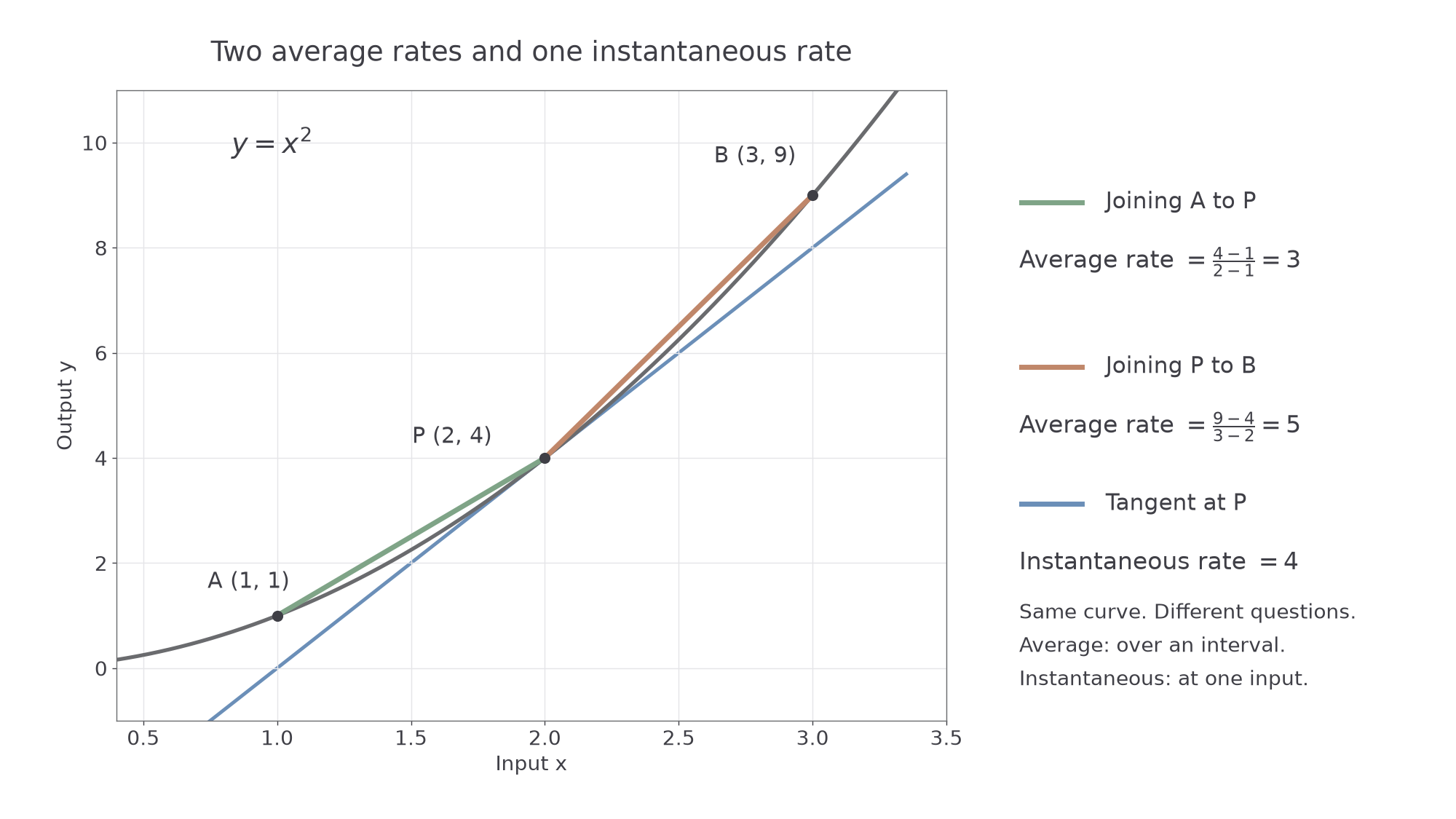
Calculate the average rates first, keeping the output and input differences in the same order.
Worked example 1: the interval before P
Question. For , find the average rate from to .
Plan. Evaluate both heights, then divide their change by the input change.
Why this step? The joining line records the total output change over that whole interval.
Answer. Average rate .
Check. A horizontal change of accompanies an output increase of , matching line .
Change only the interval, moving it one unit to the right while keeping its width.
Worked example 2: the interval after P
Question. For , find the average rate from to .
Plan. Use the same change-over-change calculation for the new endpoints.
Why this step? Equal-width intervals need not have equal output changes on a curve.
Answer. Average rate ; the rate is not constant.
Check. Line is steeper than , agreeing with .
To investigate the rate at , bring a second input closer to it:
| Interval | Average rate |
|---|---|
| to | |
| to |
The values approach , the tangent gradient. In fact, for nonzero ,
As becomes small, this approaches . Never substitute zero into the original fraction. Differentiation gives the one-point rate directly, without repeating these interval calculations.
The derivative is the function giving instantaneous rates. Write it as , or if the function is . These symbols describe gradient, not graph height. Rate units are output units divided by input units, such as litres per minute.
Watch out
Writing “the rate at is ” from the interval confuses an average with a one-point rate. The average is ; the tangent rate at is .
Compare two new equal-width intervals.
Differentiating powers and sums (Higher)
For , the derivative is , giving the rate at . A general rule lets you find the rate for other integer powers just as quickly.
Integer power rule
Here is constant and is an integer. Apply the rule where the original power is defined. A constant has derivative zero. Not in the Higher formulae sheet: learn it.
Multiply the coefficient by the old exponent, then reduce the exponent by one. Thus becomes . For a linear term, , so its derivative is . A constant's value does not change with the input, so its rate is zero; write this directly rather than .
Differentiate sums and differences term by term, keeping every sign. The answer is usually an expression because the rate depends on the input. Substitute a particular input only after differentiating.
Continue this lesson.
You’re previewing NovaLearn without an account. Create a free account to read the rest.
Create free account