4.8 - Pythagoras in two dimensions
You will use a right angle to connect three side lengths, find a missing length and solve problems in a flat diagram. The same method helps you calculate a diagonal or a sloping support. You will also decide whether a final answer needs ordinary rounding or rounding up.
The hypotenuse and Pythagoras
Two supports each span horizontally and vertically. How much timber must you buy for both, with spare, if timber is sold in whole metres? The sloping lengths are hidden for now. A right triangle will reveal them.
You already know
Squaring multiplies a number by itself; a square root reverses that operation for a non-negative number. Use the same length unit before adding or subtracting squared lengths.
Start with a smaller question. In a right triangle, perpendicular sides of and have squared lengths and . Their sum is , the square of . Pythagoras explains why this finds the third side.
Hypotenuse
The hypotenuse is the side opposite the right angle in a right-angled triangle. It is the longest side. Rotating the triangle does not change which side is the hypotenuse.
A marked right angle, a rectangle's corner, or stated horizontal and vertical directions can establish the right angle. A triangle that merely looks right-angled is not enough.
[DIAGRAM: asset_slug: m069_pythagoras; caption: A right-angled triangle with legs a and b and hypotenuse c; description: The marked right angle lies between a and b and the opposite side c is the hypotenuse. Labels are symbolic and the figure is schematic.; file: m069_pythagoras.png; recommended_method: matplotlib]
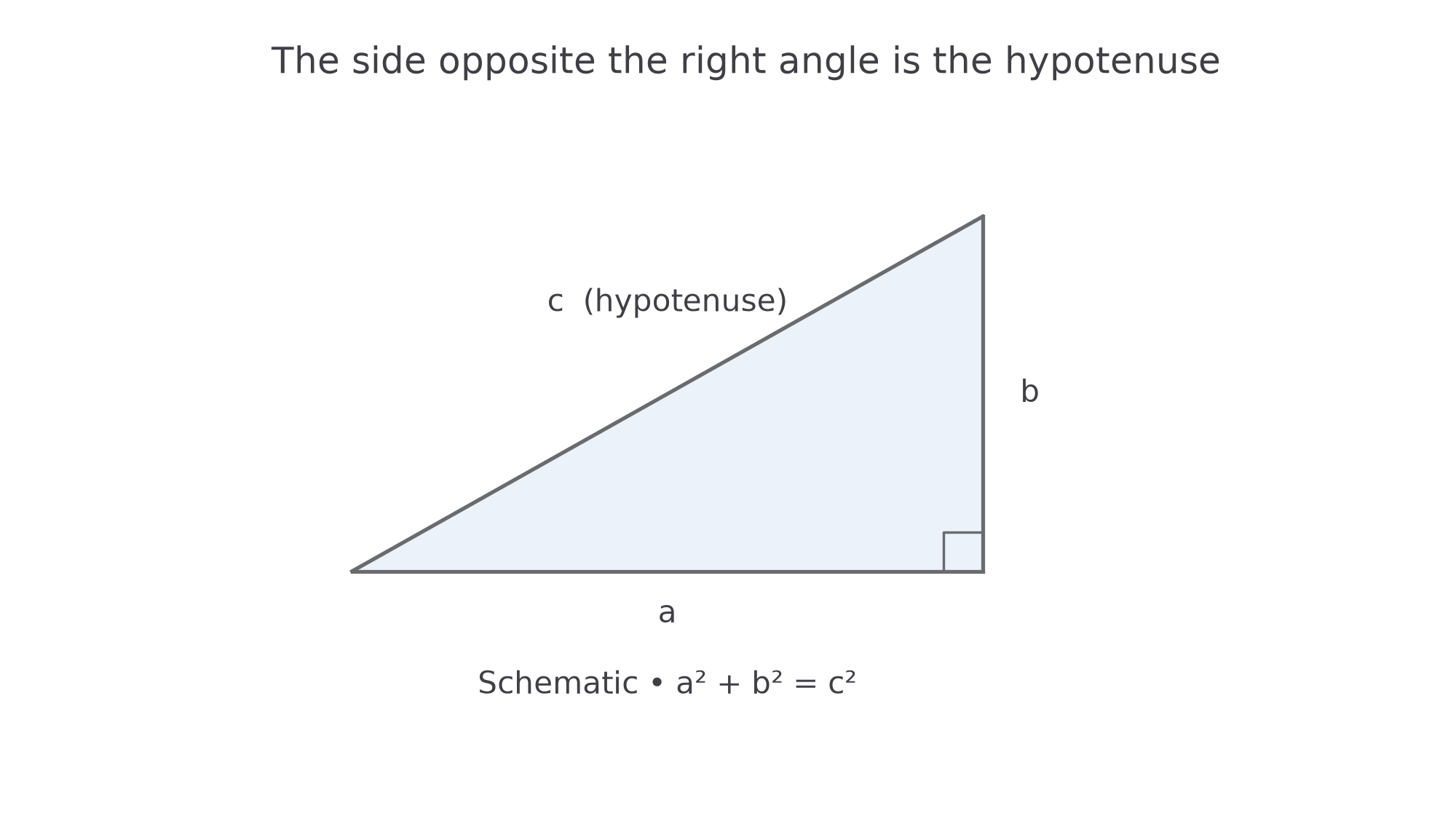
The squares built on the two shorter sides together have the same area as the square built on the hypotenuse. This is a relationship between squared lengths, not a rule for adding side lengths.
Pythagoras' theorem
For a right-angled triangle with perpendicular sides and hypotenuse ,
Absent from both the Foundation and Higher sheets. Not in the formulae sheet: learn it.
Use the equation first, then calculate its positive square root because a side length is positive.
Worked example 1: the longest side
Question. Find the hypotenuse of a right triangle with perpendicular sides and .
Plan. Add the squared perpendicular sides, then take the positive square root.
Why add? Both known sides meet at the right angle; the unknown is opposite it.
Answer. .
Check. , and .
Change only the scale: double both given lengths. The right angle and side roles stay the same.
Worked example 2: double the triangle
Question. Find the hypotenuse when the perpendicular sides are and .
Plan. Apply the same equation to the enlarged triangle.
Why is the answer doubled rather than quadrupled? The square is quadrupled, but taking its square root doubles the length.
Answer. .
Check. , matching the scale factor.
A useful surprising fact follows: one right triangle creates infinitely many more by enlargement. For any , . The familiar relationship survives every positive scale factor.
Watch out
The line adds lengths, so it does not use Pythagoras. Write , then take the square root to obtain .
Try a different pair of perpendicular sides.
Finding a shorter side
When the hypotenuse is supplied, keep its square alone on one side of the equation. Rearranging then tells you to subtract the known shorter-side square.
If is the hypotenuse and is the known shorter side, . The missing length is . This rearrangement is also absent from both tier sheets. A negative value inside the root indicates impossible lengths or a mistaken hypotenuse; it does not mean a negative side length.
Worked example 3: subtract a square
Question. A right triangle has hypotenuse and one shorter side . Find the other shorter side.
Plan. Write Pythagoras with alone, then rearrange.
Why subtract? The unknown square and must add to the hypotenuse square.
Answer. .
Check. , and .
Change only the scale again: double both known lengths. This checks whether the side roles survive a change in size.
Continue this lesson.
You’re previewing NovaLearn without an account. Create a free account to read the rest.
Create free account