6.3 - Tree diagrams and independent events
Learn to construct probability trees, multiply along paths and combine the routes that meet a target. You will use independence to decide which probabilities repeat and complements to shorten calculations. These tree methods are Higher content.
Building an independent-event tree (Higher)
A two-stage tree has four endpoints. Does that make each complete outcome have probability ? Try the concrete case of two bags: bag contains red and blue beads, while bag contains red and blue beads.
You already know
A complete outcome records the first result and then the second. Complementary branch probabilities total . You can multiply fractions to find a fraction of a fraction.
Select one bead at random from each bag, independently. Selecting from does not change bag . Start your tree with the two possible bag colours, then draw two bag branches from each first-stage endpoint.
Independence
Events are independent when knowing the result of one does not change the probability of the other. Independent second-stage probabilities repeat after either first result. A result being unknown to you does not establish independence.
A probability tree labels every branch with an outcome and its probability. Read time from left to right. Probabilities leaving any one point total , since exactly one of those alternatives happens. Do not add unrelated branches from different split points.
[DIAGRAM: asset_slug: m095_independent_tree; caption: Independent selections from bag A and bag B, with the bag B probabilities repeated after either bag A result; description: Bag A red 2/5 and blue 3/5. Each endpoint splits to bag B red 1/4 and blue 3/4. Four complete outcomes RR, RB, BR and BB. Every outgoing pair sums to one; file: m095_independent_tree.png; recommended_method: matplotlib]
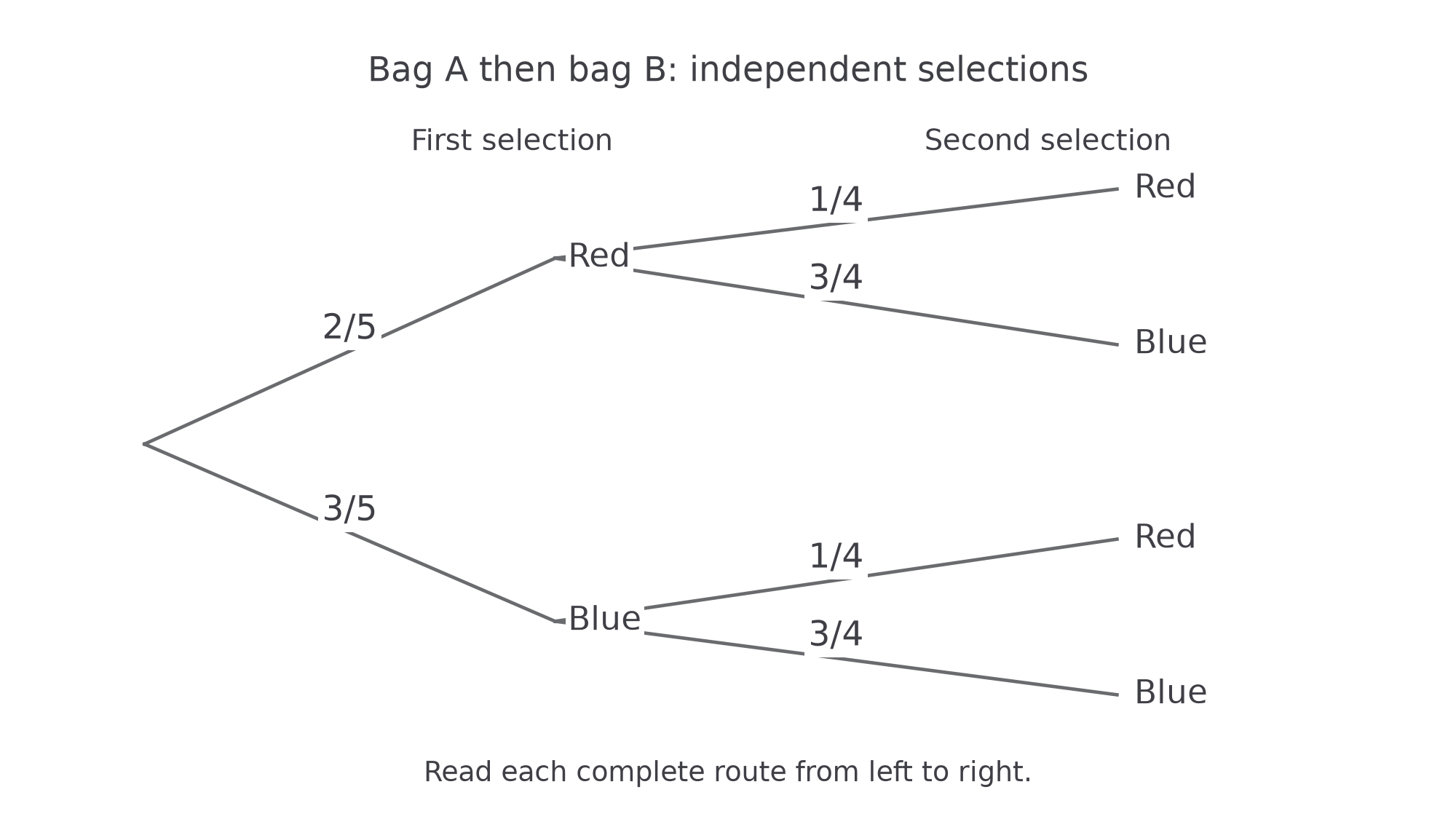
Leave enough room between endpoints to label each outgoing pair separately. The diagram has one first split and two second splits, so three split points altogether.
Worked example 1: constructing an independent tree
Question. Bag has red and blue beads. Bag has red and blue beads. Draw a tree for one independent random selection from each bag.
Plan. Draw the bag split, then repeat the bag split at both endpoints.
Why repeat the second pair? The bag result leaves the bag distribution unchanged.
Answer. The displayed tree has first branches and second branches after either colour, ending in .
Check. , and each second split gives .
Change only bag 's composition: recolour one of its blue beads red. Its total stays , and the bags are still independent. Both second splits must change together.
[DIAGRAM: asset_slug: m095_tree_variant; caption: A changed second bag gives repeated one-half probabilities; description: Independent selections from bag A with 2 red and 3 blue, then bag B with 2 red and 2 blue. First branches 2/5 and 3/5. Second branches 1/2 and 1/2 after both first outcomes. Leaves RR, RB, BR and BB; file: m095_tree_variant.png; recommended_method: matplotlib]
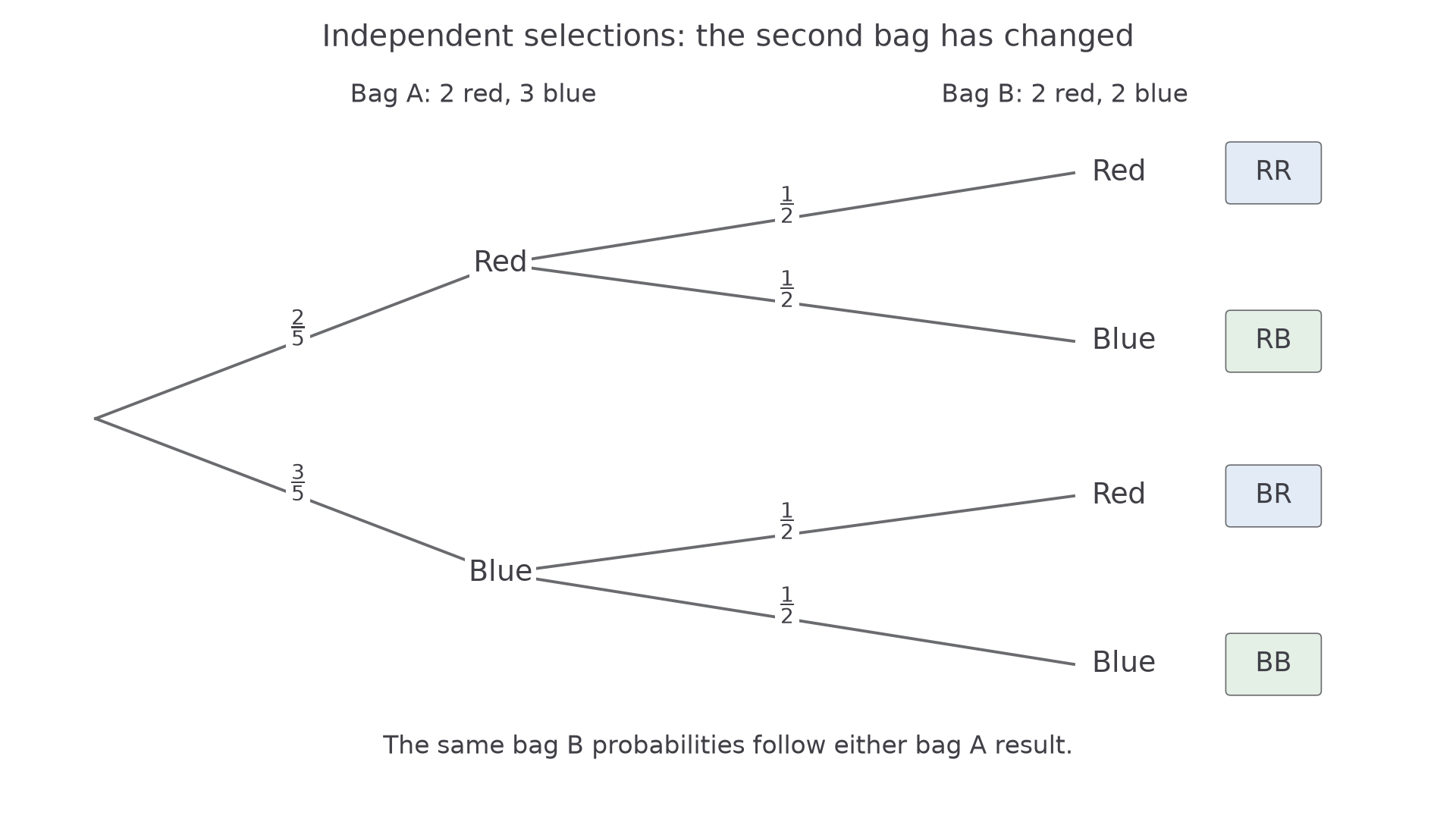
The first split remains fixed because bag has not changed.
Worked example 2: changing only the second bag
Question. Bag has red and blue beads. Bag now has red and blue beads. Draw the independent-selection tree.
Plan. Keep the first split and replace each second split with the new bag probabilities.
Why change both second splits? Bag has this same composition after either bag colour.
Answer. The second displayed tree has after either first-stage outcome, with first branches .
Check. Every outgoing pair sums to ; all four ordered colour outcomes are present.
Replacement can also give independence: return the object, restore the original composition, mix again and select randomly. Without replacement, the composition changes; that is a different model.
Watch out
Putting and on the same outgoing pair mixes two stages: they do not total . Use one bag's complementary colour probabilities at each split.
On a Pearson tree question, probabilities must be on the correct branches. Correct values written against different outcomes do not communicate the requested tree.
Exam tip
Check every outgoing pair separately. On an independent tree, show the second-stage pair after both first outcomes, rather than labelling it only once.
The check uses different devices but the same decision about which probabilities repeat.
Multiplying along a path (Higher)
A complete path means all its successive outcomes happen. In the original two-bag example, of trials start red. Of those trials, the fraction continuing red in bag is . A fraction of a fraction is found by multiplying.
Independent-event path products
For independent events,
For three or more mutually independent stages, multiply all the required stage probabilities. Probability rules appear on neither tier sheet; this method is Higher content. Not in the formulae sheet: learn it.
Continue this lesson.
You’re previewing NovaLearn without an account. Create a free account to read the rest.
Create free account