1.6 - Compound interest and depreciation
Interest can earn interest of its own. You will use repeated multipliers for compound growth and falling values. The Higher sections combine different changes and find unknown deposits, rates and whole numbers of years.
Compound interest at a fixed rate
You save at interest each year. After two years, will you have exactly ? That would add the same twice. Let's see what happens when the first year's interest stays in the account.
You already know
A increase uses multiplier . A power records repeated multiplication: .
After one year you have . Next year's interest is calculated on , including the interest already added.
Compound interest
Compound interest is interest calculated on the current balance, including earlier interest. Simple interest uses the original deposit each period instead.
Each year adds another copy of the same multiplier. Match the time period to the rate: an annual rate compounded annually uses a number of years.
Fixed-rate compound growth
Here is the starting amount, the rate per period, the number of periods, and the final amount. This model assumes a fixed rate and no extra deposits, withdrawals or fees. Total interest is .
Foundation and Higher: Not in the formulae sheet: learn it.
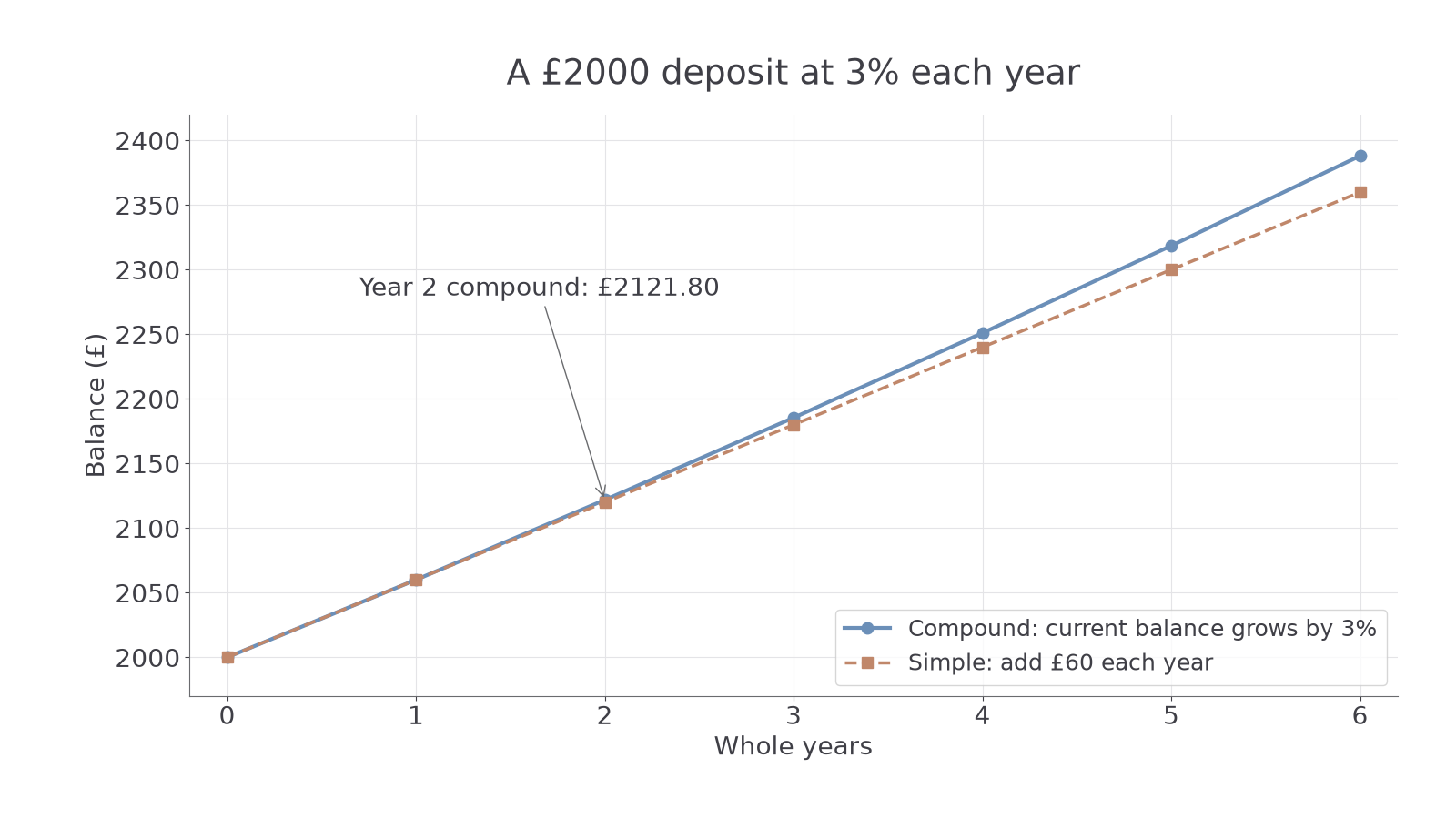
The gap in the graph is interest earned on earlier interest. These are model balances at whole year ends; the lines only join those points.
[DIAGRAM: asset_slug: compound_interest_growth; caption: Compound interest gradually pulls ahead of simple interest; description: Whole-year balances for a 2000 pound deposit at 3 percent. Compound balances use 2000 times 1.03 to the year power and simple balances use 2000 plus 60 times the year. The two-year compound balance is 2121.80 pounds and the simple balance is 2120 pounds; file: compound_interest_growth.png; recommended_method: matplotlib]
Worked example 1: interest earns interest
Question. earns annual compound interest for two years. Find the balance and total interest. There are no cash movements or fees.
Plan. Apply the annual multiplier twice, then subtract the deposit.
Why use a power? The second increase acts on the first year's new balance.
Answer. Balance ; total interest .
Check. Year one gives . Year two adds , giving .
Change only the number of years. Another year means one more multiplication, not one more equal cash payment.
Worked example 2: add another year
Question. The same earns annual compound interest for three years. Find the balance and total interest, to the nearest penny.
Plan. Use three multipliers and round the final amounts only.
Why keep the unrounded value? Early rounding can alter the final penny in a longer calculation.
Answer. Balance ; total interest .
Check. , which agrees with applying all three multipliers at once.
Here is a small surprise from the opening question: two years earn more than two equal payments. That extra amount is of the first interest.
Watch out
is simple interest. It keeps the original base for both years. Compound interest uses .
Keep the rate and three-year duration, but change the deposit.
Depreciation at a fixed rate
A car can lose the same percentage each year while losing a smaller cash amount each time. The percentage acts on a shrinking current value.
Depreciation
Depreciation is a reduction in value over time. A fixed percentage of current value gives repeated multiplication. A fixed cash loss gives repeated subtraction instead.
For a loss, remains. Use , once for each year.
Fixed-rate depreciation
For , the remaining multiplier lies between and . Here is the original value, the loss per period and the number of periods. Total loss is .
Foundation and Higher: Not in the formulae sheet: learn it.
This model describes a stated pattern of percentage loss. It does not predict a real resale price unless that pattern is appropriate.
Worked example 3: a falling current value
Question. A car worth loses of its current value each year. Find its value and total loss after two years.
Plan. Keep twice, then compare with the original value.
Why not subtract of ? The second loss uses the smaller value after year one.
Answer. Value ; total loss .
Check. Year one loses , leaving . Year two loses , leaving .
Keep the car and rate. Change only the duration to see another shrinking loss.
Worked example 4: a third year of depreciation
Question. The same car loses of current value each year for three years. Find its value and total loss.
Plan. Apply the remaining multiplier three times, then subtract from .
Why does the third year lose less cash? Its base is now only .
Answer. Value ; total loss .
Check. , and .
Always decide whether a question gives the rate lost or the rate remaining.
Watch out
repeatedly keeps only . That is an yearly loss. For a loss, use .
Now try a different starting value and percentage loss.
Successive changes at different rates (Higher)
When the rate changes, build a separate multiplier for each stage. The next percentage always acts on the amount reached at that point.
Combined percentage multiplier
With no cash movements between changes, the combined multiplier is . The signed percentage change is . A negative result means a decrease.
Higher: Not in the formulae sheet: learn it.
Adding rates loses the changing base. For fixed percentage factors alone, reversing their order gives the same product. A cash fee or deposit between stages changes that: apply it where the question places it.
Worked example 5: equal opposite rates
Question. increases by , then decreases by . Find the final amount and overall percentage change.
Plan. Multiply both factors, then compare the combined factor with .
Why do the rates fail to cancel? The rise adds , but the fall removes of , which is .
Answer. , an overall decrease.
Check. The final amount is below , and .
Keep the increase. Change only the decrease rate, from to .
Worked example 6: unequal rates
Question. increases by , then decreases by . Find the final amount and overall percentage change.
Plan. Replace only the second multiplier, then calculate the combined effect.
Why is the decrease , rather than ? The fall acts on , not .
Answer. , an overall decrease.
Check. , a loss of from the original .
Writing the multipliers is also useful evidence of method if a later arithmetic slip occurs.
Watch out
does not combine successive changes on different bases. Use , which represents a decrease.
Keep the second change and vary the first rate this time.
Unknown deposits, rates and whole years (Higher)
The same growth model can hide different unknowns. First write . Decide whether you need the starting amount , the multiplier , or a whole number of periods .
Working backwards through compound growth
For the rate formula, is the numerical percentage rate and the positive root is required. Deposits and balances are positive; there are no fees or cash movements in this model.
Higher: Not in the formulae sheet: learn it.
Division undoes all multipliers when finding a deposit. A root undoes the power when finding a rate. For a first whole year, compare successive year-end balances instead of rounding a guessed time.
Worked example 7: three different unknowns
Question. Three accounts have annual compound interest and no fees or cash movements.
(a) An account reaches after three years at . Find the deposit.
(b) A deposit reaches after two years. Find the annual rate.
(c) A deposit earns annually. Find the first year end when it exceeds .
Plan. Divide out the growth for (a), take a positive root for (b), and bracket the target between whole years for (c).
For (c), keep the calculator precision while comparing the target:
Why test the preceding year? A year above the target alone does not show it is the first. The positive growth rate makes the balances increase each year.
Answer. (a) ; (b) per year; (c) year .
Check. and . The year-two and year-three values lie on opposite sides of .
Now double every cash amount, leaving the rates and times unchanged. This one change tests a useful idea: scaling the money should double the deposit, but leave the rate and first crossing year unchanged.
Worked example 8: scale the balances
Question. Three accounts follow the same conditions.
(a) An account reaches after three years at . Find the deposit.
(b) A deposit reaches after two years. Find the annual rate.
(c) A deposit earns annually. Find the first year end when it exceeds .
Plan. Use the same inverse operations and compare the two neighbouring years.
Why is the rate unchanged? Doubling both and leaves the ratio unchanged.
Answer. (a) ; (b) per year; (c) year .
Check. All the cash results are exactly twice the corresponding results in Worked example 7, as the growth model predicts.
“Exceeds” means strictly greater. Equality at a year end would not qualify. Retain the unrounded balances until you have made that comparison.
Watch out
The line , “so the rate is ”, includes the original . The interest rate is . Likewise, reverses only one year; use to recover the deposit.
The opening savings puzzle is settled: two years give , because the first year's interest earns interest too. For the final check, find a rate in a new setting.
Quick Recap
- Compound growth applies the multiplier to the current amount each period.
- Depreciation keeps of the current value each period.
- Combine successive percentage changes by multiplying their factors.
- Recover deposits by division, rates by roots, and first whole years by checking neighbouring year ends.
The opening deposit becomes after two years at , rather than .