1.6 - Reverse percentages
A sale label tells you today's price. Can you recover yesterday's? You will undo percentage increases and decreases, choose the correct base, and check that your answer recreates the given amount.
Recovering an amount before an increase
A ticket now costs after a increase. Was its old price , or should you subtract of the new price? Keep that question in mind.
You already know
An increase of uses multiplier . Multiplication and division undo each other: means .
The old price represents . The new price represents of that same old price. We know the result of multiplying; we need to work backwards.
Reverse percentage
A reverse percentage calculation finds an original amount from an amount after a stated percentage change. Finding a discount from an original price is a forward calculation instead.
You can divide by the multiplier in one step. Alternatively, divide by to find , then multiply by . Both routes recover the same whole.
Reversing an increase
For an increase of ,
The new amount must result from this percentage increase alone. Foundation and Higher: Not in the formulae sheet: learn it.
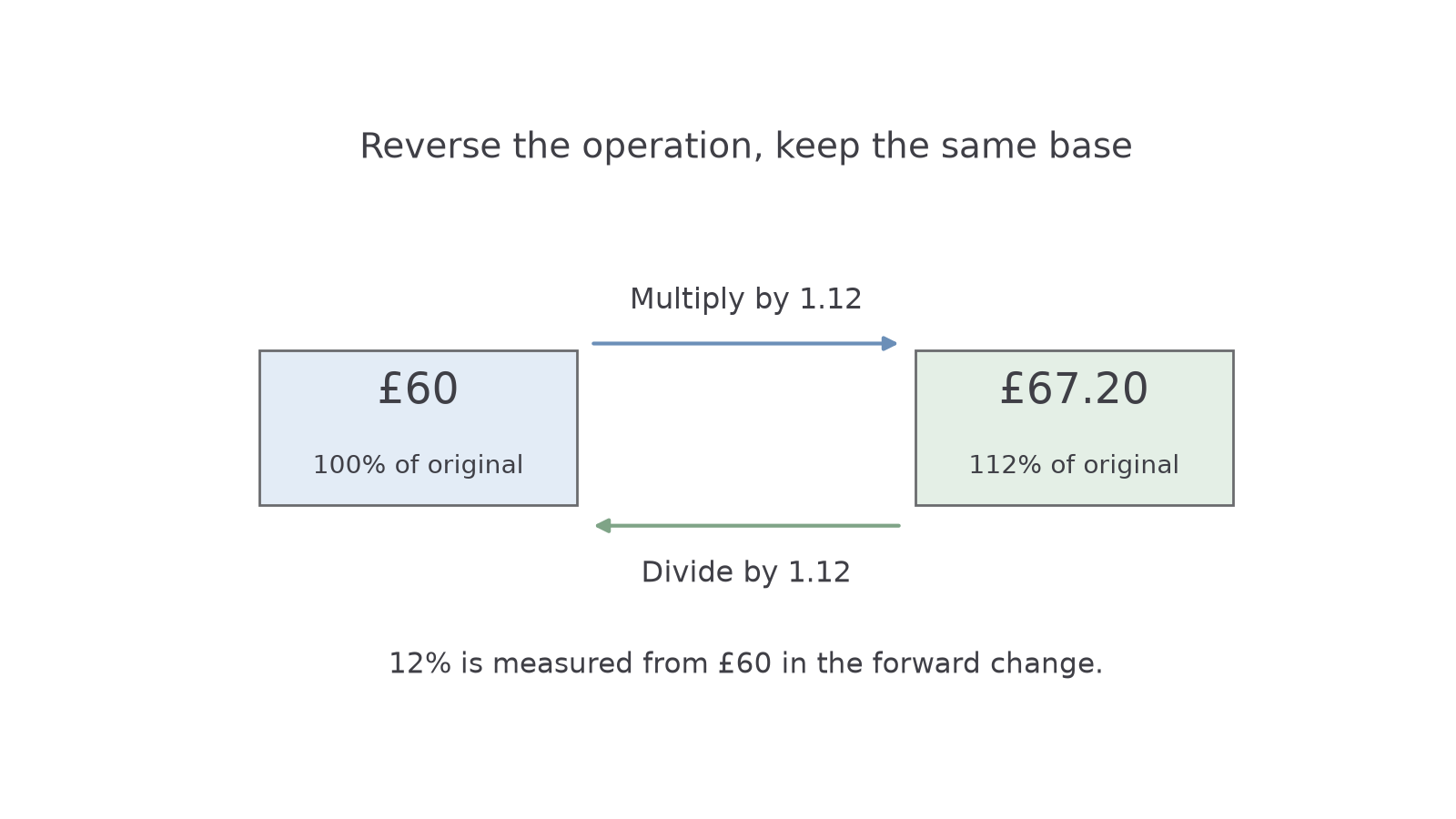
The arrows show why the reverse operation is division.
[DIAGRAM: asset_slug: reverse_percentage_arrows; caption: The forward multiplier and its inverse connect the same two prices; description: An original price of 60 pounds becomes 67.20 pounds by multiplication by 1.12. The reverse arrow divides 67.20 by 1.12 to recover 60. The original is labelled 100 percent and the new price 112 percent; file: reverse_percentage_arrows.png; recommended_method: matplotlib]
Worked example 1: recover the ticket price
Question. A ticket costs after a increase. Find its original price.
Plan. Identify the multiplier from the original price, then divide by it.
Why divide by ? The given price is , rather than , of the original.
Answer. The original price was .
Check. , and .
Now change only the rate. A larger increase requires a different divisor, even though the new price is unchanged.
Worked example 2: change the increase rate
Question. A ticket costs after a increase. Find its original price.
Plan. Divide the new price by its new multiplier.
Why is the answer smaller this time? More growth reached the same final price, so the starting price was lower.
Answer. The original price was .
Check. .
The word “original” is a reminder to label the amount that represents .
Watch out
The line does not undo the rise. It removes of the new price. Use .
Try the same rate with a different final price.
Recovering an amount before a decrease
A discount leaves a fraction of the old price. After off, the sale price is of the original. The percentage remaining is the useful one.
Reversing a decrease
For a decrease of , where ,
Foundation and Higher: Not in the formulae sheet: learn it.
Dividing by a positive number below makes the result larger. That fits a sale: the old price should exceed the discounted price. A reduction leaves zero whatever the old price was, so it cannot reveal a unique original.
Worked example 3: recover a sale price
Question. A coat costs after a discount. Find its original price.
Plan. Find the percentage remaining, then recover .
Why divide by ? The is the amount kept after the discount, not the amount removed.
Answer. The coat originally cost .
Check. of is , leaving .
Keep the sale price, but reduce the discount rate. The original price should now be closer to the sale price.
Worked example 4: a smaller discount
Question. A coat costs after a discount. Find its original price.
Plan. Divide by the fraction remaining after this discount.
Why is the wrong divisor? It describes the discount, while describes the price after discount.
Answer. The original price was .
Check. .
Before using your calculator, write which percentage the given amount represents. That one line makes your method clear.
Watch out
The line adds of the reduced price. It does not reverse the discount. The correct line is .
Use the same remaining multiplier with a new sale price.
Checking the base and the inverse
A percentage always has a base: the amount it is a percentage of. Equal percentage rates can describe unequal cash amounts when their bases differ.
Here is a useful surprise. Doubling a price is a increase, but halving the new price is only a decrease. For example, and . Opposite rates need not undo each other; inverse multipliers do.
Inverse multiplier
If and , then
The reverse multiplier is . Foundation and Higher: Not in the formulae sheet: learn it.
To test a proposed original, send it forwards through the stated change. A plausible size is helpful, but recreating the exact new amount is stronger evidence.
Worked example 5: test a proposed original
Question. An amount becomes after a increase. Sam says the original was . Is Sam correct? Find the original.
Plan. Apply the forward multiplier to Sam's answer, then use division to recover the correct value.
Why use a forward check? Any true original must produce the given final amount under the stated change.
Answer. Sam is incorrect. The original was .
Check. .
Keep the increase and the checking method. Change only the proposed original, so you can see what a successful check looks like.
Worked example 6: recognise a successful check
Question. An amount becomes after a increase. Jo says the original was . Is Jo correct?
Plan. Apply the stated increase to the proposed amount.
Why does this settle it? The nonzero multiplier has just one inverse, and Jo's amount recreates the given price.
Answer. Jo is correct: the original was .
Check. The added amount is , which is of .
We can now settle the opening ticket puzzle. grows to ; subtracting of uses the wrong base.
Watch out
The proposed inverse is false. Check the product: , not . The inverse is .
Make the final decision by checking the given candidate.
Quick Recap
- Label the original as .
- Divide by to reverse an increase of .
- Divide by to reverse a decrease below .
- Check by applying the stated change to your recovered original.
The opening ticket originally cost : .